
 Our products
 Aromatherapy - essential oils
 Essential oils
 Aroma lamps
 Aroma Diffusers
 Seeds
 Vegetables
 Herbs and spices
 Ornamental Plant Seeds
 Grass mixtures
 Sprouts and microgreens
 Growing supplies
 Cultivation and Gardening Supplies
 Hydroponics and indoor growing
 Protective equipment and gardening tools
 Exotic plants
 Exotic Fruit and Vegetables
 Exotic herbs
 Exotic trees and shrubs
 Ornamental exotic plants
 Roasted coffee
 Espresso coffee
 Ecological coffee preparation
 Thermal mugs and coffee cups
 Aeropress
 Thermos flasks and thermal mugs for coffee and tea
 Moka pot
 Filter coffee
 Coffee blends
 Accessories for coffee makers
 Water filtration
 Coffee grinders
 Cleaning the Coffee Maker
 Ecological Cleaning of Coffee Machines
 Coffee makers
 Coffee Preparation
 Coffee Accessories
 Food products
 For wildlife and pets
 Chocolate and others
 Hemp food products
 Natural cosmetics
 Hemp cosmetics
 Smoking supplies
 Bongs - water pipes
 Blunts and tubes
 E-liquids with Terpenes and CBD
 Grinders and Mills
 Papers and filters
 Smoking accessories
 Vaporizers
 Air fresheners
 CBD and CBG products
 CBD sprays
 CBD and CBN crystals
 CBD body and facial care
 Weeds
 CBD suppositories and capsules
 CBD oils and drops
 CBG oils and drops
 House and garden
 Fashion and Decoration
 Kitchen essentials and cooking
 Christmas Decorations and Accessories
 Gift Sets
 Bird feeders
 Seasonal and Special Tools
You can grow trailing Pepino gold melons even in a planter on your balcony.
Pepino gold (lat. Solanum muricatum) is a plant from the nightshade family (lat. Solanaceae). The exact origin of this plant is not precisely known, however Peru and Colombia are most commonly cited as the original homeland of pepino. From these countries, the plant spread to other areas in South America. Indigenous tribes call pepino cachuma (kachuma). Pepino gold gained great popularity in New Zealand, where it took hold and was subsequently further bred. Most pepino growers in Europe come from Italy. It's no wonder, as the climatic conditions are very favorable for cultivation.
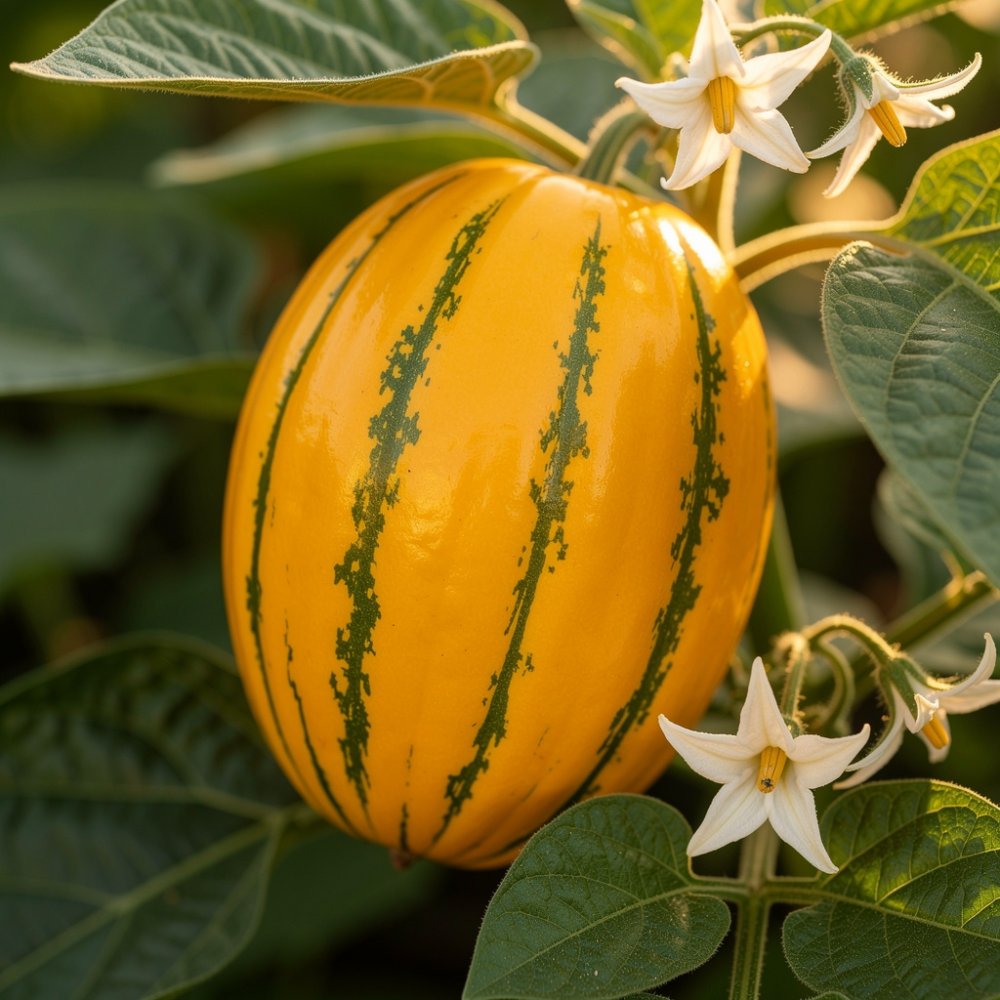
Although the climate in the Czech Republic is colder and the conditions for cultivation are not entirely optimal (especially in winter), pepino cultivation is slowly beginning to spread among our growers as well. Try to join their ranks too.
Growing your own trailing Pepino gold melons is not impossible!
Pepino gold is a perennial plant, although it is very often grown only as an annual because many growers don't have the conditions for overwintering it. Pepino grows to a height of approximately 30 - 50 cm. In its youth it grows upright, in maturity it often trails or grows in cascades. Its leaves reach a length of about 15 cm, are petiolate, elongated in shape, and have a rich green color. Pepino gold flowers are similar to potato flowers (they belong to the same family).
They grow in clusters on long stems and are hermaphroditic. Pepino fruits are egg-shaped, their skin is smooth, shiny and relatively thin. Unripe fruits are green, gradually ripening and becoming yellow to yellow-orange with distinctive longitudinal dark green to brownish-purple stripes. Fruits can grow up to 12 cm in size. Ripe fruits are soft, juicy, and sweet in taste.
Growing Pepino gold
Growing Pepino gold requires some experience and mainly adherence to basic growing rules. Otherwise it may happen that although you achieve fruits, they won't have time to ripen, or in worse cases fruits may not form at all. The growing season of Pepino gold is very long, it is stated that it's up to 50 - 60 days longer than tomatoes, therefore it is necessary to sow seeds very early, ideally at the beginning of January. If you have the option to sow under grow lights, it will be even better for the plants. Sow seeds in perlite or in horticultural substrate. Press the seeds in lightly.
Substrate
The substrate (perlite) (growing media) must be kept constantly moist. After approximately 2 weeks, the seeds will begin to germinate and grow very slowly. The seedlings are initially very thin (thread-like). After about a month, the young plants are strong enough to handle their first transplanting. Two months after sowing, the plant can grow to a height of around 5 cm, depending on growing conditions. Transplant the plant into a pot (terracotta pots) so the roots have enough space to grow. Continue growing them in a warm and bright location. This way, you have prepared seedlings for further cultivation.
Temperature Requirements
Pepino gold has similar temperature requirements to tomatoes. Pepinos are usually grown in planters or pots because if they are in open ground, although they grow vigorously, they flower later and the fruits don't have time to ripen before the first frosts arrive. However, containers that are too small are also not suitable, as the plant would not branch out, would only flower at the top, and would not produce fruits. One plant will need a planter about 40 cm long; plant two in a planter 50-60 cm long.
A suitable growing medium is universal gardening substrate, which can be supplemented with granulated fertilizer with chicken manure (fertilizer). Pour the fertilizer on the bottom of the planter. Until mid-April, you can pinch out the growing tip to encourage branching. Side shoots will grow to sufficient length in approximately one month. Then move the pepino to an outdoor location. The plant cannot tolerate frost, so be careful not to forget the pepino outside if a late frost should occur. Pepino also doesn't do well at temperatures below 6°C, at which point it stops growing. The first flowers appear on the pepino in early July. After successful pollination, fruits begin to form, which grow quite quickly; by the end of August, the first ones begin to ripen. The harvest ripens gradually; about half will ripen before the first frosts, then the plant must be moved to a greenhouse or a bright and warm place indoors. Here, by mid-November, the second half of the harvest will ripen. From forced plants, you can obtain approximately 10-15 fruits. Plants planted later will have fewer fruits.
Fertilizing
To ensure quality harvest, plants need regular fertilizing, first with, for example, Kristalon Start, and during flowering, fertilizing with Kristalon Flower and Fruit has proven effective. If you plan to overwinter the pepinos, stop fertilizing from the end of August so the tissues have time to mature sufficiently and the plant can prepare for the winter period. After the fruits ripen, move the pepino to a cooler, bright, and airy room. The minimum temperature is 3°C, but a slightly higher temperature is better.
Watering
During winter, the plant doesn't grow, so reduce watering to a level that prevents the root ball from drying out completely. In winter, pepino leaves may turn yellow, but this is not a problem as you will be pruning the long shoots in spring anyway. During the growing season, water pepino plants regularly, they like plenty of water, the root ball must never dry out. The plant is damaged by constant waterlogging. After transplanting, water the plant carefully to prevent damaged roots from rotting.
Tip: A small pot with several seeds can also be placed on top of a fish aquarium, if you have free space between the light and the top glass.
Using pepino gold
Ripe pepino fruits have yellow flesh and a sweet taste. The fruits are most often eaten raw, just peel off the skin. They are also excellent sliced in fruit salad with other types of fruit.
If your harvest is large, you can prepare excellent jam from pepino fruits. With a smaller harvest, chill the fruits, cut them into pieces and sprinkle with cinnamon and sugar - it will be a very interesting taste experience.