 Essential oils
 Aroma lamps
 Aroma Diffusers
 Vegetables
 Herbs and spices
 Ornamental Plant Seeds
 Grass mixtures
 Sprouts and microgreens
 Exotic Fruit and Vegetables
 Exotic herbs
 Exotic trees and shrubs
 Ornamental exotic plants
 Espresso coffee
 Ecological coffee preparation
 Thermal mugs and coffee cups
 Aeropress
 Thermos flasks and thermal mugs for coffee and tea
 Moka pot
 Filter coffee
 Coffee blends
 Water filtration
 Coffee grinders
 Cleaning the Coffee Maker
 Ecological Cleaning of Coffee Machines
 Coffee makers
 Coffee Preparation
 Coffee Accessories
 For wildlife and pets
 Chocolate and others
 Hemp food products
 Hemp cosmetics
 Bongs - water pipes
 Blunts and tubes
 E-liquids with Terpenes and CBD
 Grinders and Mills
 Papers and filters
 Smoking accessories
 Vaporizers
 Air fresheners
 CBD sprays
 CBD and CBN crystals
 CBD body and facial care
 Weeds
 CBD suppositories and capsules
 CBD oils and drops
 CBG oils and drops
 Fashion and Decoration
 Kitchen essentials and cooking
 Christmas Decorations and Accessories
 Gift Sets
 Bird feeders
 Seasonal and Special Tools

 Our products
 Aromatherapy - essential oils
 Seeds
 Growing supplies
 Cultivation and Gardening Supplies
 Hydroponics and indoor growing
 Protective equipment and gardening tools
 Exotic plants
 Roasted coffee
 Accessories for coffee makers
 Food products
 Natural cosmetics
 Smoking supplies
 CBD and CBG products
 House and garden


An evergreen shrub associated with love and beauty in Greek mythology. Dried or fresh leaves are used as a spice. Myrtle is an undemanding houseplant. The package contains 5 seeds.
 Wide range of quality products
Seeds, essential oils, growing supplies and exotic plants in one place
 Eco-friendly range
We prefer natural and gentle products
 Expert advice
We help you grow – guides, blog and personal support
 Delivery across the EU
PPL, DPD, GLS and local carriers – pickup point or home delivery
Myrtle is an evergreen shrub that can grow up to 5 m tall. When grown in containers, it only reaches a height of around 0.5 m. It originates from the Mediterranean region, but the genus has over 3000 species, some of which grow in Australia, New Zealand, Polynesia and South America. It is very suitable for shaping as bonsai.
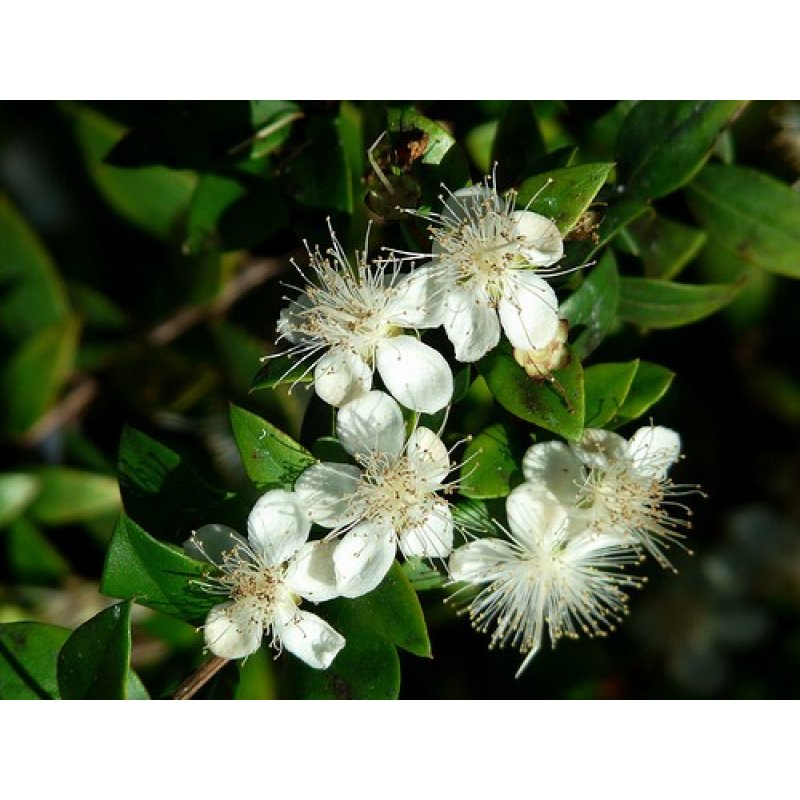
The ovate dark green leaves are very aromatic, and the flowers have a long-lasting and strong fragrance. The leaves can be up to 4 cm long and 2 cm wide. The fragrant flowers are small and white. Other species have flowers that are also delicately colored, for example in pink. It blooms throughout the summer from June to September.
Myrtle is frost-resistant down to approximately -8°C and is mainly grown indoors in our regions. The oil contained in the leaves is used in cosmetics, especially for skin and hair. It has significant revitalizing effects. Dried or fresh leaves are used as a spice. Myrtle twigs are traditionally used in grooms' boutonnieres and bridal wreaths.
The plant requires a sunny location. During summer, myrtle can also be placed outdoors in a sunny spot. From spring to summer, water abundantly with settled water. The plant is sensitive to substrate drying out. The plant benefits from misting the leaves. It's best to repot the plant in spring. Ideal winter temperature is around 8-12°C. During warmer overwintering, place the plant away from central heating and reduce watering. The plant responds well to pruning and can be grown as a bonsai. Replace the top layer of substrate annually.
Soak seeds in warm water for 1 hour before sowing. Sow seeds on the surface of the substrate, which should be the same as for adult plants. The optimal temperature for sowing is between 20 - 25 °C. The first plants will appear after 20 to 60 days. Maintain adequate substrate moisture throughout this period.
Young plants require lighter soil with a higher peat content, while older plants respond well to medium-heavy, well-draining soil with a higher topsoil content.
Fertilize plants from spring to autumn every 14 days. Suitable are 0.1–0.2% complete fertilizers that are water-soluble.
The plant can be attacked by whiteflies, mealybugs and scale insects. During summer outdoor placement, the plant may occasionally be attacked by aphids, which can be removed by showering with soapy water. If the infestation doesn't disappear, use suitable insecticides - Mospilan. Fungal leaf spot and rust can also appear on leaves. Fungal leaf spot can be removed with a fungicidal preparation. Rust is removed either mechanically or with a systemic insecticide.
Photo Sources:
Author: Forest & Kim Starr, CC BY 3.0, https://commons.wikimedia.org/w/index.php?curid=6174803
Author: Javier martin – Own work, Public domain, https://commons.wikimedia.org/w/index.php?curid=5086156
Data sheet
Specific References
Your review appreciation cannot be sent
Report comment
Report sent
Your report cannot be sent
Write your review
Review sent
Your review cannot be sent
An evergreen shrub associated with love and beauty in Greek mythology. Dried or fresh leaves are used as a spice. Myrtle is an undemanding houseplant. The package contains 5 seeds.
check_circle
check_circle