 Essential oils
 Aroma lamps
 Aroma Diffusers
 Vegetables
 Herbs and spices
 Ornamental Plant Seeds
 Grass mixtures
 Sprouts and microgreens
 Exotic Fruit and Vegetables
 Exotic herbs
 Exotic trees and shrubs
 Ornamental exotic plants
 Espresso coffee
 Ecological coffee preparation
 Thermal mugs and coffee cups
 Aeropress
 Thermos flasks and thermal mugs for coffee and tea
 Moka pot
 Filter coffee
 Coffee blends
 Water filtration
 Coffee grinders
 Cleaning the Coffee Maker
 Ecological Cleaning of Coffee Machines
 Coffee makers
 Coffee Preparation
 Coffee Accessories
 For wildlife and pets
 Chocolate and others
 Hemp food products
 Hemp cosmetics
 Bongs - water pipes
 Blunts and tubes
 E-liquids with Terpenes and CBD
 Grinders and Mills
 Papers and filters
 Smoking accessories
 Vaporizers
 Air fresheners
 CBD sprays
 CBD and CBN crystals
 CBD body and facial care
 Weeds
 CBD suppositories and capsules
 CBD oils and drops
 CBG oils and drops
 Fashion and Decoration
 Kitchen essentials and cooking
 Christmas Decorations and Accessories
 Gift Sets
 Bird feeders
 Seasonal and Special Tools

 Our products
 Aromatherapy - essential oils
 Seeds
 Growing supplies
 Cultivation and Gardening Supplies
 Hydroponics and indoor growing
 Protective equipment and gardening tools
 Exotic plants
 Roasted coffee
 Accessories for coffee makers
 Food products
 Natural cosmetics
 Smoking supplies
 CBD and CBG products
 House and garden


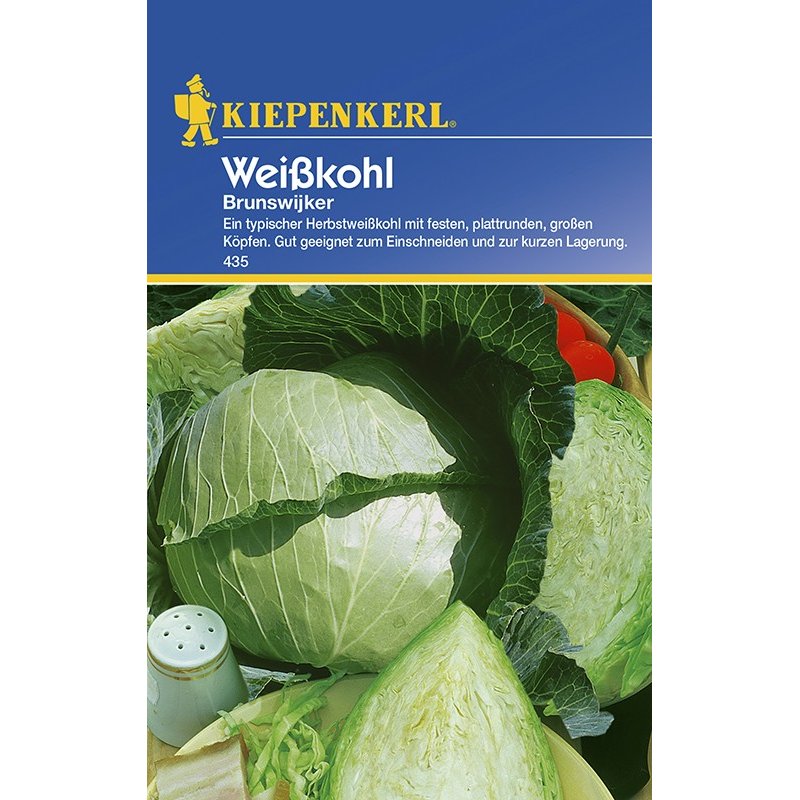
Autumn variety of white cabbage with large, firm, flattened heads. Suitable for shredding and short-term pickling.
 Wide range of quality products
Seeds, essential oils, growing supplies and exotic plants in one place
 Eco-friendly range
We prefer natural and gentle products
 Expert advice
We help you grow – guides, blog and personal support
 Delivery across the EU
PPL, DPD, GLS and local carriers – pickup point or home delivery
A biennial plant that forms heads in the first year, covered with blistered, lobed leaves of yellow-green to dark green color. It grows on a short stem. In the second year, a flower spike with four-petaled flowers grows through the head. The most well-known cabbage varieties include head cabbage, kale, and Brussels sprouts.
Cabbage is rich in vitamin C, K, and minerals. It contains many vitamins (such as B1, B2, B3, B9, C, and K). It is rich in minerals and trace elements (magnesium, selenium, potassium, calcium, phosphorus, and iron). It is used in soups, sauces, or vegetable salads.
Head cabbage grows best at a constant temperature ranging between 15–20 degrees Celsius. Do not plant them too close together. This has a negative impact on yield! The plants are frost-resistant. They tolerate temperatures from -10 to -15°C without problems. They require sunny or partially shaded locations. At the beginning of summer, plants require large amounts of water. The soil should never dry out. Regularly hoe around the plants and remove weeds. Also regularly lime and fertilize.
Early varieties are sown in February in a warm greenhouse or hotbed. Planting is carried out in April at a spacing of 40×50 cm.
Summer and semi-early varieties are sown from mid-April to May directly on site at a spacing of 50×40 cm.
Autumn varieties are planted until the end of July directly on site at a spacing of 40–50×60 cm.
Winter varieties are planted at a spacing of 40×40 cm until the end of September.
Late varieties require medium-heavy soils with sufficient calcium content. Varieties intended for field cultivation and cold forcing require lighter, sandy-loam and warming soil. The optimal pH value is 6-7.
In autumn, it is advisable to work 4–5 kg of farmyard manure/m2, 5g P2O5/m2, 10–14 g K2O/m2 into the soil. Don't forget to lime the soil. Apply another dose of 8–10 g nitrogen/m2 before planting. During the growing season, add another 2–5 g nitrogen/m2, evenly distributed for application at the 8–9 leaf stage and before head formation.
The most common cabbage pests are cabbage flea beetle, cabbage white butterfly, and cabbage moth. Among diseases, clubroot of brassicas causes the most damage.
For cabbage moth, it is advisable to use synthetic insecticides or preparations based on 'Bacillus thuringiensis' during the hatching of caterpillars from eggs.
Against clubroot of brassicas, liming of land, use of nitrogen lime, destruction of affected plants, and soil disinfection are recommended.
Plants can be protected from white butterflies by planting them among tomatoes, for example.
Early varieties are harvested in May or June. The growing period until harvest ranges from 50-70 days.
Summer and semi-early varieties have a growing period of approximately 120 days. Harvesting is therefore carried out in August to September.
Autumn varieties have a growing period of 102–160 days. Harvesting is carried out in August to September.
Winter varieties have a growing period of 240–250 days. They can be harvested until January.
Data sheet
Specific References
Your review appreciation cannot be sent
Report comment
Report sent
Your report cannot be sent
Write your review
Review sent
Your review cannot be sent
Autumn variety of white cabbage with large, firm, flattened heads. Suitable for shredding and short-term pickling.
check_circle
check_circle