 Essential oils
 Aroma lamps
 Aroma Diffusers
 Vegetables
 Herbs and spices
 Ornamental Plant Seeds
 Grass mixtures
 Sprouts and microgreens
 Exotic Fruit and Vegetables
 Exotic herbs
 Exotic trees and shrubs
 Ornamental exotic plants
 Espresso coffee
 Ecological coffee preparation
 Thermal mugs and coffee cups
 Aeropress
 Thermos flasks and thermal mugs for coffee and tea
 Moka pot
 Filter coffee
 Coffee blends
 Water filtration
 Coffee grinders
 Cleaning the Coffee Maker
 Ecological Cleaning of Coffee Machines
 Coffee makers
 Coffee Preparation
 Coffee Accessories
 For wildlife and pets
 Chocolate and others
 Hemp food products
 Hemp cosmetics
 Bongs - water pipes
 Blunts and tubes
 E-liquids with Terpenes and CBD
 Grinders and Mills
 Papers and filters
 Smoking accessories
 Vaporizers
 Air fresheners
 CBD sprays
 CBD and CBN crystals
 CBD body and facial care
 Weeds
 CBD suppositories and capsules
 CBD oils and drops
 CBG oils and drops
 Fashion and Decoration
 Kitchen essentials and cooking
 Christmas Decorations and Accessories
 Gift Sets
 Bird feeders
 Seasonal and Special Tools

 Our products
 Aromatherapy - essential oils
 Seeds
 Growing supplies
 Cultivation and Gardening Supplies
 Hydroponics and indoor growing
 Protective equipment and gardening tools
 Exotic plants
 Roasted coffee
 Accessories for coffee makers
 Food products
 Natural cosmetics
 Smoking supplies
 CBD and CBG products
 House and garden

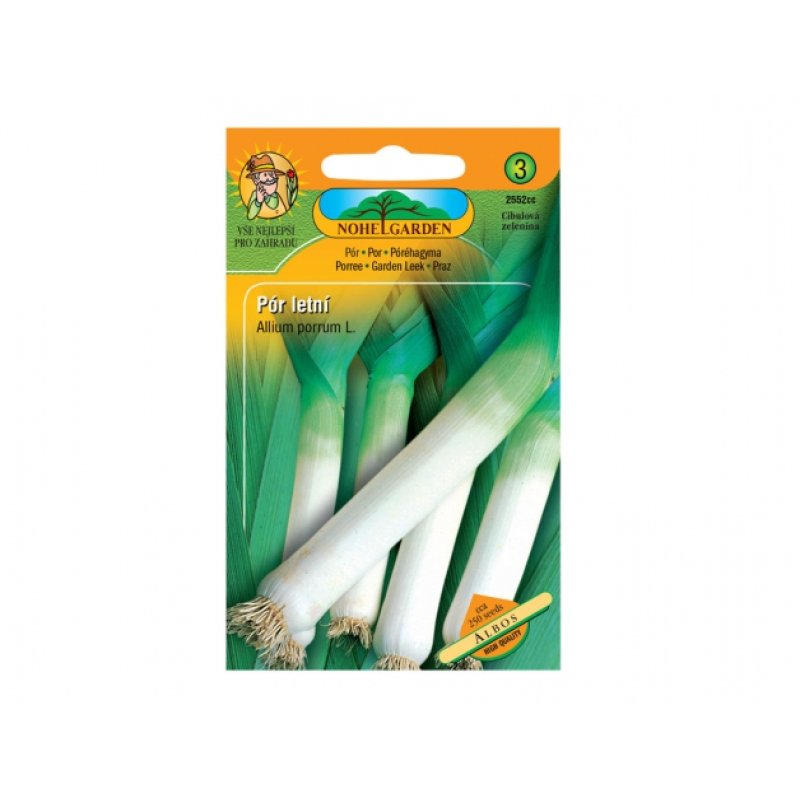
A semi-early variety designed for summer and autumn harvest. The edible part reaches up to 40 cm in length. The package contains 250 seeds.
 Wide range of quality products
Seeds, essential oils, growing supplies and exotic plants in one place
 Eco-friendly range
We prefer natural and gentle products
 Expert advice
We help you grow – guides, blog and personal support
 Delivery across the EU
PPL, DPD, GLS and local carriers – pickup point or home delivery
Leek is a biennial vegetable. In the first year, the usable part grows at a moderate depth or on the soil surface, and only in the second year does it grow into flowering and the seed matures. It reaches up to 60cm in height. We can find more than twenty varieties in our region, but many more exist. Leeks can be divided into summer, autumn, and winter varieties. The leek forms a very rich rosette of flat leaves above a bulbous thickened underground stem. The leaves contain a range of minerals, vitamins, and essential substances that give the leek its typical aroma and juiciness.
The soil for growing leeks must be well-worked and loosened to a greater depth than, for example, for onions or lettuce. It requires a bright, sunny location. After planting, gradually hill soil up to the necks; by early winter, the strong seedlings are already in ridged furrows. Until the newly planted plants establish themselves, they must be watered generously every day. Later, irrigation is only necessary occasionally, only during dry weather.
Sowing of summer crops is done in a greenhouse at the turn of December and January. At a temperature of around 18°C, from a seedling height of 5 cm, the temperature can be reduced to 15°C. In April, planting is carried out in beds at a spacing of 30×10 cm.
Sowing of autumn crops is done from mid-February to mid-March in a greenhouse. In mid-June, seedlings are planted in beds.
All sowings of various crops are done to a depth of 1 cm, at a spacing of 10×1–2 cm. We plant seedlings that are pencil-sized at their final location.
Requires very nutritious, well-loosened soil. Optimal pH 7–7.8.
N 100 kg N/ha, of which 50 kg 5 weeks after planting. P 80 kg P2O5/ha, K 200 - 250 kg K2O/ha. Ideally, leeks should be planted after crops fertilized with cow manure.
Leeks are threatened by the leek moth (Acrolepiopsis assectella), which lays eggs at the boundary between the underground and above-ground parts. The hatched larvae feed on the tissue and damage it. Against the leek moth, treat with Decis EW 50 spray at a concentration of 0.03%. Similar products are also effective against the less common onion fly.
Downy mildew may also appear. Gray-green spots covered with a grayish coating of mycelium and spores appear on the leaves; in bulbs, the inner scales rot. Protection involves fungicides with a wetting agent.
Leeks are harvested 16 to 20 weeks after sowing, but they can remain in harvest maturity for entire months. Leeks are harvested by digging them out from summer onwards, whenever needed.
Data sheet
Specific References
Your review appreciation cannot be sent
Report comment
Report sent
Your report cannot be sent
Write your review
Review sent
Your review cannot be sent
A semi-early variety designed for summer and autumn harvest. The edible part reaches up to 40 cm in length. The package contains 250 seeds.
check_circle
check_circle