 Essential oils
 Aroma lamps
 Aroma Diffusers
 Vegetables
 Herbs and spices
 Ornamental Plant Seeds
 Grass mixtures
 Sprouts and microgreens
 Exotic Fruit and Vegetables
 Exotic herbs
 Exotic trees and shrubs
 Ornamental exotic plants
 Espresso coffee
 Ecological coffee preparation
 Thermal mugs and coffee cups
 Aeropress
 Thermos flasks and thermal mugs for coffee and tea
 Moka pot
 Filter coffee
 Coffee blends
 Water filtration
 Coffee grinders
 Cleaning the Coffee Maker
 Ecological Cleaning of Coffee Machines
 Coffee makers
 Coffee Preparation
 Coffee Accessories
 For wildlife and pets
 Chocolate and others
 Hemp food products
 Hemp cosmetics
 Bongs - water pipes
 Blunts and tubes
 E-liquids with Terpenes and CBD
 Grinders and Mills
 Papers and filters
 Smoking accessories
 Vaporizers
 Air fresheners
 CBD sprays
 CBD and CBN crystals
 CBD body and facial care
 Weeds
 CBD suppositories and capsules
 CBD oils and drops
 CBG oils and drops
 Fashion and Decoration
 Kitchen essentials and cooking
 Christmas Decorations and Accessories
 Gift Sets
 Bird feeders
 Seasonal and Special Tools

 Our products
 Aromatherapy - essential oils
 Seeds
 Growing supplies
 Cultivation and Gardening Supplies
 Hydroponics and indoor growing
 Protective equipment and gardening tools
 Exotic plants
 Roasted coffee
 Accessories for coffee makers
 Food products
 Natural cosmetics
 Smoking supplies
 CBD and CBG products
 House and garden

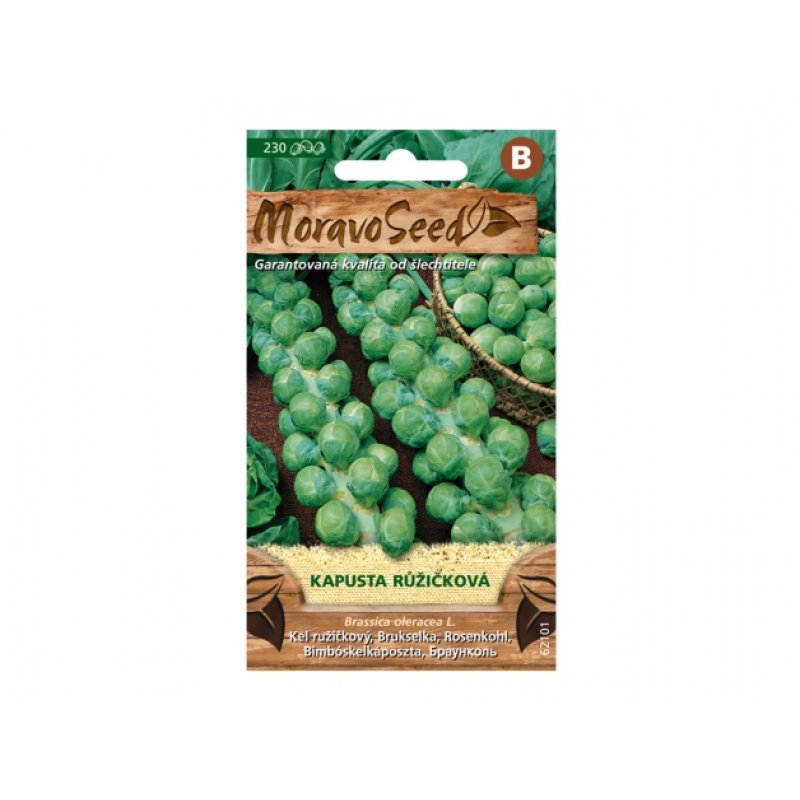
A mid-late variety suitable for gradual harvesting. It has dark green sprouts that are densely clustered, firm, with a medium-sized inner core. Package contains 230 seeds.
 Wide range of quality products
Seeds, essential oils, growing supplies and exotic plants in one place
 Eco-friendly range
We prefer natural and gentle products
 Expert advice
We help you grow – guides, blog and personal support
 Delivery across the EU
PPL, DPD, GLS and local carriers – pickup point or home delivery
Originates from Belgium. The plant grows up to 1 m in height. It is densely covered with long-stalked leaves, in whose axils small firm sprouts form. These are 30-40 mm in size. It flowers in the second year.
Thanks to its high content of proteins, minerals and fiber, it is ranked among the healthiest brassica crops. It is rich in vitamin C, E and minerals, especially zinc, phosphorus and sulfur. It is characterized by low energy value, which is why it is used in diets and healthy eating. The taste is very delicate and in the kitchen it is used in soups or as a side dish.
The plants are frost-resistant. They tolerate temperatures from -10 to -15 °C without problems. They require sunny or partially shaded locations. At the beginning of summer, plants require large amounts of water. The soil should never dry out. We regularly hoe around the plants and remove weeds. We also regularly lime and fertilize. For better sprout formation, we break off the top of the plant, ideally at the end of summer. Sprouts that experience frost have significantly better taste.
We sow seeds in April in a hotbed or heated greenhouse. We plant seedlings from June to July in beds at 50×70 cm spacing.
Direct sowing at the site is done in mid-April in rows 0.6 m apart. At the 2-leaf stage, we thin to 0.5 m distance.
Medium-heavy loamy humus soils with sufficient supply of nutrients and soil moisture are suitable.
We can use any NPK fertilizer designed for vegetables and follow the dosage on the package. Basic fertilization is done in autumn, when we work 5–7 kg of farmyard manure/m2 into the soil and thoroughly lime the soil. Another 20–25 g of nitrogen/m2 is worked in before planting. During vegetation, it is necessary to add another 8g of nitrogen/m2 and distribute this dose evenly. Additionally, during vegetation we add 13g P2O5/m2, 25 g K2O/m2 and 5 g MgO/m2 in the form of NPK fertilizer.
Brussels sprouts may be affected by alternaria leaf spot of brassicas, downy mildew, large white butterfly, small white butterfly, cabbage moth, diamondback moth, field vole and aphids.
Alternaria leaf spot manifests on stems and cotyledon leaves of young plants as small brown-black to black, slightly sunken spots. The spots subsequently merge and with severe infestation the plants die. Treatment with Ortiva preparation is suitable.
Small white butterfly and large white butterfly damage plants by feeding and leave their droppings on them. We treat plants with Steward or Karate Zeon, Biobit or Dimilin 48 SC preparations.
Downy mildew attacks mainly young plants in hotbeds. It creates light green to yellow-green undefined spots on leaves. Gray-white coatings of sporangiophores and sporangia grow on the underside. We carry out protection with Ortiva or Dithane DG Neotec products.
We harvest as needed until frost and throughout winter. We harvest whole plants from which we twist off the sprouts, or we pick individual sprouts as needed.
Data sheet
Specific References
Your review appreciation cannot be sent
Report comment
Report sent
Your report cannot be sent
Write your review
Review sent
Your review cannot be sent
A mid-late variety suitable for gradual harvesting. It has dark green sprouts that are densely clustered, firm, with a medium-sized inner core. Package contains 230 seeds.
check_circle
check_circle