 Essential oils
 Aroma lamps
 Aroma Diffusers
 Vegetables
 Herbs and spices
 Ornamental Plant Seeds
 Grass mixtures
 Sprouts and microgreens
 Exotic Fruit and Vegetables
 Exotic herbs
 Exotic trees and shrubs
 Ornamental exotic plants
 Espresso coffee
 Ecological coffee preparation
 Thermal mugs and coffee cups
 Aeropress
 Thermos flasks and thermal mugs for coffee and tea
 Moka pot
 Filter coffee
 Coffee blends
 Water filtration
 Coffee grinders
 Cleaning the Coffee Maker
 Ecological Cleaning of Coffee Machines
 Coffee makers
 Coffee Preparation
 Coffee Accessories
 For wildlife and pets
 Chocolate and others
 Hemp food products
 Hemp cosmetics
 Bongs - water pipes
 Blunts and tubes
 E-liquids with Terpenes and CBD
 Grinders and Mills
 Papers and filters
 Smoking accessories
 Vaporizers
 Air fresheners
 CBD sprays
 CBD and CBN crystals
 CBD body and facial care
 Weeds
 CBD suppositories and capsules
 CBD oils and drops
 CBG oils and drops
 Fashion and Decoration
 Kitchen essentials and cooking
 Christmas Decorations and Accessories
 Gift Sets
 Bird feeders
 Seasonal and Special Tools

 Our products
 Aromatherapy - essential oils
 Seeds
 Growing supplies
 Cultivation and Gardening Supplies
 Hydroponics and indoor growing
 Protective equipment and gardening tools
 Exotic plants
 Roasted coffee
 Accessories for coffee makers
 Food products
 Natural cosmetics
 Smoking supplies
 CBD and CBG products
 House and garden

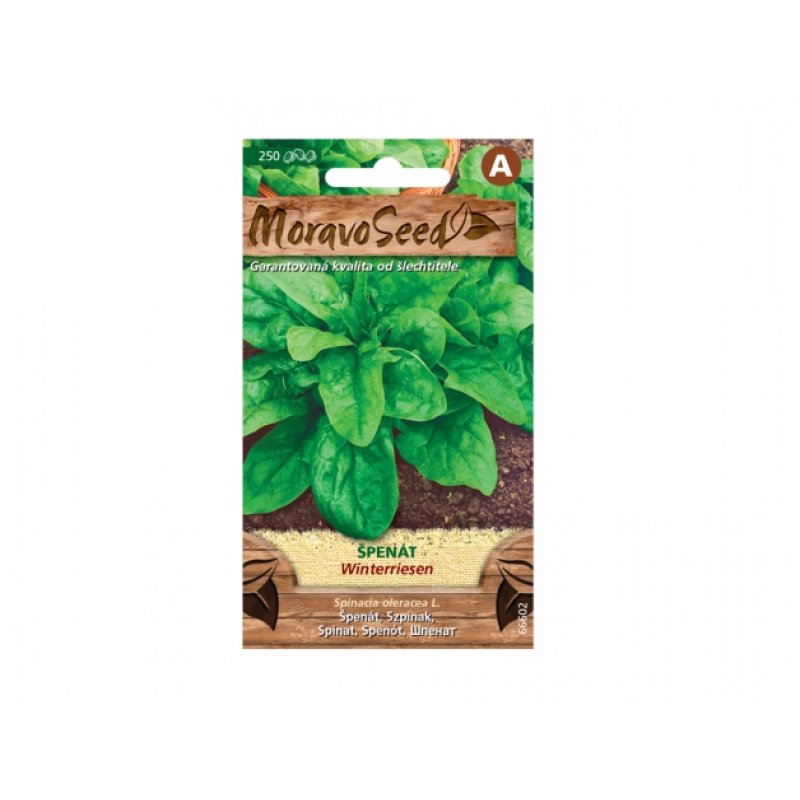
A traditional variety suitable for year-round cultivation. Forms semi-upright plants with medium green, large, slightly blistered leaves. Package contains 250 seeds.
 Wide range of quality products
Seeds, essential oils, growing supplies and exotic plants in one place
 Eco-friendly range
We prefer natural and gentle products
 Expert advice
We help you grow – guides, blog and personal support
 Delivery across the EU
PPL, DPD, GLS and local carriers – pickup point or home delivery
Spinach originates from the Caucasus, from the area of present-day Afghanistan and Turkmenistan. It grows to a height of 30 cm. The leaves are arranged in a leaf rosette, are long-petioled, entire-margined, and their shape depends on the variety. The flower stem is up to 30 cm tall. It has a deep green color. During the summer period, greenish-yellow flowers appear, which are, however, undesirable in spinach as they reduce its quality.
Spinach can be divided according to planting time into spring, summer, autumn, and winter varieties. Spinach is a rich source of lecithin, spinacin (spinach protein), and saponins, which have a beneficial effect on the function of the peritoneum and gastric mucosa. Consumption of spinach has a positive effect on heart function, blood formation, strengthens bones and teeth, fortifies hair and nails. The leaves are consumed, containing 2% carbohydrates, 4–5% proteins, 5% fiber; among vitamins, we can mention the high content of vitamin C, A, B1, B2, B6, K, and folacin, and it is a valuable source of potassium, calcium, magnesium, and iron. Spinach leaves are consumed fresh, steamed, or boiled. They are excellent as a side dish to meat.
We grow spinach in a bright location in a sheltered spot. Spinach has shallow-rooting roots, so we hoe it carefully. High temperatures and long days cause plants to bolt. Flowering plants are tough and lose their flavor.
We grow spinach by direct sowing. The optimal temperature for germination is 2–4°C. Sowing depth is 4 cm.
Overwintering crops for early sowings are sown at a spacing of 15×25 cm in September; leaves are harvested in early April.
Early sowings are carried out in February at a spacing of 20–25×20–25 cm; spinach leaves can be harvested as early as late April.
Spinach sown in April can be harvested in June. Autumn varieties sown in August are harvested in early October.
Spinach requires loamy-sandy soil that retains water sufficiently with an optimal soil pH of 6–7.5. Plants do not tolerate acidic pH.
We do not fertilize spinach with fertilizers containing nitrogen or farmyard manure. We avoid physiologically acidic forms of fertilizers. Chloride forms of fertilizers are not harmful. It is suitable to fertilize with well-decomposed compost or calcium ammonium nitrate. Spinach is not demanding in terms of nutrients.
On the leaves and growing tips, there are colonies of black-green to black-brown colored aphids. If you spot these small black beetles, the plants are infested with black bean aphid. Suitable protection is spraying with selective insecticides based on triazamate, pirimicarb, etc.
Spinach can also be threatened by slugs and snails, which feed on its leaves. Effective protection is manual collection in the crop.
A significant pest of spinach is the beet leaf miner. Infestation manifests itself in the leaf blades, where there are initially thin tunnels, which gradually expand into flat mines. These mines are initially whitish with visible larvae and frass, later they turn brown and dry out. Leaves often tear due to infestation. A suitable protective product is Sumithion Super.
Leaves are harvested before flowering. Plants with a minimum of 6 developed leaves are harvested. Spring varieties have a growing period of 52 days. Varieties for autumn harvest 65 days. Varieties intended for spring harvest 240 days.
Data sheet
Specific References
Your review appreciation cannot be sent
Report comment
Report sent
Your report cannot be sent
Write your review
Review sent
Your review cannot be sent
A traditional variety suitable for year-round cultivation. Forms semi-upright plants with medium green, large, slightly blistered leaves. Package contains 250 seeds.
check_circle
check_circle