 Essential oils
 Aroma lamps
 Aroma Diffusers
 Vegetables
 Herbs and spices
 Ornamental Plant Seeds
 Grass mixtures
 Sprouts and microgreens
 Exotic Fruit and Vegetables
 Exotic herbs
 Exotic trees and shrubs
 Ornamental exotic plants
 Espresso coffee
 Ecological coffee preparation
 Thermal mugs and coffee cups
 Aeropress
 Thermos flasks and thermal mugs for coffee and tea
 Moka pot
 Filter coffee
 Coffee blends
 Water filtration
 Coffee grinders
 Cleaning the Coffee Maker
 Ecological Cleaning of Coffee Machines
 Coffee makers
 Coffee Preparation
 Coffee Accessories
 For wildlife and pets
 Chocolate and others
 Hemp food products
 Hemp cosmetics
 Bongs - water pipes
 Blunts and tubes
 E-liquids with Terpenes and CBD
 Grinders and Mills
 Papers and filters
 Smoking accessories
 Vaporizers
 Air fresheners
 CBD sprays
 CBD and CBN crystals
 CBD body and facial care
 Weeds
 CBD suppositories and capsules
 CBD oils and drops
 CBG oils and drops
 Fashion and Decoration
 Kitchen essentials and cooking
 Christmas Decorations and Accessories
 Gift Sets
 Bird feeders
 Seasonal and Special Tools

 Our products
 Aromatherapy - essential oils
 Seeds
 Growing supplies
 Cultivation and Gardening Supplies
 Hydroponics and indoor growing
 Protective equipment and gardening tools
 Exotic plants
 Roasted coffee
 Accessories for coffee makers
 Food products
 Natural cosmetics
 Smoking supplies
 CBD and CBG products
 House and garden

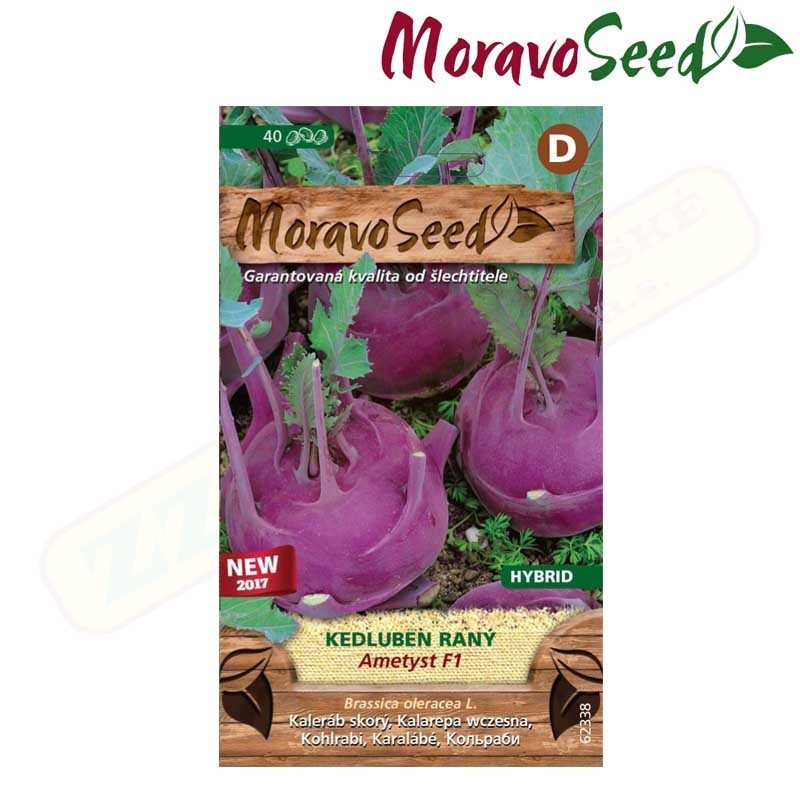
Early variety of purple kohlrabi. Very resistant to cracking, becoming woody, or bolting.
 Wide range of quality products
Seeds, essential oils, growing supplies and exotic plants in one place
 Eco-friendly range
We prefer natural and gentle products
 Expert advice
We help you grow – guides, blog and personal support
 Delivery across the EU
PPL, DPD, GLS and local carriers – pickup point or home delivery
A biennial plant originating from the Mediterranean region and Western Europe. Many cultivars have been bred from the wild plant, which are very different in appearance: cabbage, headed cabbage, Brussels sprouts, marrow-stem kale, fodder cabbage, broccoli, cauliflower, kohlrabi.
Kohlrabi has a stem up to 20 cm long, from which long-stalked leaves grow above the bulb, and the leaves below the bulb die off. The most basic division of kohlrabi is into purple and white varieties, with white varieties being the earliest. In addition to its pleasant taste, kohlrabi is also a rich source of vitamins B, C and E, calcium, potassium, selenium, zinc, iron, folic acid and pantothenic acid. It is consumed raw, tastes good on its own or as part of vegetable salads. We can boil it, braise it, bake it, use it like courgette in dough instead of potatoes for fritters, or fry it in breadcrumbs.
The site should have a more humid climate and does not require high temperatures. We ensure even soil moisture, water regularly with moderate amounts of water, and hoe. In dry conditions, the bulbs become woody and crack after heavier watering. Keep the bed free of weeds.
Early varieties: sow in February. Plant them at 25x25 cm spacing in mid-April. White early varieties of kohlrabi do not tolerate higher temperatures in early summer. Cover spring varieties with fleece at planting.
Summer varieties: sow in March or April. Plant at 25x25 cm spacing in the first half of May.
Late varieties: sow at the turn of April and May. Seedlings must be planted by mid-August at the latest.
Plants require loamy or sandy-loam soil with sufficient humus content and adequate available nutrients. The optimal pH value ranges between 6–7.3.
Before planting, it is advisable to apply commercial fertilisers to the soil at a rate of 30–60 g/m2 with an NPK nutrient ratio of 1.5:1:2. For late varieties or direct sowing, apply the first half of the dose at planting and the second during the growing season.
Drought damage manifests as cracking of roots, bulbs and fruits, and in cases of severe damage, drying out.
Pests affecting kohlrabi include the Turnip flea beetle (Phyllotreta undulata), Black flea beetle (Phyllotreta atra), Cabbage flea beetle (Phyllotreta nemorum) and Cabbage aphid (Brevicoryne brassicae).
Among fungal diseases, powdery mildew is particularly common.
Harvest kohlrabi selectively according to size. Early varieties are usually harvested when they reach 4 cm in size. It is not advisable to harvest plants that have bolted.
Data sheet
Specific References
Your review appreciation cannot be sent
Report comment
Report sent
Your report cannot be sent
Write your review
Review sent
Your review cannot be sent
Early variety of purple kohlrabi. Very resistant to cracking, becoming woody, or bolting.
check_circle
check_circle