 Essential oils
 Aroma lamps
 Aroma Diffusers
 Vegetables
 Herbs and spices
 Ornamental Plant Seeds
 Grass mixtures
 Sprouts and microgreens
 Exotic Fruit and Vegetables
 Exotic herbs
 Exotic trees and shrubs
 Ornamental exotic plants
 Espresso coffee
 Ecological coffee preparation
 Thermal mugs and coffee cups
 Aeropress
 Thermos flasks and thermal mugs for coffee and tea
 Moka pot
 Filter coffee
 Coffee blends
 Water filtration
 Coffee grinders
 Cleaning the Coffee Maker
 Ecological Cleaning of Coffee Machines
 Coffee makers
 Coffee Preparation
 Coffee Accessories
 For wildlife and pets
 Chocolate and others
 Hemp food products
 Hemp cosmetics
 Bongs - water pipes
 Blunts and tubes
 E-liquids with Terpenes and CBD
 Grinders and Mills
 Papers and filters
 Smoking accessories
 Vaporizers
 Air fresheners
 CBD sprays
 CBD and CBN crystals
 CBD body and facial care
 Weeds
 CBD suppositories and capsules
 CBD oils and drops
 CBG oils and drops
 Fashion and Decoration
 Kitchen essentials and cooking
 Christmas Decorations and Accessories
 Gift Sets
 Bird feeders
 Seasonal and Special Tools

 Our products
 Aromatherapy - essential oils
 Seeds
 Growing supplies
 Cultivation and Gardening Supplies
 Hydroponics and indoor growing
 Protective equipment and gardening tools
 Exotic plants
 Roasted coffee
 Accessories for coffee makers
 Food products
 Natural cosmetics
 Smoking supplies
 CBD and CBG products
 House and garden

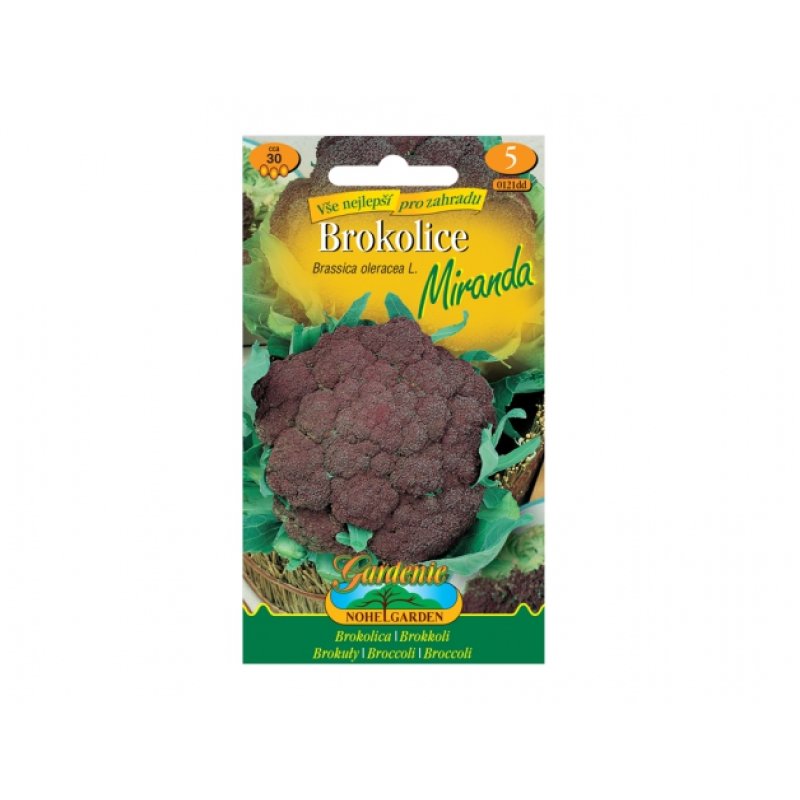
This semi-late variety produces a large purple rosette. Each rosette can weigh up to 300 g! The package contains 30 seeds.
 Wide range of quality products
Seeds, essential oils, growing supplies and exotic plants in one place
 Eco-friendly range
We prefer natural and gentle products
 Expert advice
We help you grow – guides, blog and personal support
 Delivery across the EU
PPL, DPD, GLS and local carriers – pickup point or home delivery
Broccoli is rich in fiber, beta-carotene, vitamins C and E, folic acid, minerals, and flavonoids. It also has a low sugar and fat content, making it not only a very healthy food but also suitable for diets. It originates from the Mediterranean, from the area of the Apennine Peninsula. One plant can even provide multiple harvests!
To preserve valuable nutrients, it's better to steam broccoli rather than boil it. It can also be eaten raw. It can be prepared by braising, boiling, frying, or added to salads when pre-cooked, and is often part of frozen vegetable mixes. Broccoli leaves are edible and can be prepared similarly to cabbage!
Plants tolerate higher temperatures in summer and lower temperatures in autumn. Broccoli requires deep, loamy-sandy, humus-rich soil with calcium content and plenty of organic matter. Summer heat causes premature development of flower buds and the plant blooms quickly, so light partial shade with cooler air flow is suitable. It tolerates frost down to -6 °C. During head formation, we reduce overhead watering to avoid damaging the edible part. Never let the soil where we grow broccoli dry out completely. Keep the surrounding soil weed-free and hoed.
We sow spring crops in January or February. In April or May, we transplant them to beds with 45×45 cm spacing.
We sow summer crops from March to May. We transplant them to beds in June with 50×45 cm spacing.
We sow autumn crops in June. Transplanting to beds takes place in July with 50×40 cm spacing.
We sow seeds in sterilized substrate. Germination requires daytime temperatures of 15 to 18 °C, at night between 12-16 °C. Greenhouses or cold frames are suitable for spring sowing. We transplant broccoli to its final location when it has at least 5 leaves and a stronger stem. After transplanting, we cover broccoli with non-woven fabric, which ensures uniform temperature and protects the crop against water loss and pest attacks.
Heavier permeable soils with sufficient soil moisture ratio and optimal pH 6–7.5 are suitable. Broccoli also has high calcium requirements, so alkaline soils are unsuitable.
The planting site should be well fertilized with organic fertilizers. To support growth, we apply multi-component fertilizers containing boron and molybdenum, as broccoli is sensitive to deficiency of these trace elements. Nitrogen doses should not exceed 20g/m2. This would lead to nitrogen accumulation and thus storage of hazardous nitrates in the plant, making it unsuitable for consumption. In autumn, we apply manure to the plot, lime with dolomitic limestone, and add 6.5 g/m2 P2O5 and 45g/m2 potassium sulfate to the soil. We avoid fertilizers containing chlorine.
In acidic soil, broccoli can be affected by clubroot. "Buttoning" of broccoli heads can be caused by molybdenum deficiency. The cause may also be damage to the growing tip by cabbage root fly.
Plants are attacked by flea beetles. We keep young seedlings moist (moisture doesn't suit flea beetles) and covered with fabric.Broccoli is also attacked by cabbage aphid and cabbage seed weevil. Another pest is cabbage aphid. Affected leaves are twisted, yellowing or reddening. In case of cabbage aphid infestation, we recommend immediate removal of post-harvest residues and immediate treatment of crops with insecticidal preparations.
Protection against powdery mildew and other fungal diseases with fungicidal preparations is also suitable.
We harvest the main head as soon as it's firm and the buds are not yet open. We don't delay harvesting so the head doesn't flower. After harvesting the main head, side shoots develop in most varieties. They are smaller but just as tender and tasty as the main head.
Data sheet
Specific References
Your review appreciation cannot be sent
Report comment
Report sent
Your report cannot be sent
Write your review
Review sent
Your review cannot be sent
This semi-late variety produces a large purple rosette. Each rosette can weigh up to 300 g! The package contains 30 seeds.
check_circle
check_circle