 Essential oils
 Aroma lamps
 Aroma Diffusers
 Vegetables
 Herbs and spices
 Ornamental Plant Seeds
 Grass mixtures
 Sprouts and microgreens
 Exotic Fruit and Vegetables
 Exotic herbs
 Exotic trees and shrubs
 Ornamental exotic plants
 Espresso coffee
 Ecological coffee preparation
 Thermal mugs and coffee cups
 Aeropress
 Thermos flasks and thermal mugs for coffee and tea
 Moka pot
 Filter coffee
 Coffee blends
 Water filtration
 Coffee grinders
 Cleaning the Coffee Maker
 Ecological Cleaning of Coffee Machines
 Coffee makers
 Coffee Preparation
 Coffee Accessories
 For wildlife and pets
 Chocolate and others
 Hemp food products
 Hemp cosmetics
 Bongs - water pipes
 Blunts and tubes
 E-liquids with Terpenes and CBD
 Grinders and Mills
 Papers and filters
 Smoking accessories
 Vaporizers
 Air fresheners
 CBD sprays
 CBD and CBN crystals
 CBD body and facial care
 Weeds
 CBD suppositories and capsules
 CBD oils and drops
 CBG oils and drops
 Fashion and Decoration
 Kitchen essentials and cooking
 Christmas Decorations and Accessories
 Gift Sets
 Bird feeders
 Seasonal and Special Tools

 Our products
 Aromatherapy - essential oils
 Seeds
 Growing supplies
 Cultivation and Gardening Supplies
 Hydroponics and indoor growing
 Protective equipment and gardening tools
 Exotic plants
 Roasted coffee
 Accessories for coffee makers
 Food products
 Natural cosmetics
 Smoking supplies
 CBD and CBG products
 House and garden

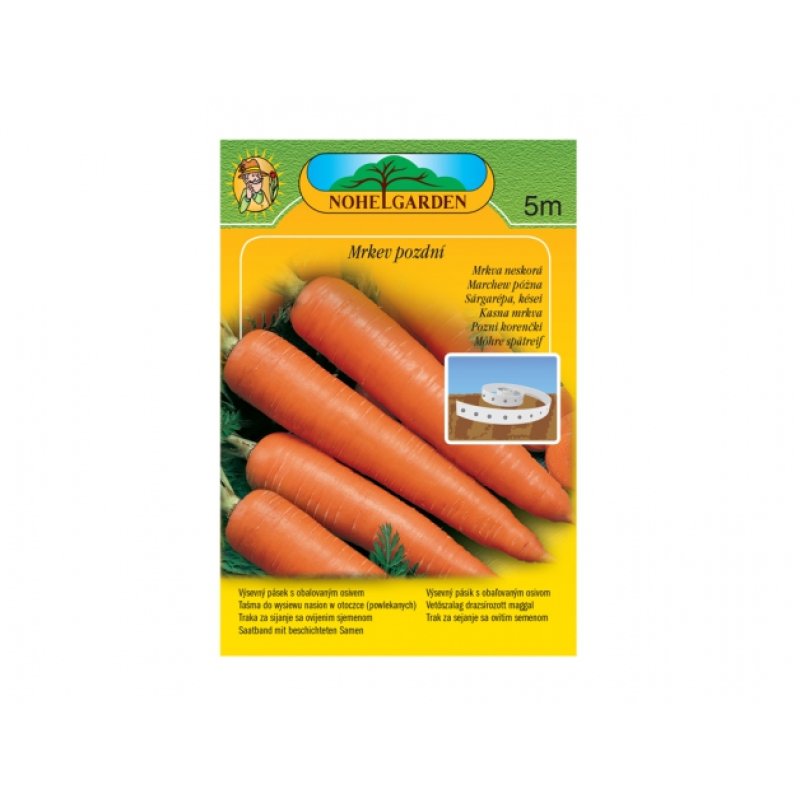
High-yielding variety for universal use. The root develops excellent color. Package contains 5 meters of seed tape, approximately 250 seeds.
 Wide range of quality products
Seeds, essential oils, growing supplies and exotic plants in one place
 Eco-friendly range
We prefer natural and gentle products
 Expert advice
We help you grow – guides, blog and personal support
 Delivery across the EU
PPL, DPD, GLS and local carriers – pickup point or home delivery
Everyone knows it, everyone loves its taste, and it's one of the most commonly used root vegetables in the kitchen. Yes, we're talking about carrots. Originally from South Asia, the region of present-day Afghanistan, Pakistan, and Iran. Carrots are biennial plants with pinnate leaves. The flower stem can reach up to 1.5 m in height, the inflorescence forms a compound umbel with whitish flowers.
Carrots can be divided into two basic types - wild carrot (the original undomesticated form with a white root) and cultivated carrot (which includes all carrot varieties grown today). Cultivated carrots have a more robust root, whose color can be white, yellow, orange, red, purple, or even multicolored (the exterior can differ from the interior).
According to sowing time, we distinguish carrots into - BABY CARROT (finer early carrot, shorter with a more rounded root), MINI BABY CARROT (young early baby carrot, characterized by a delicate taste and tender structure), and CLASSIC CARROT (late type, has a sweet smooth root of semi-long shape with a pointed end).
But that's not all. Popular carrots can also be divided according to the shape of the root for which we grow them. For example, the Berlikum type has larger cylindrical roots with a blunt end. Carrots of this type are suitable for direct consumption, long-term storage, drying, and other processing. Flakee is characterized by very long tapered roots with a wide flat end. Suitable for direct consumption, long-term storage, drying, and other types of processing. Parisian has small radish-shaped roots. This type is suitable for direct consumption and processing. Nantes is the classic baby carrot we encounter in stores. And finally, the Chantenay type is a carrot with shorter, rather conical roots. Suitable for direct consumption, drying, and other types of processing.
Carrots have a high content of mineral substances. They also have high content of potassium, magnesium, phosphorus, but also chlorine. They contain numerous trace elements - boron, vanadium, iron, iodine, cobalt, copper, manganese, zinc. As is well known, carrots affect vision quality! They are a source of provitamin A - beta-carotene. They also contain some vitamin C and B group vitamins.
The advantage of carrots is that they are very undemanding vegetables. You can also grow them in containers, for example on a terrace!
Requires a sunny location. Loosen and water beds regularly. Definitely don't overwater, as this could destroy the entire sowing. Carrots are cold-loving plants; they thrive best at temperatures around 16°C. We prevent greening of root heads by hilling soil around the plants.
Freshly manured soil is unsuitable for planting. We sow seeds in beds when frosts are over. Daytime temperature should be at least 7°C on average (ideal carrot growing is at daytime temperatures around 16°C). Sow to a depth of 1 to 2 cm at a distance of about 15 cm. Emerging seedlings must be thinned to about 5 cm spacing. We sow late carrot varieties in the same way from late spring to early summer.
Carrots require thoroughly worked soil with sufficient nutrients and moisture. Soil should be light and fertile. Optimal pH is neutral to slightly alkaline. Soil should not contain clods and stones.
Before loosening the soil, it's advisable to enrich the sowing site with well-aged compost. Before sowing, work into the soil 70g N, 30g P, and 150g K. In the 3-5 leaf stage, apply 20g N as top dressing. During vegetation, fertilize with NPK fertilizer with lower nitrogen content and higher potassium proportion. Don't use manure. Carrots react to this type of fertilization with cracking.
Black rot of carrots manifests in germinating plants as darkening, thinning, and rot of the root collar and leaf drying. During vegetation, this disease doesn't show much on roots. Dark, dry, sunken spots appear on affected roots. Protection is carried out with Dithane DG Neotec.
Leaf blight of carrots manifests during vegetation, spreading among plants through wind and rain by conidia that form on affected leaves. On the oldest leaves, one to two millimeter yellowish-brown spots with lighter borders appear. Spots gradually enlarge, merge, and darken. In later stages, leaves are completely dark and dead. Protection is carried out with Ortiva.
Carrot fly shows on younger plants that yellow and die. On the root surface, especially in its upper third, tunnel-like feeding marks with fly larvae are visible from the outside. Damaged plants rot during storage. Protection is not currently possible. Previously, it was carried out with Dursban 10 G.
Soft rot of carrots is caused by improper storage of root vegetables in humid environments. Carrots turn into a mushy, foul-smelling mass. Before storage, inspect carrots and clean them of soil residues.
Due to nematode feeding, carrot roots are deformed and produce excessive amounts of lateral rootlets. Sowing marigolds can significantly reduce nematode occurrence in soil. We also observe crop rotation.
Powdery mildew manifests on all above-ground parts (leaves, petioles, stems, inflorescences, and seeds) as whitish powdery coatings. Protection against powdery mildew of umbellifers is carried out with Ortiva.
We harvest early varieties from week 8 after planting. Late varieties sometimes need up to 11 weeks. Harvesting is done manually by pulling or we can carefully help with a fork so as not to damage the plant roots.
Data sheet
Specific References
Your review appreciation cannot be sent
Report comment
Report sent
Your report cannot be sent
Write your review
Review sent
Your review cannot be sent
High-yielding variety for universal use. The root develops excellent color. Package contains 5 meters of seed tape, approximately 250 seeds.
check_circle
check_circle