 Essential oils
 Aroma lamps
 Aroma Diffusers
 Vegetables
 Herbs and spices
 Ornamental Plant Seeds
 Grass mixtures
 Sprouts and microgreens
 Exotic Fruit and Vegetables
 Exotic herbs
 Exotic trees and shrubs
 Ornamental exotic plants
 Espresso coffee
 Ecological coffee preparation
 Thermal mugs and coffee cups
 Aeropress
 Thermos flasks and thermal mugs for coffee and tea
 Moka pot
 Filter coffee
 Coffee blends
 Water filtration
 Coffee grinders
 Cleaning the Coffee Maker
 Ecological Cleaning of Coffee Machines
 Coffee makers
 Coffee Preparation
 Coffee Accessories
 For wildlife and pets
 Chocolate and others
 Hemp food products
 Hemp cosmetics
 Bongs - water pipes
 Blunts and tubes
 E-liquids with Terpenes and CBD
 Grinders and Mills
 Papers and filters
 Smoking accessories
 Vaporizers
 Air fresheners
 CBD sprays
 CBD and CBN crystals
 CBD body and facial care
 Weeds
 CBD suppositories and capsules
 CBD oils and drops
 CBG oils and drops
 Fashion and Decoration
 Kitchen essentials and cooking
 Christmas Decorations and Accessories
 Gift Sets
 Bird feeders
 Seasonal and Special Tools

 Our products
 Aromatherapy - essential oils
 Seeds
 Growing supplies
 Cultivation and Gardening Supplies
 Hydroponics and indoor growing
 Protective equipment and gardening tools
 Exotic plants
 Roasted coffee
 Accessories for coffee makers
 Food products
 Natural cosmetics
 Smoking supplies
 CBD and CBG products
 House and garden

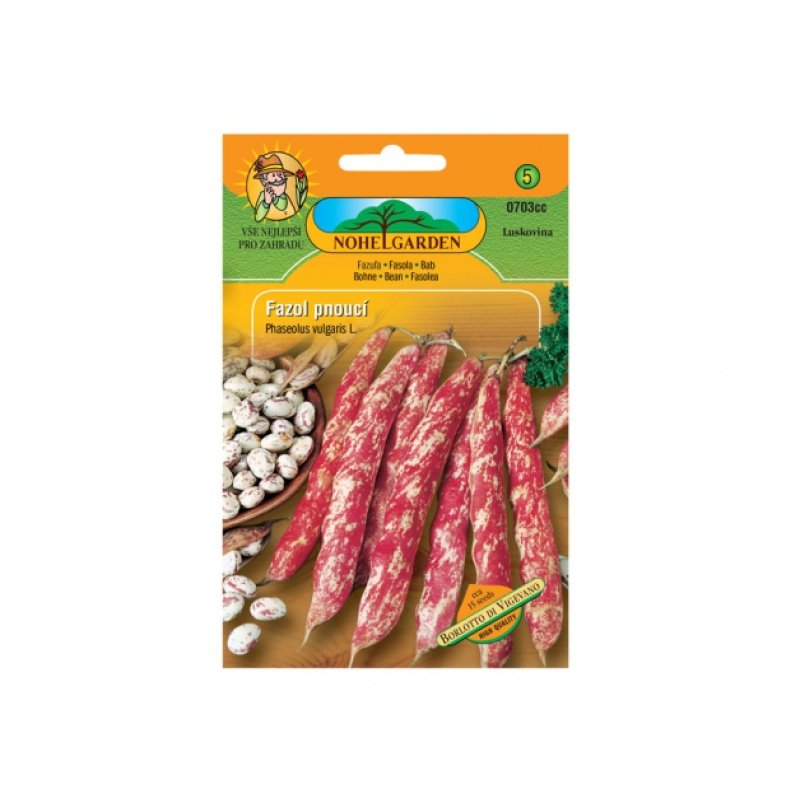
Grows up to 200 cm in height. Late-maturing variety with good yield and health. The pods are covered with numerous red-purple spots on the surface. Package contains 15 seeds.
 Wide range of quality products
Seeds, essential oils, growing supplies and exotic plants in one place
 Eco-friendly range
We prefer natural and gentle products
 Expert advice
We help you grow – guides, blog and personal support
 Delivery across the EU
PPL, DPD, GLS and local carriers – pickup point or home delivery
An annual plant originally from tropical regions of America. It has a climbing stem that can reach a height of 1.5 - 2 metres. The fruit is a pod containing various amounts of kidney-shaped seeds. They differ in colour and size depending on the variety. Bean seeds are poisonous. They contain a substance called phaseolin. This is lost during cooking. Therefore, we do not consume uncooked seeds. The flowers are white, pink, yellow or purple in colour and form sparse clusters. It blooms from June to August.
Beans contain a source of amino acids and ascorbic acid.
This is a heat-loving plant, so we plant it in a sunny location that is protected from wind. During flowering, beans need temperatures ranging between 20-25 degrees Celsius. Beans are demanding when it comes to watering, the soil must not dry out, but at the same time it must not be waterlogged! All types of beans need support. Ornamental types will look great on pergolas, fences or in containers with climbing structures. We plant edible varieties near stakes, or create a place for tying them with string. We loosen the soil around the plant and keep it weed-free. Regular harvesting of pods encourages the formation of additional fruit.
We sow seeds in March. We plant the seeds in permeable nutritious substrate and place them in a bright location. Beans require warmth for germination, so a greenhouse or hotbed is suitable. We sow beans at their final location after 15th May, when there is no risk of frost.
We sow bush varieties with 3-4 seeds in prepared holes about 5 cm deep. Spaced about 20 cm apart.
We sow climbing varieties with about 5 seeds in holes 5 cm deep and up to a metre apart depending on the type of support.
Light sandy-loam soils with sufficient soil microorganisms and nutrients are suitable. Ideal pH around 6.5.
We use NPK fertilisers with a low nitrogen ratio. In spring, it is recommended to add 3 kg of nitrogen per m2, 3-4 kg P2O5/m2 and 11 kg K2O/m2 as a one-off application to the bean site. If beans are grown in nutritious soil, we may not need to apply fertilisers at all.
The most serious disease of beans is anthracnose. Browning, enlarging spots appear on young pods, the mycelium penetrates inside the pod and attacks the seeds, forming yellow-brown to red-brown spots on them. We treat with chemical preparations - fungicides and by destroying post-harvest residues.
Beans are also attacked by other fungal or bacterial infections, such as grey mould, brown leaf spot, bacterial blight, bean rust and others.
The seedcorn maggot is a fly whose larvae attack germinating cotyledons and the growing tip of the plant whilst still in the soil, especially in cooler, wet weather. Suitable protection is seed treatment with insecticides.
A small, dark beetle - the bean weevil attacks seeds in which it overwinters. This leads to deterioration of the harvest. Suitable protection is to store shelled seeds in the freezer (at a temperature of -10 °C the beetles die within 10-14 days, at a frost of -17 °C within 8 hours).
We harvest for grain when the pods are drying and the seeds are firm, well-ripened and fully coloured.
For culinary use, we harvest immature pods which, when bent slightly, will snap.
Data sheet
Specific References
Your review appreciation cannot be sent
Report comment
Report sent
Your report cannot be sent
Write your review
Review sent
Your review cannot be sent
Grows up to 200 cm in height. Late-maturing variety with good yield and health. The pods are covered with numerous red-purple spots on the surface. Package contains 15 seeds.
check_circle
check_circle