 Essential oils
 Aroma lamps
 Aroma Diffusers
 Vegetables
 Herbs and spices
 Ornamental Plant Seeds
 Grass mixtures
 Sprouts and microgreens
 Exotic Fruit and Vegetables
 Exotic herbs
 Exotic trees and shrubs
 Ornamental exotic plants
 Espresso coffee
 Ecological coffee preparation
 Thermal mugs and coffee cups
 Aeropress
 Thermos flasks and thermal mugs for coffee and tea
 Moka pot
 Filter coffee
 Coffee blends
 Water filtration
 Coffee grinders
 Cleaning the Coffee Maker
 Ecological Cleaning of Coffee Machines
 Coffee makers
 Coffee Preparation
 Coffee Accessories
 For wildlife and pets
 Chocolate and others
 Hemp food products
 Hemp cosmetics
 Bongs - water pipes
 Blunts and tubes
 E-liquids with Terpenes and CBD
 Grinders and Mills
 Papers and filters
 Smoking accessories
 Vaporizers
 Air fresheners
 CBD sprays
 CBD and CBN crystals
 CBD body and facial care
 Weeds
 CBD suppositories and capsules
 CBD oils and drops
 CBG oils and drops
 Fashion and Decoration
 Kitchen essentials and cooking
 Christmas Decorations and Accessories
 Gift Sets
 Bird feeders
 Seasonal and Special Tools

 Our products
 Aromatherapy - essential oils
 Seeds
 Growing supplies
 Cultivation and Gardening Supplies
 Hydroponics and indoor growing
 Protective equipment and gardening tools
 Exotic plants
 Roasted coffee
 Accessories for coffee makers
 Food products
 Natural cosmetics
 Smoking supplies
 CBD and CBG products
 House and garden

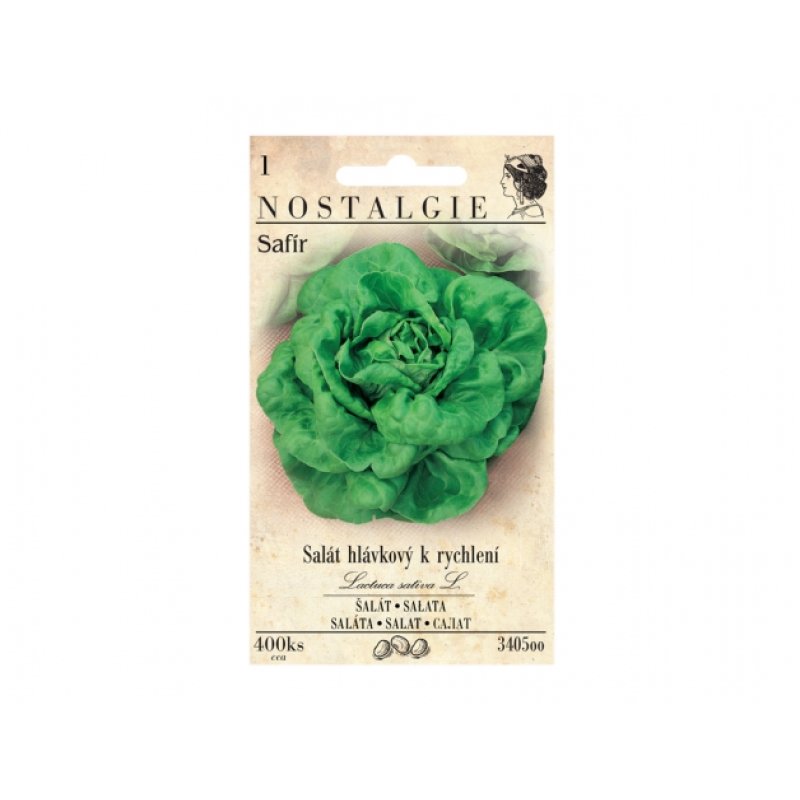
The Safír variety tolerates cooler conditions. It produces large heads with light green, slightly blistered leaves weighing 100 - 150 g. It excels in resistance to tip burn and downy mildew. The package contains 400 seeds.
 Wide range of quality products
Seeds, essential oils, growing supplies and exotic plants in one place
 Eco-friendly range
We prefer natural and gentle products
 Expert advice
We help you grow – guides, blog and personal support
 Delivery across the EU
PPL, DPD, GLS and local carriers – pickup point or home delivery
Lettuce is an annual plant that has been bred from wild lettuce. It is grown in both head and leaf forms with smooth, round, light green leaves. There are several types of this vegetable: romaine lettuce, semi-romaine lettuce, butterhead lettuce, leaf lettuce, and finally iceberg lettuce.
Head and leaf lettuce are the most commonly grown types. According to cultivation, they can be divided into early, summer, for greenhouse planting, heated greenhouses, outdoor, etc. Iceberg lettuce has firm, crisp leaves, and the head resembles cabbage. Romaine lettuce resembles Chinese cabbage. It is often considered by gourmets to be the tastiest lettuce. Iceberg lettuce is valued for its crispness and firm head. It is characterized by excellent taste and outstanding crispness.
Lettuces contain 10–15% protein, 15–27% carbohydrates, 3–6% fat, 9–12% fiber. They have a high content of vitamins C, E, A, and PP, and we must not overlook the content of potassium, calcium, phosphorus, chlorine, and magnesium. It has a minimal amount of calories, making it suitable for weight-loss diets. Head lettuce is suitable for classic preparation with sweet and sour dressing, or with fried bacon. Romaine lettuce can also be braised with meat, used in wraps, stuffing, risotto, etc. There are no limits to creativity.
A sunny location is suitable. During growth, water regularly - rather in smaller doses, more frequently. Regular weeding of the bed is necessary. Never grow plants in the same location for more than 2 years in a row. Mulching lettuce with organic material is recommended. It prevents weed growth, maintains moisture, and keeps temperatures lower during hot months.
Spring varieties are sown in February in a hotbed. In March or April, we transplant them at a spacing of 20–25×20–25cm.
Summer varieties are sown directly in the bed in April, the final plant spacing should be 25×30 cm.
Autumn varieties are sown directly in the bed in August, the final plant spacing should be 25×25 cm.
Overwintering varieties are sown directly in the bed in October.
We sow seeds directly into the soil approximately 1 cm below the surface. It is advisable to pre-soak the seeds. After emergence, plants must be thinned to the spacing mentioned above. When thinning, avoid covering the lettuce crown.
Lettuce requires well-drained soil with sufficient readily available nutrients. Soils should be lighter and well-worked.
Beds intended for lettuce cultivation must be well prepared. When preparing beds, work 3–5 kg of compost/m2 into the soil, lime with 3 kg of limestone/m2, and add 1.8 P2O5/m2 and 14g K2O/m2.
When fertilizing, it is important to be careful about nitrogen over-fertilization. Dangerous nitrates then accumulate in the leaves. Do not fertilize beds with farmyard manure!
Bacterial lettuce rot initially appears as sharply defined, dark blackening spots. The first lower leaves that are on the ground are affected.
Calcium deficiency is the cause of marginal leaf necrosis, which gradually turns brown and subsequently dies. The outer leaves are most often damaged in this way, but it can also be leaves hidden inside the formed heads. Treat with Champion 50 WP and disinfect the soil.
Downy mildew of lettuce appears especially on older leaves, where light green to yellow-green spots of various sizes form, often bounded by veins. The spots gradually enlarge, dry out, and necrotize. Treat with Rovral 50 WP or Rovral FLO.
Plants are also affected by grey mold and can be eaten by slugs or attacked by aphids.
Treat them with suitable preparations against fungal diseases. It is important to observe the protective period before consumption.
Leaf lettuce can be harvested as early as 7 weeks after sowing. Head lettuce after 10-11 weeks and romaine lettuce a week longer. Head, butterhead, romaine, and curly lettuce must be harvested whole as soon as they reach the desired size.
Data sheet
Specific References
Your review appreciation cannot be sent
Report comment
Report sent
Your report cannot be sent
Write your review
Review sent
Your review cannot be sent
The Safír variety tolerates cooler conditions. It produces large heads with light green, slightly blistered leaves weighing 100 - 150 g. It excels in resistance to tip burn and downy mildew. The package contains 400 seeds.
check_circle
check_circle