
 Our products
 Aromatherapy - essential oils
 Essential oils
 Aroma lamps
 Aroma Diffusers
 Seeds
 Vegetables
 Herbs and spices
 Ornamental Plant Seeds
 Grass mixtures
 Sprouts and microgreens
 Growing supplies
 Cultivation and Gardening Supplies
 Hydroponics and indoor growing
 Protective equipment and gardening tools
 Exotic plants
 Exotic Fruit and Vegetables
 Exotic herbs
 Exotic trees and shrubs
 Ornamental exotic plants
 Roasted coffee
 Espresso coffee
 Ecological coffee preparation
 Thermal mugs and coffee cups
 Aeropress
 Thermos flasks and thermal mugs for coffee and tea
 Moka pot
 Filter coffee
 Coffee blends
 Accessories for coffee makers
 Water filtration
 Coffee grinders
 Cleaning the Coffee Maker
 Ecological Cleaning of Coffee Machines
 Coffee makers
 Coffee Preparation
 Coffee Accessories
 Food products
 For wildlife and pets
 Chocolate and others
 Hemp food products
 Natural cosmetics
 Hemp cosmetics
 Smoking supplies
 Bongs - water pipes
 Blunts and tubes
 E-liquids with Terpenes and CBD
 Grinders and Mills
 Papers and filters
 Smoking accessories
 Vaporizers
 Air fresheners
 CBD and CBG products
 CBD sprays
 CBD and CBN crystals
 CBD body and facial care
 Weeds
 CBD suppositories and capsules
 CBD oils and drops
 CBG oils and drops
 House and garden
 Fashion and Decoration
 Kitchen essentials and cooking
 Christmas Decorations and Accessories
 Gift Sets
 Bird feeders
 Seasonal and Special Tools
Frankincense does not mean just one single scent. Different types of frankincense differ in origin, botanical name and the overall character of the aroma. Some are warmer and earthier, others fresher or gently citrusy. In this article we look at three well-known types of frankincense, their scent, origin and the atmosphere they most often suit. If you are choosing a frankincense oil for a diffuser, meditation or home rituals, this overview will make the choice easier.
In short: The term frankincense covers three main species of the genus Boswellia. Serrata smells warm, woody and earthy, frereana fresh, piney and slightly citrusy, and sacra from Oman softly balsamic with a citrus hint. For a diffuser, start with 1–2 drops; on the skin, always dilute the oil in a carrier oil.
| Boswellia serrata | Warm, woody, earthy and gently resinous scent – evening calm and relaxation |
|---|---|
| Boswellia frereana | Fresh, resinous, piney, slightly citrusy – meditation and concentration |
| Boswellia sacra (sacred frankincense) | Origin Oman, soft balsamic and slightly citrusy scent – quiet moments and rituals |
| Diffuser dosage | Start with 1–2 drops, only then add more if needed |
| Evening blend | 3 drops of lavender + 1 drop of frankincense + 1 drop of citrus oil |
| Use on the skin | Only diluted in a carrier oil, patch test beforehand |
Frankincense is among the best-known resinous scents in the world. But you may be surprised that there is not just one type of frankincense. The name frankincense covers several species of the genus Boswellia, which differ in place of origin, the character of the resin and the scent itself.
Some species feel warmer and earthier, others are softer, slightly citrusy or even freshly resinous. In practice this means that when choosing a frankincense oil, it also matters what atmosphere you want to create at home – whether you are looking for a calm evening hush, a meditative mood or a cleaner, uplifting scent for the room.
Contents
- What frankincense is and why there are several types
- The main types of frankincense and their differences
- Comparison of scent, origin and use
- How to choose frankincense according to the atmosphere you are looking for
- How to use frankincense oil safely
- In conclusion
- FAQ: the most common questions on the topic
What frankincense is and why there are several types
Frankincense is an aromatic resin obtained from trees of the genus Boswellia. It is from this resin that frankincense essential oil is subsequently made by gentle distillation. And because there are several species of Boswellia trees, there are also several types of frankincense.
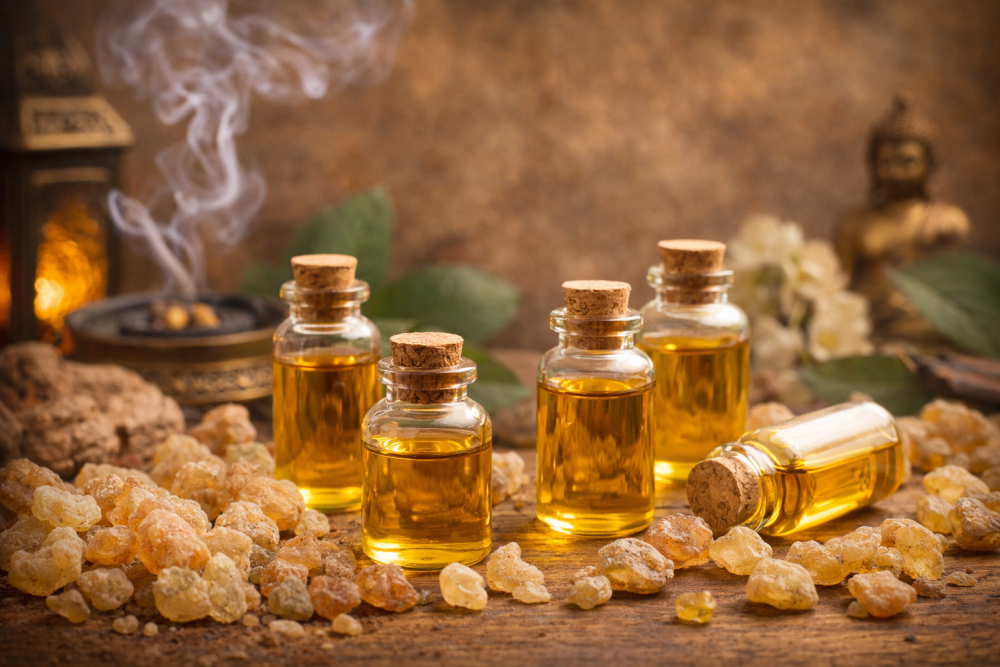
Each species grows in slightly different conditions, comes from a different region and has its own aromatic profile. Put simply: just as the scents of different citrus fruits or lavenders differ, so do the types of frankincense.
For millennia, frankincense has been associated with rituals, meditation, quiet reflection and a ceremonial atmosphere. In many cultures it held an exceptional position and was among the most valuable raw materials. It is therefore no wonder that its scent has also found a place in modern home aromatherapy.
The main types of frankincense and their differences
Well-known types of frankincense include, for example, Boswellia serrata, Boswellia frereana and Boswellia sacra. Each has a slightly different origin and a different scent profile.
Boswellia serrata: warm, woody and gently resinous frankincense
Boswellia serrata is a type of frankincense that is popular for its warm, earthy and gently balsamic scent. It feels calm and grounded and is often associated with evening quiet, home relaxation or meditation.
Its aroma tends to be fuller and more "grounding". If you like resinous scents with a woody base, this type may suit you most. It also works well in blends with lavender, bergamot or rose, where it adds depth to the composition.
Boswellia frereana: fresher frankincense with a slightly citrusy hint
Compared with other species, Boswellia frereana frankincense is often perceived as lighter and airier. The scent has resinous, piney and gently citrusy notes that feel cleaner and more uplifting.
That is precisely why some people choose it for a study, a meditation corner or wherever they want to combine calm with a light freshness. It is not as heavy as some other frankincense scents and tends to be pleasantly diffuse in a room.
In aromatherapy it combines well with cedar, elemi, lavender, myrrh or citrus. The resulting blend can feel cleaner and softer than with the classic deep resinous notes.
Boswellia sacra: sacred frankincense with a soft balsamic depth
Boswellia sacra is often referred to as sacred frankincense. This species is traditionally associated with Oman, a region that has for centuries been considered one of the most important for growing and processing quality frankincense.
Its scent is soft, balsamic-resinous and slightly citrusy. Compared with Boswellia serrata it feels smoother and gentler, but still keeps the depth typical of frankincense. It suits moments of concentration, meditation and calm home rituals.
Precisely because of its historical and cultural context, Boswellia sacra is perceived as a ceremonial and very noble type of frankincense. If you are looking for a scent for a quieter, contemplative atmosphere, it is a very interesting choice.
Comparison of scent, origin and use
To make the difference between the individual types of frankincense easier to see, a simple comparison will help. Take it as a practical cheat sheet for choosing.
| Type of frankincense | Botanical name | Origin | Scent character | Suits |
|---|---|---|---|---|
| Classic frankincense | Boswellia serrata | Somalia | Warm, woody, earthy, gently resinous | Relaxation, evening calm, home rituals |
| Frereana frankincense | Boswellia frereana | Somalia / Somaliland | Fresh, resinous, piney, slightly citrusy | Meditation, concentration, cleaner aromatic blends |
| Sacred frankincense | Boswellia sacra | Oman | Soft, balsamic, resinous, slightly citrusy | Meditation, quiet reflection, ceremonial and spiritual atmosphere |
How to choose frankincense according to the atmosphere you are looking for
When choosing frankincense, it is often not only about the botanical name but mainly about the feeling you expect from the scent. One type suits quiet evenings and another, say, meditation practice or gently scenting a workspace.
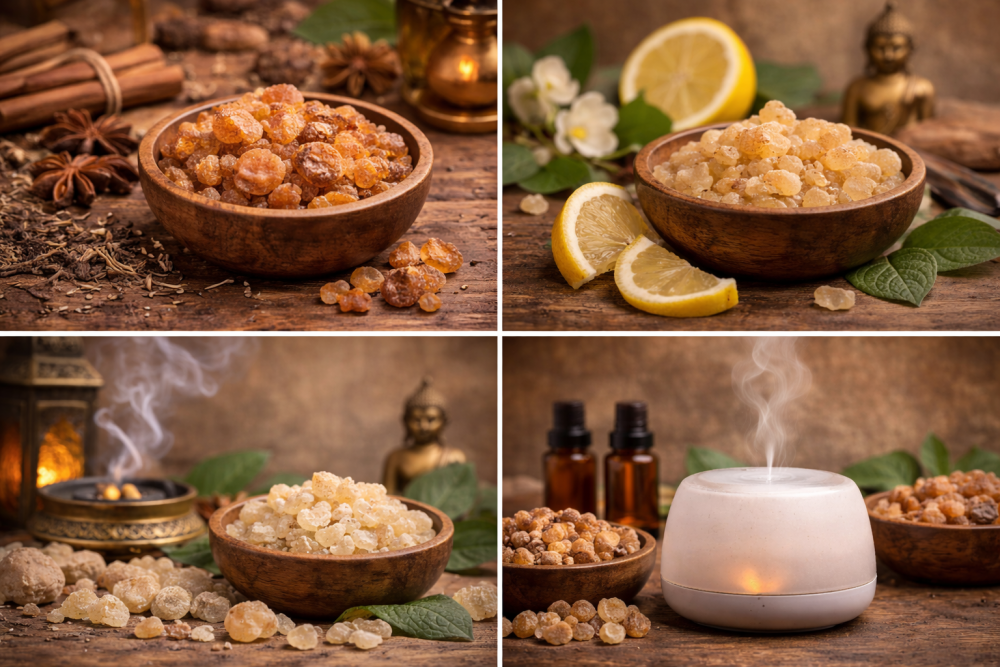
For calm evenings and home quiet time
If you are looking for a scent that feels warmer, grounded and calm, Boswellia serrata is often a pleasant choice. Its earthy-woody profile complements evening reading, rest or moments when you want to switch off your mind.
For a lighter meditative or focused atmosphere
If you like cleaner, somewhat fresher scents, Boswellia frereana may suit you better. Its slightly citrusy and piney hint feels airier and also works well where you do not want too heavy an aroma.
For ceremonial and spiritually tuned moments
For deeper quiet, meditation or a ritual atmosphere, Boswellia sacra is often a lovely choice. Sacred frankincense has a softness, depth and historical resonance that make it a very distinctive scent.
A simple checklist for choosing frankincense
- Do you prefer a warm and earthy scent? Reach for Boswellia serrata.
- Are you looking for a fresher, slightly citrusy frankincense? Boswellia frereana may appeal to you.
- Are you drawn to a soft, sacred-feeling scent with a tradition? Try Boswellia sacra.
- Planning blends for a diffuser? Consider whether you want a grounding scent or, on the contrary, a lightened one.
- If you are starting with frankincense, first use a smaller number of drops and notice how it affects you.
How to use frankincense oil safely
Whichever type of frankincense you choose, it is always good to bear safe use in mind. Frankincense essential oil is concentrated and is suitable mainly for aromatherapy, homemade blends or cosmetic use after correct dilution.
A small amount is usually enough for a diffuser. With more pronounced resinous scents, it often works well to start with 1–2 drops and only then add more if needed. External use on the skin is suitable only after dilution in a carrier oil and ideally after a patch test.
- do not apply essential oil undiluted directly to the skin,
- avoid contact with the eyes and mucous membranes,
- do not take it internally unless expressly instructed otherwise by a specialist,
- keep out of the reach of children,
- for sensitive skin, do a patch test before first use.
What frankincense combines well with
Frankincense is often combined with other scents depending on the impression you want to create. Blends with lavender for a calmer evening atmosphere, with cedar for more depth, or with bergamot and lemon for a lighter, fresher result are very popular.
Combinations with myrrh or sandalwood are also traditional and very interesting. These blends feel more ceremonial and are associated with meditative or ritual moments.
In conclusion
The types of frankincense differ more than they seem at first glance. The difference is not only in the botanical name but also in the scent, the origin and the overall impression they create in a room. That is precisely why it pays to choose a frankincense oil according to the atmosphere you are looking for at home.
Boswellia serrata will please lovers of warm, earthy and resinous notes. Boswellia frereana appeals with a fresher, cleaner character. And Boswellia sacra brings a soft, sacred-toned depth with a slightly citrusy hint.
If the scent of frankincense attracts you, this may be the ideal moment to try which type suits you most. Sometimes a few drops in a diffuser are enough to completely transform the atmosphere of your home.
What is in the bottle: origin, composition and conservation of the individual species
Scent is only half of the difference. The types of frankincense also differ chemically: a comparative study of 46 samples of resins and oils (Niebler and Buettner, 2016) showed that B. sacra, B. serrata, B. frereana and B. papyrifera can be reliably told apart by their volatile compounds. That is why the full botanical name on the label matters.
| Oil at Pěstík | Botanical name | Typical origin | Note |
|---|---|---|---|
| BIO Frankincense | Boswellia serrata | India | a Least Concern species according to the IUCN |
| BIO Frankincense Frereana | Boswellia frereana | northern Somalia (Somaliland) | resin locally called maydi |
| BIO Sacred Frankincense | Boswellia sacra (syn. B. carterii) | Oman, Yemen, Somalia | a Near Threatened species according to the IUCN |
Two things that are often confused:
- Boswellia carterii and Boswellia sacra are the same species. Carterii is an older synonym, used mainly for Somali frankincense. "Somali carterii" and "Omani sacra" therefore differ in origin, not in species.
- The essential oil does not contain boswellic acids. These substances are in the resin and in extracts from it, but they are not volatile and practically do not pass into the oil by distillation. Robert Tisserand sums it up by saying that at most traces are found in a normally distilled oil. The oil is a scent, not a substitute for resin extracts.
All frankincense oils consist mainly of monoterpenes, roughly 75–90% according to analyses. In B. sacra, α-pinene predominates, followed by α-phellandrene, limonene and myrcene. It is these substances that give frankincense its fresh, piney-citrus opening and at the same time determine how quickly the oil ages.
Oxidation, children and animals: what applies to all three species
Tisserand and Young state no dermal maximum or contraindication for frankincense, with one exception: do not use an oxidised oil. Monoterpenes oxidise in air and light, and an oxidised oil causes a skin allergy markedly more often.
- Close the bottle straight after use and store it in a cool, dark place.
- On the skin, use the oil within about 1 year of opening, in a diffuser and oil burner within 2 years.
- When the oil thickens, turns yellow or starts to smell sharp and turpentine-like, it no longer belongs on the skin.
- For the face, dilution of 1% (2 drops per 10 ml, 6 drops per 30 ml), for the body up to 2%.
- Children: do not use frankincense under 2 years. For older children, 1 drop in a blend in a diffuser; on the skin only dilution by age (2–6 years 0.5–1%, from 6 years up to 1%). The rules are summarised in the article essential oils and children.
- Pregnancy and breastfeeding: only briefly in a diffuser, on the skin after consulting a doctor. Beware of blends with myrrh: it is contraindicated in pregnancy.
- Cats: frankincense is rich in α-pinene, a substance typical of conifers, which are risky for cats. Do not diffuse in a room with a cat unless it can leave. See essential oils and pets.
Three blends in which the difference between the types is best smelled
- Serrata in the evening (oil burner): 2 drops of frankincense, 3 drops of lavender.
- Frereana for concentration (diffuser): 2 drops of Frereana frankincense, 2 drops of elemi, 1 drop of lemon.
- Sacred frankincense and wood (diffuser): 2 drops of sacred frankincense, 1 drop of myrrh, 2 drops of Himalayan cedar. Not in pregnancy because of the myrrh.
Sources for the addendum
- Niebler J., Buettner A.: Frankincense Revisited, Part I: Comparative Analysis of Volatiles in Commercially Relevant Boswellia Species, Chemistry & Biodiversity 2016 – PubMed 27012219
- Tisserand Institute: Does Frankincense oil contain boswellic acid? – tisserandinstitute.org
- AromaWeb: Frankincense Essential Oil (species, origin, safety) – aromaweb.com
- Tisserand R., Young R.: Essential Oil Safety, 2nd edition, Churchill Livingstone 2014, pp. 287–289.
Updated: 27 September 2026
FAQ: the most common questions on the topic
You might also be interested in: Gift tips: how to choose scent sets and essential oils for every occasion