
 Our products
 Aromatherapy - essential oils
 Essential oils
 Aroma lamps
 Aroma Diffusers
 Seeds
 Vegetables
 Herbs and spices
 Ornamental Plant Seeds
 Grass mixtures
 Sprouts and microgreens
 Growing supplies
 Cultivation and Gardening Supplies
 Hydroponics and indoor growing
 Protective equipment and gardening tools
 Exotic plants
 Exotic Fruit and Vegetables
 Exotic herbs
 Exotic trees and shrubs
 Ornamental exotic plants
 Roasted coffee
 Espresso coffee
 Ecological coffee preparation
 Thermal mugs and coffee cups
 Aeropress
 Thermos flasks and thermal mugs for coffee and tea
 Moka pot
 Filter coffee
 Coffee blends
 Accessories for coffee makers
 Water filtration
 Coffee grinders
 Cleaning the Coffee Maker
 Ecological Cleaning of Coffee Machines
 Coffee makers
 Coffee Preparation
 Coffee Accessories
 Food products
 For wildlife and pets
 Chocolate and others
 Hemp food products
 Natural cosmetics
 Hemp cosmetics
 Smoking supplies
 Bongs - water pipes
 Blunts and tubes
 E-liquids with Terpenes and CBD
 Grinders and Mills
 Papers and filters
 Smoking accessories
 Vaporizers
 Air fresheners
 CBD and CBG products
 CBD sprays
 CBD and CBN crystals
 CBD body and facial care
 Weeds
 CBD suppositories and capsules
 CBD oils and drops
 CBG oils and drops
 House and garden
 Fashion and Decoration
 Kitchen essentials and cooking
 Christmas Decorations and Accessories
 Gift Sets
 Bird feeders
 Seasonal and Special Tools
Rhaponticum carthamoides, also known as Maral root, is an undemanding decorative perennial that easily overwinters in your garden. It strikingly resembles a thistle, but offers far greater benefits than a weed.
In short: Maral root (Rhaponticum carthamoides) is a hardy, thistle-like perennial herb about 1.5 m tall, grown mainly for its root. Sow 2–4 seeds per hole 3–4 cm deep in March–April; they germinate from 5–6 °C. Dig up the root at the end of the third year and dry it at no more than 40–50 °C.
| Plant height | approx. 1.5 m |
|---|---|
| Sowing time | March–April, or autumn at the end of September |
| Sowing depth | 3–4 cm, 2–4 seeds per hole |
| Germination temperature | from 5–6 °C |
| Root harvest | end of the third year, autumn or early spring |
| Drying temperature | max. 40–50 °C |
The original homeland of Leuzea carthamoides is eastern Kazakhstan, Mongolia and the Baikal region. In its native territory, it can be found growing wild in meadows and forests, even at altitudes of 1200-2000 meters above sea level. This indicates a certain hardiness that Leuzea undoubtedly possesses. In our regions, it is often part of herb gardens. Other folk names by which Leuzea is known and widespread include maral root, rhapontica or safflower-leaved leuzea.
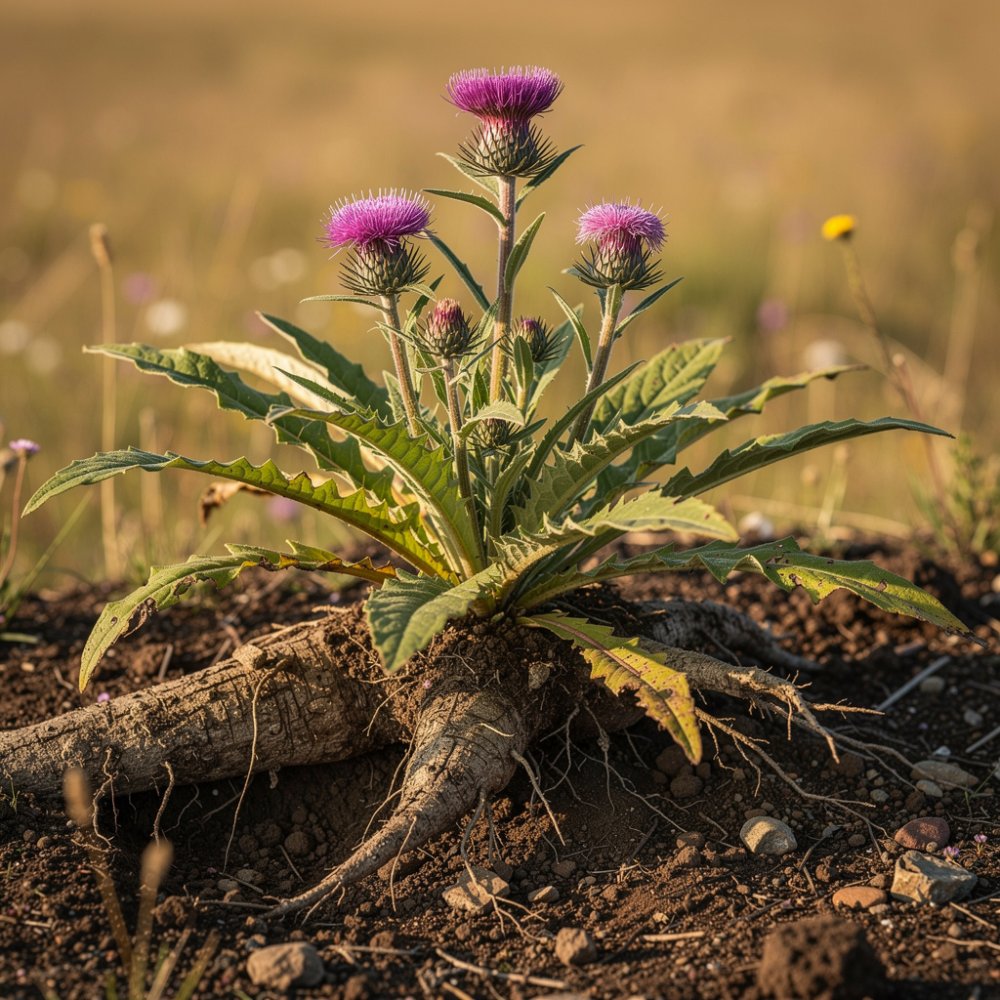
Its more well-known folk name maral root was introduced by Russian settlers in the Altai region. It comes from the fact that Siberian maral deer would dig up and feed on Leuzea roots during winter, especially during their rutting season. The root also helped them survive the harsh Siberian winter. In the past, the Tatars also used it in larger quantities as an aphrodisiac. According to preserved information, Leuzea root is used to treat up to 14 diseases. People in the past used its root elution to remove general fatigue and weakness. During winter, it was the main preparation for strengthening immunity.
How to grow Leuzea with ease
Safflower-leaved Leuzea (lat. Leuzea rhapontica) is a perennial, very hardy herb strikingly similar to thistle, which grows to a height of approximately 1.5 m. It belongs to the Asteraceae family. We grow it mainly for its root. It is not demanding in terms of soil selection; we sow seeds in loamy-sandy soil with a moderate content of humus and nutrients. Leuzea seeds germinate at temperatures as low as 5-6°C and we place them at a depth of approximately 3-4 cm, with 2-4 seeds per hole, ideally during March-April.
In some cases, we can also carry out autumn sowing (at the end of September); by winter, the seedling will grow 8-12 true leaves, thanks to which Leuzea survives the winter without harm. We can also pre-grow the Leuzea plant in a hotbed to accelerate its growth. It is demanding in terms of moisture, especially during the initial stages of seedling development. Throughout the entire growing season, we regularly loosen the soil and remove weeds from around the plant.
Safflower-leaved Leuzea is characterized by a thick stem and produces two types of leaves. Its basal leaves are cordate-ovate, undivided, grey on the underside and felted. In contrast, the stem leaves are sessile, bright green on the upper side and grey again on the underside. The Leuzea root is thick, 1-2 cm in diameter, interwoven with brown thin shoots that become woody with age. In the first year of Leuzea cultivation, the seedling creates a basal rosette of leaves. Subsequently, in spring, several upright stems (1-8 pieces) grow from the rosette, at the end of which flowers form. Leuzea stands out with its striking purple flower, which you will most often see from June to August. Its fruit is a brownish-grey ribbed achene.
The Root is Most Important
You can dig up the root at the end of the third year, ideally during autumn or very early spring. After digging, remove the soil and gently wash it. Long washing is not recommended as it removes the active compounds. Dry it in thin layers in a well-ventilated space, ideally at a maximum temperature of 40-50°C.
You can also collect younger and stem leaves, though they have milder effects than the root. Use gloves when harvesting. The medicinal effects work to harmonize the organism. It works very effectively on various post-operative conditions, has significant regenerative abilities and positively influences the overall state of the organism. It also supports the function of endocrine glands, protein metabolism, reduces cholesterol and blood sugar levels, supports digestion, eliminates loss of appetite, regulates menstrual cycles, increases potency and generally strengthens the function of sexual glands. It also improves brain function and the central nervous system, stopping physical and mental aging. Regular use positively affects heart muscle function, especially during rehabilitation after myocardial infarction, increases blood flow and mildly affects blood pressure values.
It plays an irreplaceable role in removing heavy metals, flushes toxins from the organism and breaks down alcohol. During cancer treatment, always consult your doctor before taking any supplements. Generally, its effects can be compared to ginseng. However, be careful with higher than recommended doses - it suppresses heart function and may cause unpleasant heart palpitations. The root contains biologically active substances that create physical and mental harmony and have an invigorating effect on the organism. We use products for a maximum of 1 month; cycles can be repeated 3-4 times a year. Always take before meals. Drink with plenty of fluids! Most commonly prepared as tea or tincture.
- Maral root tea is prepared by pouring 500ml of boiling water over 2 coffee spoons of home-grown and dried root mixture and leaving it to steep for 10 minutes, then strain. Drink this freshly prepared tea 2-3 times daily.
- Maral tincture: Soak 50g of dried chopped maral root in 40-60% alcohol. Leave this prepared mixture in a well-sealed bottle, shake the mixture periodically and strain after approximately two weeks. Take the tincture always before meals in amounts of 20-30 drops for a period of 3-4 weeks.
Summary in Conclusion
Rhaponticum or maral root is an undemanding decorative perennial that overwinters without problems in your garden. It is hardy and therefore can be found growing wild even at higher altitudes around 1500 meters above sea level. It bears a striking resemblance to our thistle, but unlike it, the surface of rhaponticum is soft and without thorns. Currently, it is a highly sought-after herb that increases the body's resistance. We collect its leaves and dig up its root, which has similar effects to the well-known ginseng. Rhaponticum has been used for hundreds of years, our grandmothers used it, and it will continue to be used in the future.