 Essential oils
 Aroma lamps
 Aroma Diffusers
 Vegetables
 Herbs and spices
 Ornamental Plant Seeds
 Grass mixtures
 Sprouts and microgreens
 Exotic Fruit and Vegetables
 Exotic herbs
 Exotic trees and shrubs
 Ornamental exotic plants
 Espresso coffee
 Ecological coffee preparation
 Thermal mugs and coffee cups
 Aeropress
 Thermos flasks and thermal mugs for coffee and tea
 Moka pot
 Filter coffee
 Coffee blends
 Water filtration
 Coffee grinders
 Cleaning the Coffee Maker
 Ecological Cleaning of Coffee Machines
 Coffee makers
 Coffee Preparation
 Coffee Accessories
 For wildlife and pets
 Chocolate and others
 Hemp food products
 Hemp cosmetics
 Bongs - water pipes
 Blunts and tubes
 E-liquids with Terpenes and CBD
 Grinders and Mills
 Papers and filters
 Smoking accessories
 Vaporizers
 Air fresheners
 CBD sprays
 CBD and CBN crystals
 CBD body and facial care
 Weeds
 CBD suppositories and capsules
 CBD oils and drops
 CBG oils and drops
 Fashion and Decoration
 Kitchen essentials and cooking
 Christmas Decorations and Accessories
 Gift Sets
 Bird feeders
 Seasonal and Special Tools

 Our products
 Aromatherapy - essential oils
 Seeds
 Growing supplies
 Cultivation and Gardening Supplies
 Hydroponics and indoor growing
 Protective equipment and gardening tools
 Exotic plants
 Roasted coffee
 Accessories for coffee makers
 Food products
 Natural cosmetics
 Smoking supplies
 CBD and CBG products
 House and garden

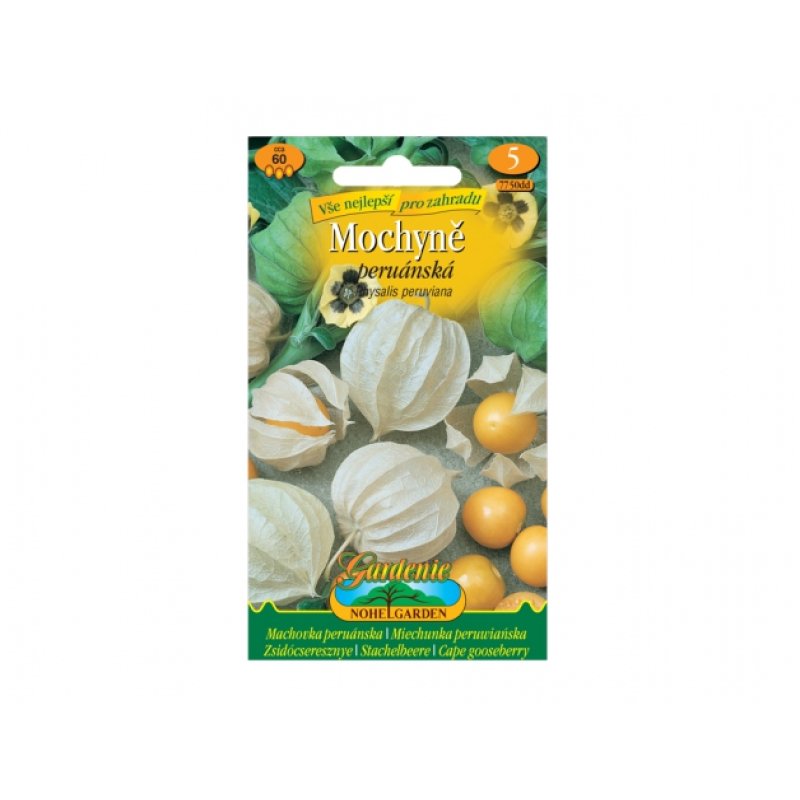
Peruvian groundcherry is grown primarily for its delicious fruits with high vitamin C content. The dried husks can be used in dried flower arrangements. The fruits have a beautiful canary yellow color. Their taste is very tangy, similar to pineapple.
 Wide range of quality products
Seeds, essential oils, growing supplies and exotic plants in one place
 Eco-friendly range
We prefer natural and gentle products
 Expert advice
We help you grow – guides, blog and personal support
 Delivery across the EU
PPL, DPD, GLS and local carriers – pickup point or home delivery
A perennial bedding plant with expansive growth. It reaches a height of 60 - 120 cm. Undemanding, easy to grow and propagate. In spring, it is adorned with inconspicuous flowers, later the flowers are replaced by inflated bladders, whose color transitions from green, through yellow to bright orange and red. The bladders closely resemble lanterns and conceal small spherical fruits that are red, orange, or yellow in color. Depending on the species of Physalis, the fruits may or may not be edible.
As mentioned above, there are over 100 species of Physalis. Among the most well-known is Cape gooseberry (P. peruviana), whose fruits are edible and have a pineapple-like flavor. Chinese lantern (P. alkekengi) is grown primarily as an ornamental plant. Tomatillo or Mexican husk tomato (P. ixocarpa) belongs to the annual Physalis species. Its fruits are edible and are cultivated in America as a vegetable.
The berries of edible Physalis have a piquant, sweet-sour, very refreshing taste. They contain small amounts of sugars, pectins, provitamin A and vitamin C. Among minerals, the content of potassium, phosphorus and calcium is significant. The fruits can be made into jams, sauces, and can also be consumed raw or stewed with honey. Chinese lantern is among the most sought-after ornamental plants. Its lanterns can be used for various creative activities. The lanterns can be made into dried arrangements for a vase, or they can be stripped and incorporated into autumn wreaths, or peeled to create little stars that can be placed in a bowl as decoration. However, the greatest advantage of Physalis is their rapid growth.
Plants require a sunny to partially shaded location. Water plants as needed. In our conditions, it is grown as an annual. It grows very vigorously. Therefore, carefully consider where to plant it. There is a risk that it will suppress other plants in the bed.
Sow seeds in March to April in special substrate intended for sowing and propagation. Plant mature seedlings in their final location only in May after the last frost. For one plant, it is advisable to leave a space of approximately 0.5 x 0.5 m.
Chinese lantern does not require any special soil. The most suitable is nutritious, permeable, moist substrate with a slightly alkaline reaction.
Cape gooseberry requires deeply worked humus-rich soil.
Plants do not need additional fertilization in nutritious soils, especially Chinese lantern. Cape gooseberry requires fertilization every 14 days in liquid form with complete NPK fertilizer. It is suitable to choose, for example, Cererit or Kristalon - fruit and flower.
Plants are not attacked by any pests or birds.
Cape gooseberry is harvested from September to October. Their ripeness can be recognized by the brownish color of the lantern. They are picked with the calyx, which must be removed after harvest to prevent the fruits from becoming bitter.
Chinese lantern intended for decoration is harvested as needed. It can be dried in a warm, dark and airy room.
Data sheet
Specific References
Your review appreciation cannot be sent
Report comment
Report sent
Your report cannot be sent
Write your review
Review sent
Your review cannot be sent
Peruvian groundcherry is grown primarily for its delicious fruits with high vitamin C content. The dried husks can be used in dried flower arrangements. The fruits have a beautiful canary yellow color. Their taste is very tangy, similar to pineapple.
check_circle
check_circle