 Essential oils
 Aroma lamps
 Aroma Diffusers
 Vegetables
 Herbs and spices
 Ornamental Plant Seeds
 Grass mixtures
 Sprouts and microgreens
 Exotic Fruit and Vegetables
 Exotic herbs
 Exotic trees and shrubs
 Ornamental exotic plants
 Espresso coffee
 Ecological coffee preparation
 Thermal mugs and coffee cups
 Aeropress
 Thermos flasks and thermal mugs for coffee and tea
 Moka pot
 Filter coffee
 Coffee blends
 Water filtration
 Coffee grinders
 Cleaning the Coffee Maker
 Ecological Cleaning of Coffee Machines
 Coffee makers
 Coffee Preparation
 Coffee Accessories
 For wildlife and pets
 Chocolate and others
 Hemp food products
 Hemp cosmetics
 Bongs - water pipes
 Blunts and tubes
 E-liquids with Terpenes and CBD
 Grinders and Mills
 Papers and filters
 Smoking accessories
 Vaporizers
 Air fresheners
 CBD sprays
 CBD and CBN crystals
 CBD body and facial care
 Weeds
 CBD suppositories and capsules
 CBD oils and drops
 CBG oils and drops
 Fashion and Decoration
 Kitchen essentials and cooking
 Christmas Decorations and Accessories
 Gift Sets
 Bird feeders
 Seasonal and Special Tools

 Our products
 Aromatherapy - essential oils
 Seeds
 Growing supplies
 Cultivation and Gardening Supplies
 Hydroponics and indoor growing
 Protective equipment and gardening tools
 Exotic plants
 Roasted coffee
 Accessories for coffee makers
 Food products
 Natural cosmetics
 Smoking supplies
 CBD and CBG products
 House and garden

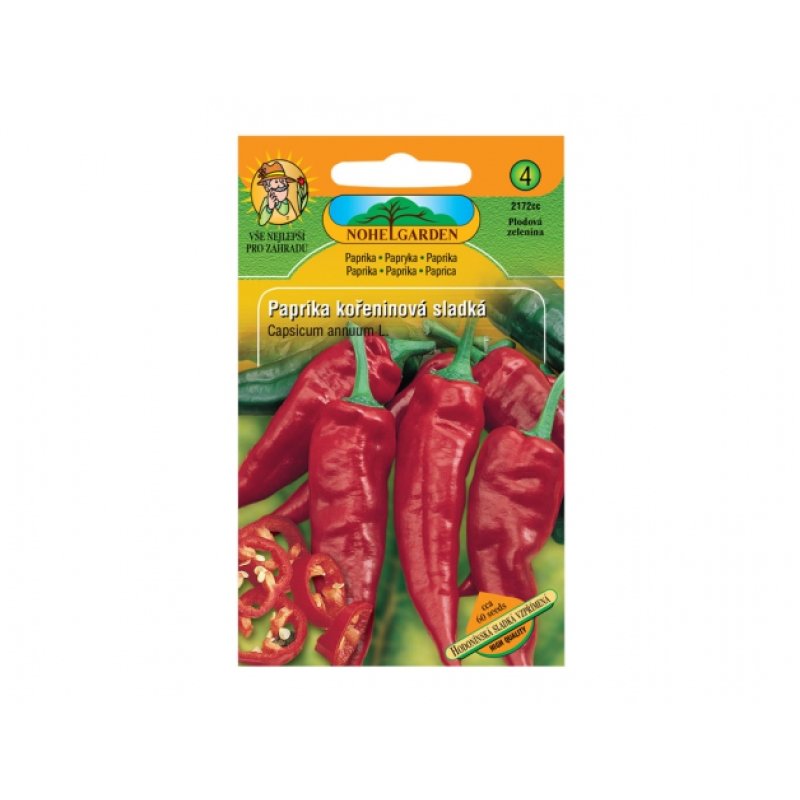
Spice pepper designed for drying. The fruits are slender at botanical maturity, dark red in color with very uniform ripening.
 Wide range of quality products
Seeds, essential oils, growing supplies and exotic plants in one place
 Eco-friendly range
We prefer natural and gentle products
 Expert advice
We help you grow – guides, blog and personal support
 Delivery across the EU
PPL, DPD, GLS and local carriers – pickup point or home delivery
A perennial plant originally from Mexico. In cultivation, it is grown as an annual and can reach a height of 0.5–1.5 m. It has alternately arranged lanceolate leaves. The flowers are white and pentamerous. The fruit is a pod, whose natural color is red. About three thousand varieties of peppers are cultivated, both sweet and hot. The heat is caused by the alkaloid capsaicin. It was first grown as an ornamental plant. Its use as a spice or vegetable came later. Today, two main types of peppers are primarily used. The first is the annual pepper (Capsicum annuum). Another pepper widely used for spice production are varieties of the species Capsicum frutescens, referred to as chili. In general, however, peppers are divided into six groups: pointed peppers (Hungarian type), bell peppers, cherry peppers, kapia peppers, bull's horn and ram's horn peppers, and spice peppers or chili.
Peppers contain plenty of potassium, phosphorus and sodium and are, among others, a significant source of vitamin C, U and carotene. Vegetable varieties are used fresh, in salads or in cold and hot cuisine. Spice varieties are excellent spicy seasoning! Peppers have wide applications, they can be heat-treated, eaten cold, are suitable for preparing salads, Asian dishes or for pickling. They are a great supplement for diets.
Requires a warm, sunny, sheltered location. The optimal temperature range during the growing season is 18–23°C. Temperatures below 14 and above 30°C are extreme and not suitable for peppers. We plant peppers 2 next to each other. Peppers should be tied up progressively. Ideal is to attach the plant to a leading stake both at the lower part of the plant and at the upper part. Regular watering and weeding around the plants is important. Under no circumstances should we water or spray in direct sunlight, because we would burn them. In a polytunnel or greenhouse, peppers will also grow much faster, mainly thanks to temperature and humidity. We regularly check peppers to see if they are attacked by pests or showing signs of physiological or fungal diseases.
We sow peppers from January at the latest until the end of March. To make sowing easier, we can plant them in peat jiffy pellets. If we choose planting in substrate, it should contain perlite mixed in a suitable ratio with nutrient-rich soil. So we can use special substrate for sowing, which we mix with perlite or sand. We plant seeds approximately 1 cm deep. We treat planted seeds with Previcur, thus ensuring protection against damping off of seedlings. The temperature must be around 25 degrees Celsius. Air humidity should not change for proper seedling growth. Seedlings need plenty of light so they don't stretch. When at least two leaves appear on small plants, it's time to transplant them into a pot. Plants with root ball are pricked out to permanent location at spacing of 60–70 cm x 25–40 cm.
Peppers require humus-rich, nutritious soil with sufficient available soil water and pH in the range of 6.5–7.5.
Basic fertilization is to incorporate into the soil where we will plant peppers, matured cow manure or alternatively compost. We carry out this fertilization in autumn. In autumn we also lime the area with a dose of approximately 3.6 kg/m2 of ground limestone or 2 kg/m2 depending on the soil at the location. Before planting, it is advisable to incorporate into the soil 50 – 70 g/m2 of NPK fertilizer with a higher nitrogen content. During the growing season, we then fertilize with water-soluble NPK fertilizer - Cererit, Kristalon. It is important that the water-soluble fertilizer also contains microelements! We apply fertilizer every 14 days.
Peppers are attacked by sucking pests such as aphids, whiteflies, or spider mites. For protection we can use Mospilan, Decis Mega or Symphony from Natura.
In high air humidity, fruits can be attacked by molds and fungi. The most well-known fungal diseases are gray and white rot. A suitable preparation for protection against these fungal diseases is Ortiva.
Bacterial spot of pepper plants is dangerous. Necrotic fruits affected by this spotting usually crack and are destroyed. Various colored spots especially on fruits are caused by bacterial disease called bronze spot. In case of these plant infestations, the best method is their elimination.
Lack of calcium in the soil, irregular irrigation, or presence of potassium in the soil causes physiological disorders. These deficiencies can manifest as disorders of fruits, leaves, flowers, which are often mistaken for fungal disease. In case the plants are affected by necrosis, we maintain even irrigation, sufficient nutrition and treat them, for example, with effective calcium chloride or special foliar fertilizer.
Peppers grown for green fruits are harvested already in mid-July. Red or yellow fruits are harvested at the end of August and in September. Spice peppers (chili) are harvested in autumn, if grown outdoors or in a greenhouse.
Data sheet
Specific References
Your review appreciation cannot be sent
Report comment
Report sent
Your report cannot be sent
Write your review
Review sent
Your review cannot be sent
Spice pepper designed for drying. The fruits are slender at botanical maturity, dark red in color with very uniform ripening.
check_circle
check_circle