 Essential oils
 Aroma lamps
 Aroma Diffusers
 Vegetables
 Herbs and spices
 Ornamental Plant Seeds
 Grass mixtures
 Sprouts and microgreens
 Exotic Fruit and Vegetables
 Exotic herbs
 Exotic trees and shrubs
 Ornamental exotic plants
 Espresso coffee
 Ecological coffee preparation
 Thermal mugs and coffee cups
 Aeropress
 Thermos flasks and thermal mugs for coffee and tea
 Moka pot
 Filter coffee
 Coffee blends
 Water filtration
 Coffee grinders
 Cleaning the Coffee Maker
 Ecological Cleaning of Coffee Machines
 Coffee makers
 Coffee Preparation
 Coffee Accessories
 For wildlife and pets
 Chocolate and others
 Hemp food products
 Hemp cosmetics
 Bongs - water pipes
 Blunts and tubes
 E-liquids with Terpenes and CBD
 Grinders and Mills
 Papers and filters
 Smoking accessories
 Vaporizers
 Air fresheners
 CBD sprays
 CBD and CBN crystals
 CBD body and facial care
 Weeds
 CBD suppositories and capsules
 CBD oils and drops
 CBG oils and drops
 Fashion and Decoration
 Kitchen essentials and cooking
 Christmas Decorations and Accessories
 Gift Sets
 Bird feeders
 Seasonal and Special Tools
- Out of stock

 Our products
 Aromatherapy - essential oils
 Seeds
 Growing supplies
 Cultivation and Gardening Supplies
 Hydroponics and indoor growing
 Protective equipment and gardening tools
 Exotic plants
 Roasted coffee
 Accessories for coffee makers
 Food products
 Natural cosmetics
 Smoking supplies
 CBD and CBG products
 House and garden


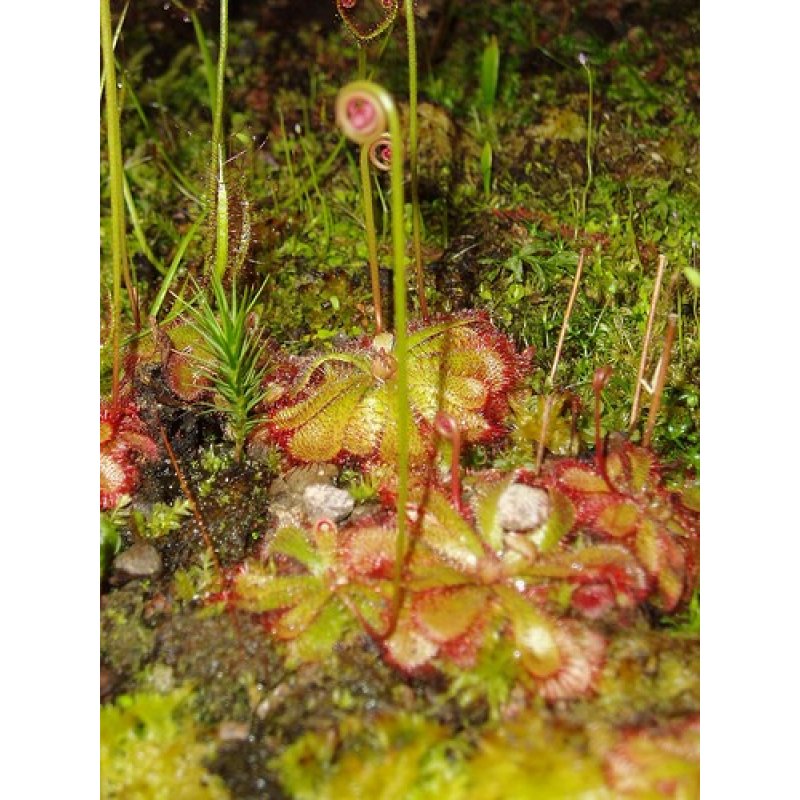
South African tropical sundew. In terms of cultivation, it ranks among the least demanding sundews. Suitable for beginners. Package contains 30 seeds.
 Wide range of quality products
Seeds, essential oils, growing supplies and exotic plants in one place
 Eco-friendly range
We prefer natural and gentle products
 Expert advice
We help you grow – guides, blog and personal support
 Delivery across the EU
PPL, DPD, GLS and local carriers – pickup point or home delivery
Sundews (genus Drosera) are perhaps the most well-known carnivorous plants. They are small plants with a basal rosette of leaves. The leaves are dewy, mostly circular. The main prey of these plants is small or larger insects - mosquitoes, flies, gnats, beetles and butterflies. They attract prey with the sparkle of droplets and some species even secrete a honey-like scent. They can be divided into two basic types: tropical sundews and overwintering sundews. Tropical sundews grow year-round, have no winter dormancy period, and are therefore the most suitable choice for beginner growers. They inhabit favorable biotopes in tropical and subtropical areas where they have constant moisture and light. These include sundews: Drosera adelae, Drosera aliciae, Drosera capensis, Drosera capillaris, Drosera collinsiae, Drosera dielsiana, Drosera petiolaris (paradoxa, lanata, falconeri, ordensis), Drosera prolifera, Drosera schizandra, Drosera spathulata.
Overwintering sundews survive periods unfavorable for vegetation in the form of overwintering buds, or greatly restrict their growth. They grow mainly in the temperate climate zone of the northern parts of Europe, Asia and America, and in mountainous areas of Australia, Tasmania and New Zealand. They usually tolerate frost and are often under a layer of snow during winter. These include species Drosera rotundifolia, D. anglica, D. intermedia, D. arcturi, D. filiformis, D. linearis, D. stenopetala, D. binata and others.
There are also pygmy sundews, which grow mainly in southwestern Australia, in areas with warm, dry summers and cool, wet winters. They differ from other sundews in the formation of vegetative propagating bodies - gemmae. Gemmae are stunted leaf bases bearing an embryo of a new plant at the base. These include, for example, Drosera androsacea, Drosera barbigera, Drosera callistos, Drosera citrina, Drosera closterostigma, Drosera dichrosepala, Drosera echinoblastus, Drosera enneaba, Drosera grievei or Drosera helodes.
Tuberous sundews occur mainly in southwestern Australia in open shrublands and forests. They are among the more demanding for cultivation.
Sundews require primarily sufficient lighting. Species from higher altitudes require rather cooler climates and good ventilation. Lowland species require warmth and higher air humidity. Year-round maintained room temperature - summer 20-35°C, winter from 10°C to 18°C. Some species need sufficient ventilation. Pots can stand in water (about 2-3 cm) throughout spring and summer. During winter we reduce watering so that the substrate is only moist, but it must never dry out. We start watering again in spring. It is best to water with rainwater or alternatively distilled water. Higher air humidity benefits the plants - approximately 40% - 80%. We repot plants annually or once every few years, preferably in spring. If we cannot provide enough light for the plants, this problem can be solved with a UV lamp.
TROPICAL SUNDEWS (Drosera capensis, Drosera aliciae, Drosera capillaris, Drosera spathulata, Drosera dielsiana, Drosera collinsiae)
We sow seeds on wet peat. The peat must be without adjusted pH. Suitable is peat from the manufacturer Agro-Torf (pH up to 5.5). In the selected sowing container, place a layer of peat approximately 5 cm high, which we thoroughly water so that it is moist. We sow seeds on the surface of the substrate, they germinate in light. It must never dry out, so it is good to cover it with a piece of glass or plastic bag. Place it in a bright spot at room temperature. Do not place the seed container in the sun, as this could burn the seedlings. Seeds germinate between 14 days and 1 month. After seed germination, it is possible to start carefully ventilating the seedlings. The seedlings must always stand in a tray with water. After about 2-3 months we can transplant the plants into growing substrate made from a mixture of peat and sand. You can recognize thriving plants by the abundant dew on their leaves.
SUNDEWS WITH OVERWINTERING BUDS Drosera binata, Drosera filiformis, Drosera rotundifolia, Drosera anglica, Drosera intermedia
We perform sowing in the same way. The difference is that the sown seeds must go through a winter dormancy period. So we place them in the refrigerator for about 1 month, where we maintain a temperature of about 4 degrees Celsius. Remember that in autumn the plants enter winter dormancy. The temperature must be reduced to about 10°C. Not as much light is needed because the plants have no assimilation leaves. In spring we monitor the plants and place them back in the light and gradually increase watering.
Sundews require a mixture of peat with silica sand in a ratio of 2-1:1. The mixture or peat can also be combined with perlite. At the bottom of the pot, it is advisable to place a drainage layer of expanded clay 2-3 cm high.
We do not fertilize plants with artificial fertilizers. To supplement essential nutrients, we feed plants with small insects. These must come into contact with the sticky tentacles.
Most commonly, plants are attacked by aphids and scale insects (more often during outdoor cultivation). When attacked by, for example, aphids, it is necessary to intervene immediately and eliminate the pest either mechanically or by spraying (e.g. FastK - aphid spray, etc.). Always keep in mind that chemical sprays will burn the delicate sticky hairs on the leaves.
Fungal diseases attack only stressed plants that do not have suitable growing conditions. High air humidity causes mold on leaves and in the plant rosette.
Data sheet
Your review appreciation cannot be sent
Report comment
Report sent
Your report cannot be sent
Write your review
Review sent
Your review cannot be sent
South African tropical sundew. In terms of cultivation, it ranks among the least demanding sundews. Suitable for beginners. Package contains 30 seeds.
check_circle
check_circle