
 Our products
 Aromatherapy - essential oils
 Essential oils
 Aroma lamps
 Aroma Diffusers
 Seeds
 Vegetables
 Herbs and spices
 Ornamental Plant Seeds
 Grass mixtures
 Sprouts and microgreens
 Growing supplies
 Cultivation and Gardening Supplies
 Hydroponics and indoor growing
 Protective equipment and gardening tools
 Exotic plants
 Exotic Fruit and Vegetables
 Exotic herbs
 Exotic trees and shrubs
 Ornamental exotic plants
 Roasted coffee
 Espresso coffee
 Ecological coffee preparation
 Thermal mugs and coffee cups
 Aeropress
 Thermos flasks and thermal mugs for coffee and tea
 Moka pot
 Filter coffee
 Coffee blends
 Accessories for coffee makers
 Water filtration
 Coffee grinders
 Cleaning the Coffee Maker
 Ecological Cleaning of Coffee Machines
 Coffee makers
 Coffee Preparation
 Coffee Accessories
 Food products
 For wildlife and pets
 Chocolate and others
 Hemp food products
 Natural cosmetics
 Hemp cosmetics
 Smoking supplies
 Bongs - water pipes
 Blunts and tubes
 E-liquids with Terpenes and CBD
 Grinders and Mills
 Papers and filters
 Smoking accessories
 Vaporizers
 Air fresheners
 CBD and CBG products
 CBD sprays
 CBD and CBN crystals
 CBD body and facial care
 Weeds
 CBD suppositories and capsules
 CBD oils and drops
 CBG oils and drops
 House and garden
 Fashion and Decoration
 Kitchen essentials and cooking
 Christmas Decorations and Accessories
 Gift Sets
 Bird feeders
 Seasonal and Special Tools
How many drops of essential oil for a diffuser or oil burner is just right? A practical, clear guide that tells you how many drops for a diffuser and how many drops for an oil burner according to the type of device and the size of the room. It includes a dosage table, tips on how long to diffuse, what to do when a room is "over-scented" and how to adjust the dosage for children.
In short: For an ultrasonic diffuser, use 2–4 drops in a small room (10–15 m²), 4–6 drops in a medium one and 6–8 drops above 26 m². An oil burner needs 2–5 drops, a nebuliser 1–2. For children, 1–3 drops and short blocks of 10–20 minutes. Always start with the lower dose and add one drop at a time.
| Ultrasonic diffuser | 2–4 drops (10–15 m²), 4–6 drops (16–25 m²), 6–8 drops (26+ m²) |
|---|---|
| Nebuliser (no water) | 1–2 drops in a small room, 3–4 drops in a larger one, short cycle |
| Oil burner | 2–3 drops (small), 3–5 drops (medium), 5–7 drops (larger) |
| Children | diffuser 1–3 drops, oil burner 1–2 drops; sensitive children 1–2 drops and 1 drop respectively |
| Diffusing time | normally 20–30 minutes, then a break; children 10–20 minutes, sensitive ones 5–15 minutes |
| Fine-tuning the intensity | wait 10–15 minutes, then add one drop at a time |
How many drops of essential oil for a diffuser or oil burner is "just right"? You may know the feeling: sometimes the scent is barely noticeable, other times it is far too much. Instead of comfort, you feel the flat is "over-scented". In our article you will find a simple and practical guide to how many drops of essential oil for a diffuser and how many drops for an oil burner usually make sense. We have also added a clear table by device type and room size, and tips on how to adjust the dosage for children (and why it pays to always start more cautiously with them).
We will also show you how long to diffuse, what to do if you "overdo" the scent, and what the most common mistakes in practice are. All in plain language, clearly and safely – so that aromatherapy brings joy at home, not worry.
Contents
- Quick dosage (rough overview)
- How many drops for a diffuser (ultrasonic, nebuliser)
- How many drops for an oil burner
- How to adjust the dosage for children
- How long to diffuse and when a break is enough
- How to tell it is "too much"
- The most common mistakes and quick fixes
- Frequently asked questions (FAQ)
- In conclusion: fewer drops, more comfort
Quick dosage (rough overview)
Did you know that the right amount is often not about putting in as many drops as possible? In aromatherapy, gentleness usually wins. The scent should develop pleasantly, not "overpower" you.
A basic rule that works almost always: start with a smaller amount and give it a few minutes. If the scent is weak, add one drop at a time. In practice you will often find that less is enough than you expected.
Clear table: how many drops for a diffuser and how many for an oil burner
The table below is a simple guide for an ordinary home. If you have an open-plan space (kitchen + living room), treat it as a medium size and add slowly.
| Device | Small room (10–15 m²) | Medium (16–25 m²) | Larger (26+ m²) |
| Ultrasonic diffuser (water + mist) | 2–4 drops | 4–6 drops | 6–8 drops |
| Nebuliser (no water, more intense) | 1–2 drops / short cycle | 2–3 drops / short cycle | 3–4 drops / short cycle |
| Oil burner (bowl with water, candle) | 2–3 drops | 3–5 drops | 5–7 drops |
Take the dosage as a rough guide. It depends on the type of device, the size of the room and how sensitive your sense of smell is. Some oils are pronounced even in a small dose (e.g. mint, eucalyptus, cinnamon). Others feel gentler and "lighter" – often citrus, lavender or geranium.
How many drops for a diffuser (ultrasonic, nebuliser)
When working out how many drops of essential oil for a diffuser, the first step is to find out the type of device. The same oil can be perceived completely differently in different diffusers.
Most often you will come across an ultrasonic diffuser (oil + water) and a nebuliser (oil without water; sometimes also called a nebulising diffuser). An ultrasonic one tends to be gentler, a nebuliser more intense.
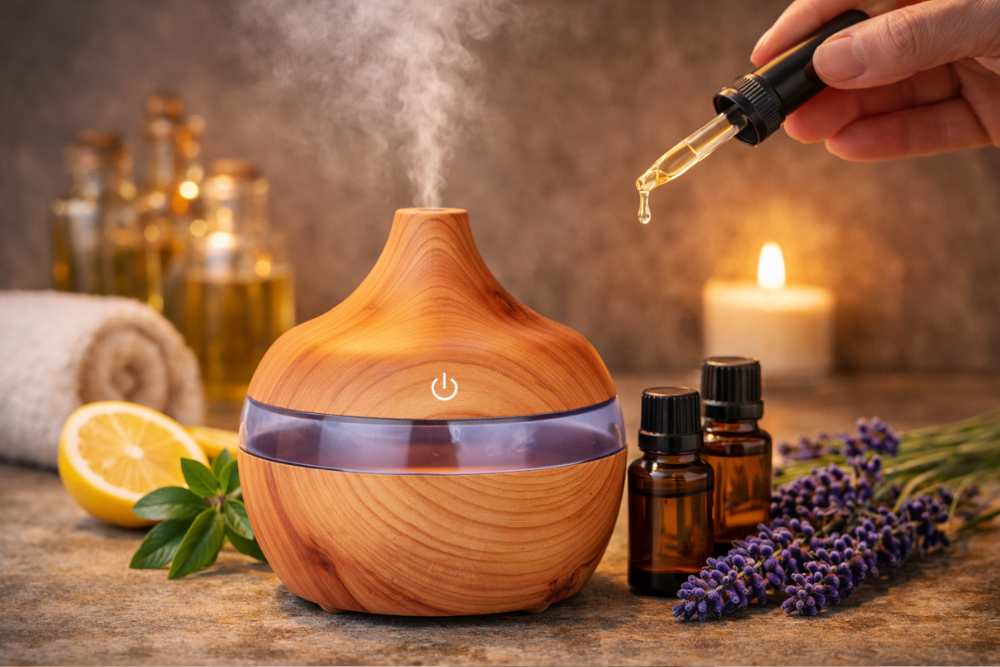
Ultrasonic diffuser: the most convenient choice for an ordinary home
An ultrasonic diffuser is great for everyday comfort. The scent is released gradually and is usually not as sharp. It also suits places where scents change with your mood – citrus in the morning, something gentler in the evening.
Do you have a tank of roughly 100–200 ml? For a medium room, a pleasant start is 4–6 drops. If the scent seems weak to you, add one at a time. This small fine-tuning is completely normal.
If you like to tune scents or want to try a combination of several oils, it helps to know a few basic rules. You will find inspiration in the article: How to combine essential oils: simple and safe blends.
Nebuliser: fewer drops, shorter time
A nebuliser can be "powerful". It is a bit like a perfume spray – a little is enough and the effect is noticeable straight away. That is exactly why it pays to start really cautiously.
Start with 1–2 drops and a short mode (a few minutes). If it is pleasant, extend the time or add one drop. With a nebuliser, more drops are often not needed, rather a smarter mode.
How many drops for an oil burner
With an oil burner, two things come up most often: how many drops for an oil burner and how to prevent the water from boiling away. And water is the basis here. Without it, the scent is often sharper and less pleasant.
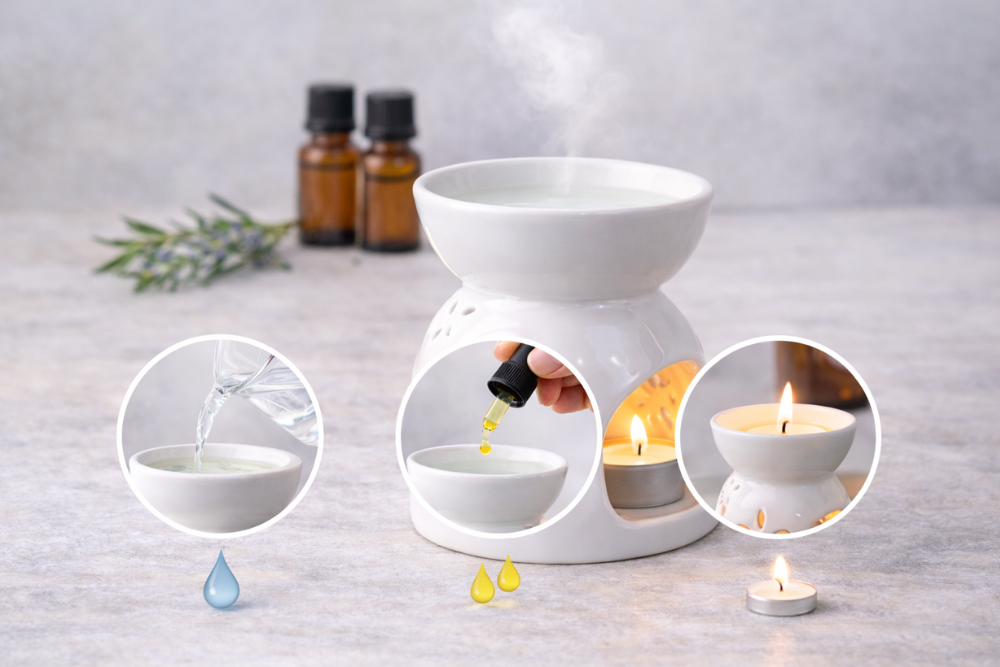
The procedure is simple. First put warm water (not boiling) into the bowl and only then add the oil. If in doubt, start with 2 drops. An oil burner can be surprisingly intense, especially in a smaller room.
If you feel the scent is too strong, do not add more water all at once. Rather put out the candle, air the room and use one drop fewer next time.
Practical step-by-step procedure
- Pour warm water into the bowl (up to about 2/3).
- Add 2–5 drops depending on the size of the room.
- Light a tea light and watch the intensity during the first minutes.
- As the water level drops, top it up.
How to adjust the dosage for children
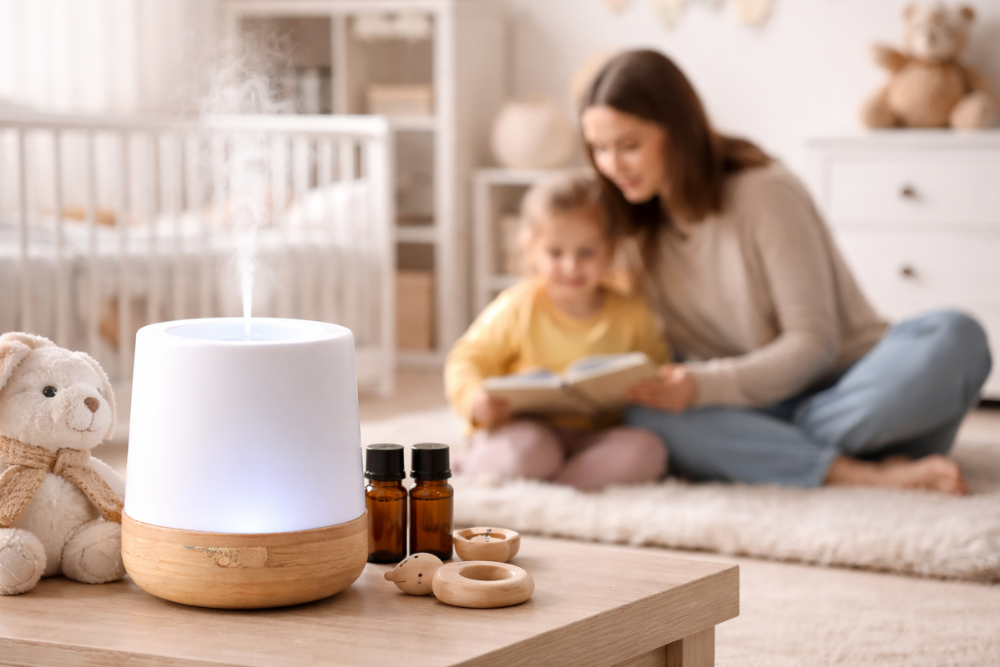
For children, a simple sentence applies: less is more. A child's sense of smell is more sensitive and sometimes a hint of scent is enough. It is often nicer to briefly scent a shared room than to diffuse for a long time in the children's room.
In general, it pays to choose gentler scents, a lower dosage and a shorter diffusing time. If you want a broader context, our articles Safe use of essential oils and also Essential oils and babies: what is really safe and when it is better not to follow on from this topic.
Rough dosage for children (general guide)
Take this as a simple guide for ordinary households. If the child is sensitive to scents, start even lower and watch the reaction.
| Group | Ultrasonic diffuser | Oil burner | Duration |
| Children (in general) | 1–3 drops | 1–2 drops | 10–20 min, then a break |
| Sensitive children | 1–2 drops | 1 drop | 5–15 min, then a break |
Recommendation: If any discomfort appears (e.g. burning in the nose, headache or nausea), immediately turn the scent down or switch it off and air the room.
With the youngest, extra caution is always appropriate. If you are not sure, choose minimal intensity and short blocks. Sometimes it is enough to briefly scent another room and merely air the children's room.
If you are interested in which scent combinations are often used in the evening with children, you can get inspired by the article Aromatherapy blends: the key to calm sleep for children.
How long to diffuse and when a break is enough
A common mistake is letting the diffuser run for a long time without a break. The scent can then be tiring even if it is otherwise lovely. Sometimes a short scented moment is all you need.
That is exactly why short blocks prove their worth in practice: diffuse for a while, then take a break or air the room. It is simple and often more pleasant than letting the diffuser run non-stop for several hours.
- Ordinary home: 20–30 minutes, then a break (or ventilation).
- Before bed: a shorter time and gentler intensity.
- Smaller room: fewer drops + a shorter time.
How to tell it is too much
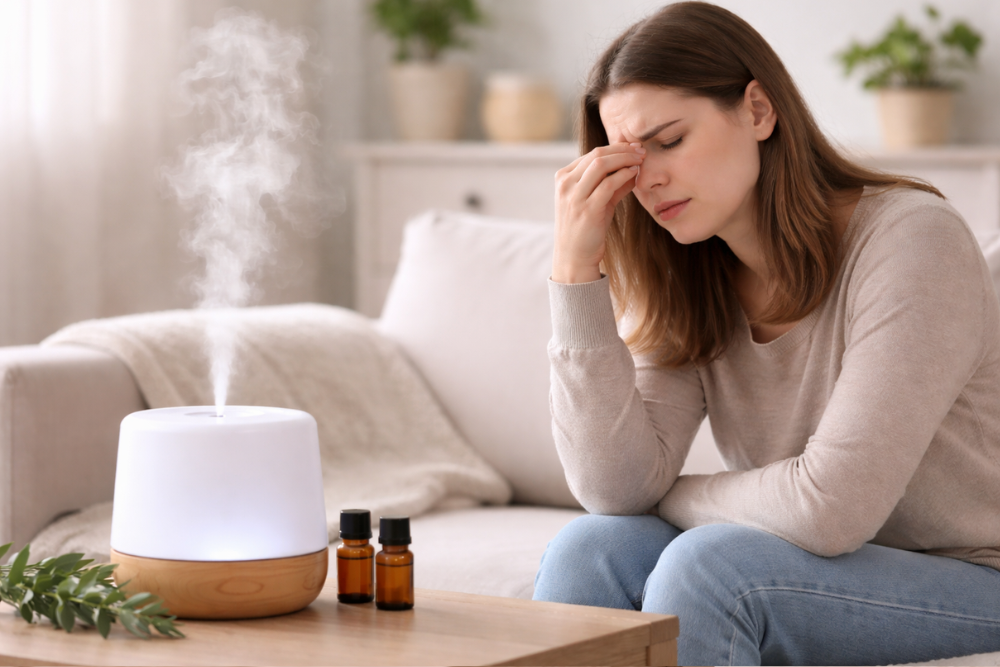
Did you know that you often recognise "over-scenting" with your body sooner than with your head? When the scent is too much, the body says so quickly – and it is good to listen to it.
The signals are mostly clear. They are not dramas, rather a few small signs of discomfort that suggest less is enough next time:
- the scent is pungent or "heavy"
- burning in the nose or eyes
- headache or nausea
- children are restless or, on the contrary, irritated by the scent
The most common mistakes
1) I'll put in more drops so that I can smell it
This is the most common trap. The nose gets used to a scent quickly, so you feel you need to add more. But the scent is often already there – you just stop noticing it as much after a while.
The solution is simple: start with a smaller amount, wait 10–15 minutes and add drop by drop.
2) Oil burner without water
When the bowl runs "dry", the oil can overheat and the scent tends to be sharper. It also often happens faster than you expect.
Solution: top up the water as you go and do not leave the oil burner unattended.
3) Diffuser by the head or by the cot
The scent is most intense right next to the device. If you put the diffuser by the bed, it can be needlessly strong – especially for children and more sensitive people.
Solution: move the device farther away and choose a shorter mode. You will often solve an overly intense scent this way, even without changing the number of drops.
4) An uncleaned diffuser
Oil residues can change the intensity and the impression of the scent. The diffuser may then smell "odd" or you may feel you can hardly smell the scent.
Solution: regular cleaning. It is a small step, but scents tend to be cleaner and more pleasant.
Frequently asked questions (FAQ)
In conclusion: fewer drops, more comfort
Dosing essential oils is not about exact numbers or about doing it "correctly". It is more about being aware of yourself, the space and the people around you. Sometimes a few drops are enough, other times you simply add one more drop of scent. What matters is that it feels pleasant to you.
Remember that for aromatherapy a simple rule applies: start gently, give the scent time and allow yourself breaks. Short diffusing blocks, occasional airing and a more sensitive approach (especially with children) often do more good than an intense scent all day long.
Whether you use a diffuser, an oil burner or are only trying out what suits you at home, take aromatherapy as a small everyday ritual. One that is meant to bring calm, comfort and joy.