 Essential oils
 Aroma lamps
 Aroma Diffusers
 Vegetables
 Herbs and spices
 Ornamental Plant Seeds
 Grass mixtures
 Sprouts and microgreens
 Exotic Fruit and Vegetables
 Exotic herbs
 Exotic trees and shrubs
 Ornamental exotic plants
 Espresso coffee
 Ecological coffee preparation
 Thermal mugs and coffee cups
 Aeropress
 Thermos flasks and thermal mugs for coffee and tea
 Moka pot
 Filter coffee
 Coffee blends
 Water filtration
 Coffee grinders
 Cleaning the Coffee Maker
 Ecological Cleaning of Coffee Machines
 Coffee makers
 Coffee Preparation
 Coffee Accessories
 For wildlife and pets
 Chocolate and others
 Hemp food products
 Hemp cosmetics
 Bongs - water pipes
 Blunts and tubes
 E-liquids with Terpenes and CBD
 Grinders and Mills
 Papers and filters
 Smoking accessories
 Vaporizers
 Air fresheners
 CBD sprays
 CBD and CBN crystals
 CBD body and facial care
 Weeds
 CBD suppositories and capsules
 CBD oils and drops
 CBG oils and drops
 Fashion and Decoration
 Kitchen essentials and cooking
 Christmas Decorations and Accessories
 Gift Sets
 Bird feeders
 Seasonal and Special Tools

 Our products
 Aromatherapy - essential oils
 Seeds
 Growing supplies
 Cultivation and Gardening Supplies
 Hydroponics and indoor growing
 Protective equipment and gardening tools
 Exotic plants
 Roasted coffee
 Accessories for coffee makers
 Food products
 Natural cosmetics
 Smoking supplies
 CBD and CBG products
 House and garden

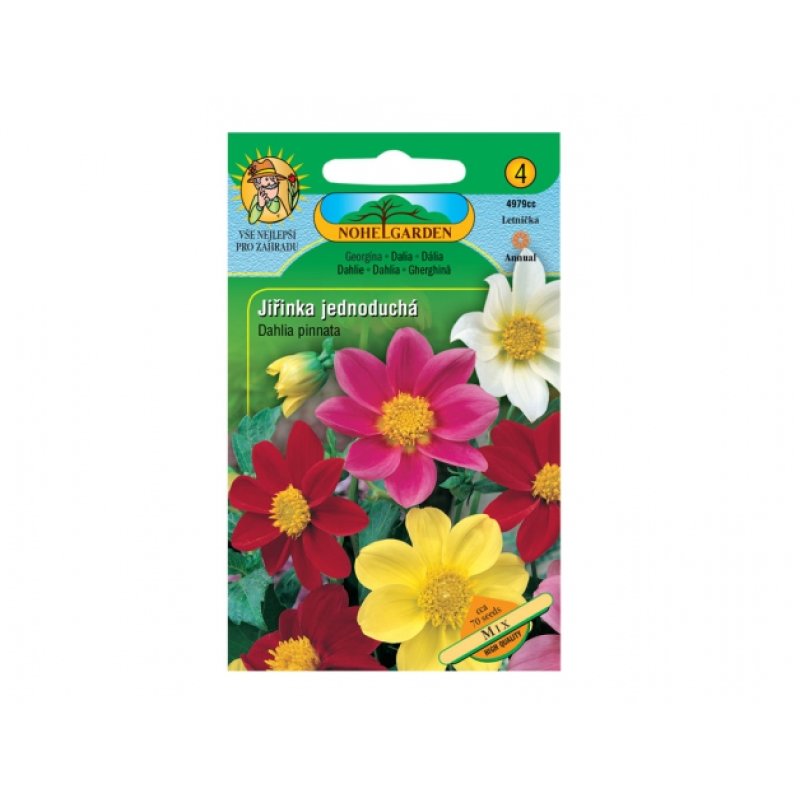
Dahlia is a popular annual used for planting in flower beds and for cut flowers. This variety is characterised by simple large flowers. Package contains 70 seeds.
 Wide range of quality products
Seeds, essential oils, growing supplies and exotic plants in one place
 Eco-friendly range
We prefer natural and gentle products
 Expert advice
We help you grow – guides, blog and personal support
 Delivery across the EU
PPL, DPD, GLS and local carriers – pickup point or home delivery
These are among the most popular and beloved garden flowers. They are used in outdoor beds and are also suitable for cutting. Thanks to breeding work, there exists a large complex of cultivars with various shapes and a whole spectrum of colors. Dahlias originate from Mexico, where the tubers were originally even eaten. They bloom from the end of July until the first frost. Depending on the variety, they grow from 25 cm to 2 m tall.
There are many types of flowers. According to flower shape, dahlias are divided into: single-flowered dahlias, anemone dahlias, collarette dahlias, waterlily dahlias, decorative dahlias, ball dahlias, pompon dahlias, cactus dahlias, semi-cactus dahlias, fringed dahlias, and orchid dahlias.
The plants require generous watering. The soil must never dry out. They also require a sunny location; they won't bloom in shade or partial shade. During growth, pinch out side buds and remove faded flowers to prevent the plants from becoming exhausted. Provide support for taller varieties to prevent them from breaking. No later than the end of October, carefully dig out the clumps with tubers using a spade. Remove the foliage about 7 cm from the tuber. Clean the clump of soil. Let the tubers dry for about a week and store them in a dry, dark cellar. The tubers must not freeze! Regularly check whether mold is forming on the tubers or if they are becoming damp.
Plant tubers in early May at a distance of 30–90 cm depending on variety, about 8 cm below the surface. Always plant tubers with the eye facing upward.
Well-drained, rather sandy soil is suitable. In heavy and waterlogged soils, tubers easily rot.
In heavy and clay soils, adding peat is beneficial. In light soils, add manure or good compost. If the soil is not too sandy, we don't fertilize the plants during the growing season. In autumn, it's advisable to plow the planting site thoroughly. Suitable autumn fertilization is with Thomas meal at a rate of 5 kg/ha and 40% potassium salt at 3 kg/ha. If manure fertilization was not applied, spread dried Organoferm manure at a rate of 80-100g/m2 or complete fertilizer such as Cererit or Synferta at a rate of 30-40g/m2 in spring before soil preparation. After 2.5 months, it's advisable to repeat fertilization with complete fertilizer at the same rate, working it into the soil around the plant.
Powdery spots appear on leaves, leaves turn yellow and fall off. The cause is powdery mildew. Treat plants with fungicides Sulikol, Topsin M 70 WP, or Baycor 25 WP.
If plants are covered in gray-brown coatings on leaves and stems, they were probably attacked by gray mold. Treat with Novozir MN 80, Rovral 50 WP, or Euparen Multi.
Yellow-green spots that appear on older leaves, where they darken and dry out, with leaves then drying prematurely, are caused by leaf spot disease. Treat such affected plants with fungicides and remove affected leaves.
There are many viral infections - from leaf mosaic to deformations and uneven flower coloring. The worst thing is that viruses attack tubers, so we don't discover that plants were infected. The only protection is elimination of affected plants and spraying against sucking insects (aphids, thrips) that transmit viral infections.
Plants are naturally attacked by sucking pests - aphids, whiteflies, spider mites, thrips, and leaf hoppers. Treat with insecticides mainly on the undersides of leaves where insects reside. Yellow sticky traps will catch whiteflies; insecticides such as Applaud 25 WP, Decis, or Karate can be used.
Data sheet
Specific References
Your review appreciation cannot be sent
Report comment
Report sent
Your report cannot be sent
Write your review
Review sent
Your review cannot be sent
Dahlia is a popular annual used for planting in flower beds and for cut flowers. This variety is characterised by simple large flowers. Package contains 70 seeds.
check_circle
check_circle