
 Our products
 Aromatherapy - essential oils
 Essential oils
 Aroma lamps
 Aroma Diffusers
 Seeds
 Vegetables
 Herbs and spices
 Ornamental Plant Seeds
 Grass mixtures
 Sprouts and microgreens
 Growing supplies
 Cultivation and Gardening Supplies
 Hydroponics and indoor growing
 Protective equipment and gardening tools
 Exotic plants
 Exotic Fruit and Vegetables
 Exotic herbs
 Exotic trees and shrubs
 Ornamental exotic plants
 Roasted coffee
 Espresso coffee
 Ecological coffee preparation
 Thermal mugs and coffee cups
 Aeropress
 Thermos flasks and thermal mugs for coffee and tea
 Moka pot
 Filter coffee
 Coffee blends
 Accessories for coffee makers
 Water filtration
 Coffee grinders
 Cleaning the Coffee Maker
 Ecological Cleaning of Coffee Machines
 Coffee makers
 Coffee Preparation
 Coffee Accessories
 Food products
 For wildlife and pets
 Chocolate and others
 Hemp food products
 Natural cosmetics
 Hemp cosmetics
 Smoking supplies
 Bongs - water pipes
 Blunts and tubes
 E-liquids with Terpenes and CBD
 Grinders and Mills
 Papers and filters
 Smoking accessories
 Vaporizers
 Air fresheners
 CBD and CBG products
 CBD sprays
 CBD and CBN crystals
 CBD body and facial care
 Weeds
 CBD suppositories and capsules
 CBD oils and drops
 CBG oils and drops
 House and garden
 Fashion and Decoration
 Kitchen essentials and cooking
 Christmas Decorations and Accessories
 Gift Sets
 Bird feeders
 Seasonal and Special Tools
How do you use essential oils on your skin safely? Simply and calmly. A practical explanation of dilution, choosing a carrier oil and the situations when it is better not to use oils on your skin.
In short: Essential oil belongs on the skin only when diluted – roughly 1 to 2 drops in 10 ml of carrier oil, and for sensitive skin 1 drop is enough. Mix small batches of 10 to 15 ml and first test every new blend on the inner forearm, watching for a reaction for 24 hours. Use citrus blends on the skin in the evening only.
| Dilution for skin blends | 1–2 drops of essential oil in 10 ml of carrier oil |
|---|---|
| Sensitive skin | stick to 1 drop in the whole blend |
| Recommended blend volume | 10–15 ml (fresh, quick feedback) |
| Patch test | a small amount on the inner forearm, watch for 24 hours |
| Frequency at the beginning | a few times a week, ideally in the evening |
| Citrus oils on the skin | evening only; during the day, better in a diffuser |
Essential oils can scent home care beautifully. But they are highly concentrated – which is exactly why it is good to know three basic things: how to dilute them, when it is better to leave them out and how to choose a suitable carrier oil. In this article you will find simple rules, practical tips and explanations of things that are often oversimplified online.
If you are wondering "essential oil on the skin – can I?" or "how to use oils on the face", you are in the right place. No rocket science – rather a calm guide to doing it gently and sensibly.
Contents
- Why you should always dilute essential oils for the skin
- How to dilute essential oils for the skin (simply and safely)
- When it is better not to use essential oils on the skin
- Citrus oils and the sun: what is good to know
- How to choose a carrier oil (so that it feels pleasant on the skin)
- Quick overview of carrier oils (table)
- 3 gentle blends to start with
- FAQ – common questions
- In conclusion: what to watch out for and what to start with
Why you should always dilute essential oils for the skin
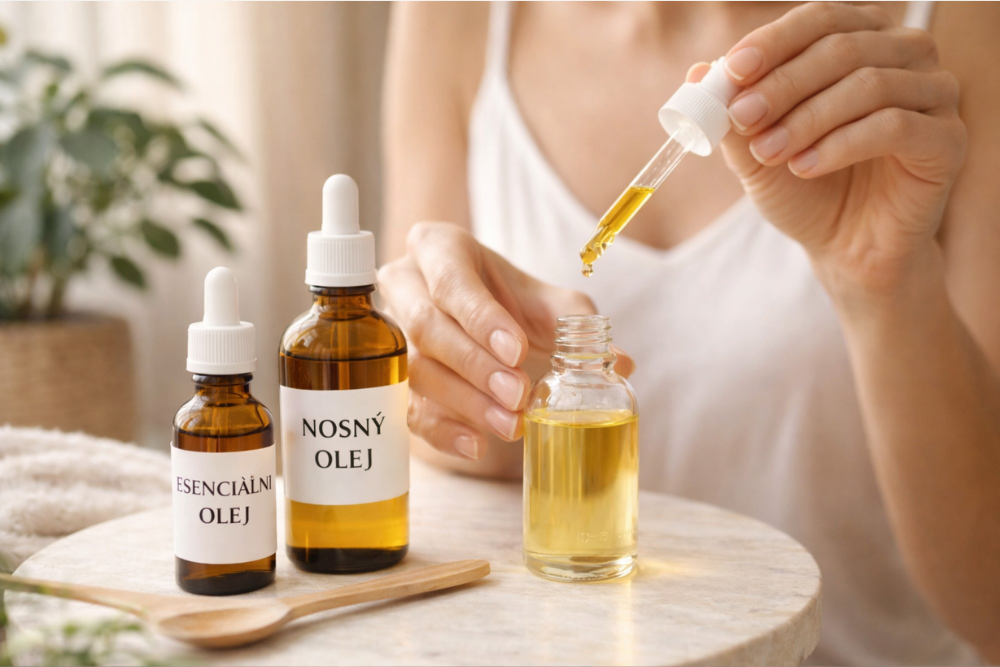
Essential oils are concentrated aromatic extracts from plants. That is why they work "in drops". But the skin (especially on the face) is sensitive and likes gentleness.
Imagine an essential oil as a really strong syrup. You would not pour it neat into your tea either. You add a few drops and the base makes up the rest. For the skin, that base is a carrier oil.
- Dilution lowers the risk of irritation and helps the skin tolerate the blend better.
- The carrier oil creates a "soft" base in which the essential oil is dispersed.
- Water is not suitable – oils do not mix with it and could remain on the skin in concentrated droplets.
How to dilute essential oils for the skin (simply and safely)
For the face, a simple rule applies: a little really is enough. Facial blends are best when gentle. Not because you "have to", but because the skin often prefers calm to intensity.
For home use, it is safe to stick to this logic: the more sensitive the skin, the fewer drops. And if you are not sure, always start with the gentlest variant.
If counting and tables confuse you, do it even more simply: mix a small amount (say 10 ml), try it for a few days and only then adjust if needed. With the skin, it is better to proceed slowly than to go "all in" at once.
When it is better not to use essential oils on the skin
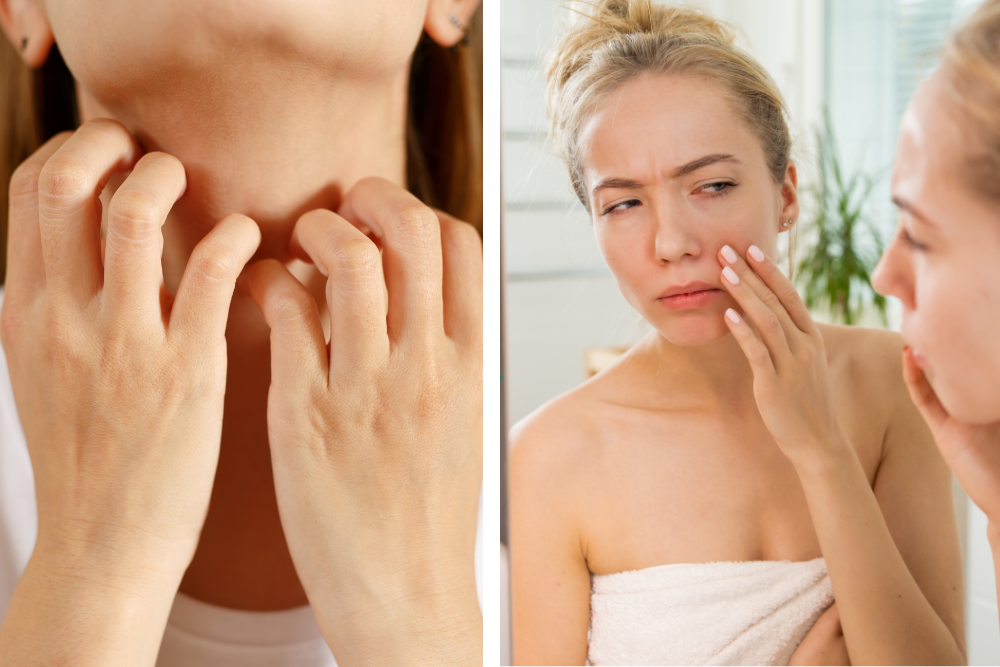
There are days when the skin mainly wants peace. And that is completely fine. Set essential oils aside for a while if any of these situations applies to you:
- Irritated, injured or sunburnt skin (for example after sun, after shaving, after a strong peeling).
- The area around the eyes, mucous membranes, the inside of the nose and ears – oils do not belong there.
- After cosmetic procedures – the skin needs time, not further "active" stimuli.
- If you have ever had a strong reaction – start very carefully and ideally with a consultation.
- Pregnancy, breastfeeding, small children – increased caution and gentle choices are appropriate here.
If burning, marked redness or itching appears, wash the blend off with a carrier oil (not water) and give the skin a break. Going back to a simple routine for a few days often helps.
Citrus oils and the sun: what is good to know
Citrus scents are wonderful. They can "lighten" the day and feel fresh. But with some citrus essences it is good to keep one practical thing in mind: after use on the skin they may increase sensitivity to the sun.
In lay terms: if you put some citrus oils in a blend for the skin and then go out into direct sun, the skin may be more prone to irritation or blotches. This does not mean you have to avoid citrus forever. It is just better to use it wisely.
- Use citrus blends on the skin preferably in the evening.
- During the day, give preference to gentle, neutral blends.
- In summer and on holiday, be more careful than usual.
How to choose a carrier oil (so that it feels pleasant on the skin)
The carrier oil is the base of the whole blend. And it is often great on its own, too. When it suits you, you are halfway there – your skin routine is then simple and pleasant.
When choosing, go mainly by what feel you want on the skin. Some oils are light and absorb quickly. Others are more nourishing and suit the night or winter better.
Quick overview of carrier oils (table)
Every skin likes something different. So take the table as a rough guide by texture and feel – not as a strict rule.
| Carrier oil | How it "feels" on the skin | When people often choose it |
|---|---|---|
| Jojoba | Light, pleasant, usually leaves no heavy film | When they want a universal and "unobtrusive" base |
| Almond | Soft, smoothing, more comforting and nourishing | When the skin seems dry or wants "softer" care |
| Grape seed | Very light, absorbs quickly | When they want the lightest possible oil (often in warmer weather) |
| Rosehip | Feels "more luxurious", more of an evening oil | When they want more nourishing care for the night |
| Argan | More nourishing, thicker than light oils | When the skin seems tired and wants "comfort" |
3 gentle blends to start with
Take these blends as inspiration. They are deliberately simple and gentle. If you have sensitive skin, start even more carefully – just with a carrier oil is fine.
1) Evening "mini serum" (gentle variant)
- 10 ml of jojoba or almond oil
- 1 drop of essential oil (e.g. lavender) in the whole blend
Apply 2–3 drops of the blend to slightly dampened skin. Use a few times a week and see how your skin behaves.
2) A light blend for when you want "just gentle"
- 10 ml of grape seed oil
- 1 drop of a gentle essential oil in the whole blend
Suitable when you want a light feel on the skin and nothing intense. If your skin is happy, you can later add one more drop to the whole blend.
3) Evening blend with a citrus scent (for night only)
- 15 ml of carrier oil (e.g. jojoba)
- 1 drop of lavender + 1 drop of a citrus scent in the whole blend
Caution: Use citrus in a skin blend in the evening only. During the day, rather do not experiment with the sun.
FAQ: the most common questions
In conclusion: what to watch out for and what to start with
If you want to take away the most important thing, it is actually simple: essential oil is always used "in drops". It belongs on the skin only when diluted, ideally in a gentle carrier oil. And if you are not sure, always start with the calmest variant.
The biggest difference is often not made by a complicated recipe. It is made by regularity, simplicity and not overloading your skin. If you mix small batches, use them gently and give your skin time, you will usually quickly work out what suits you.