 Essential oils
 Aroma lamps
 Aroma Diffusers
 Vegetables
 Herbs and spices
 Ornamental Plant Seeds
 Grass mixtures
 Sprouts and microgreens
 Exotic Fruit and Vegetables
 Exotic herbs
 Exotic trees and shrubs
 Ornamental exotic plants
 Espresso coffee
 Ecological coffee preparation
 Thermal mugs and coffee cups
 Aeropress
 Thermos flasks and thermal mugs for coffee and tea
 Moka pot
 Filter coffee
 Coffee blends
 Water filtration
 Coffee grinders
 Cleaning the Coffee Maker
 Ecological Cleaning of Coffee Machines
 Coffee makers
 Coffee Preparation
 Coffee Accessories
 For wildlife and pets
 Chocolate and others
 Hemp food products
 Hemp cosmetics
 Bongs - water pipes
 Blunts and tubes
 E-liquids with Terpenes and CBD
 Grinders and Mills
 Papers and filters
 Smoking accessories
 Vaporizers
 Air fresheners
 CBD sprays
 CBD and CBN crystals
 CBD body and facial care
 Weeds
 CBD suppositories and capsules
 CBD oils and drops
 CBG oils and drops
 Fashion and Decoration
 Kitchen essentials and cooking
 Christmas Decorations and Accessories
 Gift Sets
 Bird feeders
 Seasonal and Special Tools
- Out of stock

 Our products
 Aromatherapy - essential oils
 Seeds
 Growing supplies
 Cultivation and Gardening Supplies
 Hydroponics and indoor growing
 Protective equipment and gardening tools
 Exotic plants
 Roasted coffee
 Accessories for coffee makers
 Food products
 Natural cosmetics
 Smoking supplies
 CBD and CBG products
 House and garden

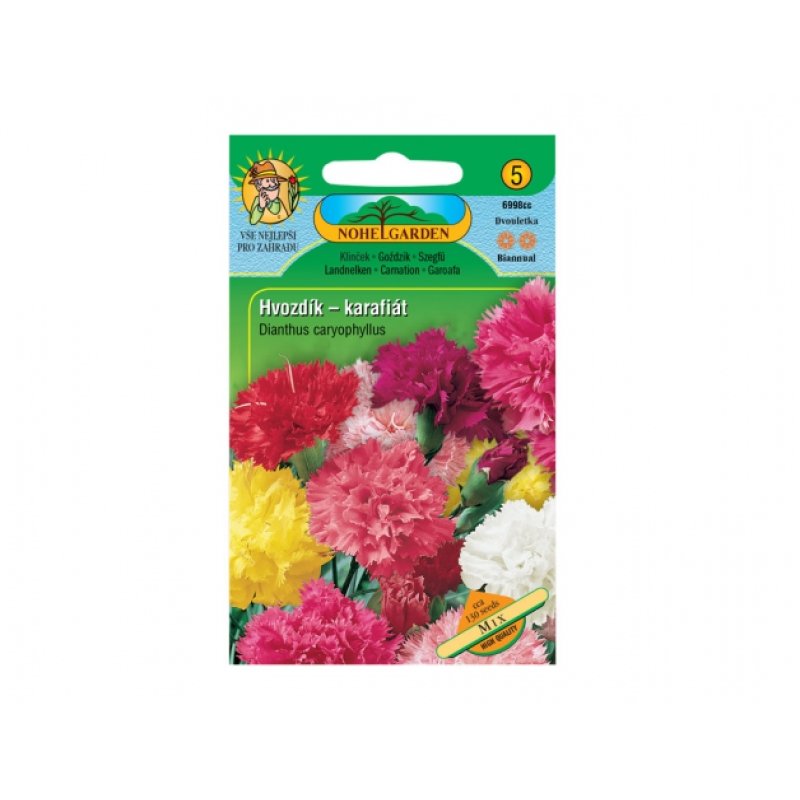
Abundantly flowering biennial with fragrant flowers. This plant is suitable for planting in flower beds and for cut flowers. We grow it on balconies or in planters. We use it mainly for cutting. The package contains 130 seeds.
 Wide range of quality products
Seeds, essential oils, growing supplies and exotic plants in one place
 Eco-friendly range
We prefer natural and gentle products
 Expert advice
We help you grow – guides, blog and personal support
 Delivery across the EU
PPL, DPD, GLS and local carriers – pickup point or home delivery
Originates from Europe and Asia, where it grows on rocks and stony slopes. The leaves are linear, undivided, and silvery. The flowers are single, white, or pink. It blooms from June to September depending on the species.
There is an endless variety of carnations. Some decorate flower beds as perennials. Others, with their low growth, are best suited for rock gardens. Still others belong among non-frost-resistant annuals or hardy biennials.
Garden carnations are perennials that grow 60-90 cm tall. Large flowers appear from July to August. This includes species D. caryophyllus and D. plumarius.
Rock garden pinks grow in cushion-like formations. Their height ranges from 15 to 40 cm. Rock garden species of pinks include D. allwoodii, D. deltoides, and D. arenarius.
The most well-known biennial is D. barbatus (Sweet William). It reaches a height of 40 cm. The flowers come in many shades of pink, red, purple, and white. They bloom from May to July and are grown primarily for cutting.
Annual pinks come in low-growing (15-20 cm) or tall varieties (30-40 cm). The tall varieties are also excellent for cutting. The flowers can be single-colored or multicolored in shades of white, pink, and red. Annual species include D. chinensis and D. caryophyllus.
Carnations are nowadays used in various types of floral arrangements. They can be used to create wedding bouquets and look stunning as interior arrangements. Their advantage is that they last a long time, don't wilt, and don't shed petals. Low-growing pinks are particularly suitable for planters, but also for edges or borders of flower beds. Smaller pinks work excellently both as standalone plantings and in mixed containers with lobelias, low-growing marigolds, or larkspur.
They require sunny to semi-shaded locations. They don't need frequent watering, but drying out of the soil or substrate is not desirable. In June, attach at least 70 cm long wire to mature seedlings to prevent stems from bending under the weight of flowers. It's good to cover perennials with spruce branches for winter. Annuals should be removed after flowering and seeds collected for the next season.
Annual species are sown under glass or in hotbeds from February to March. They are planted in flower beds only at the end of May.
D. barbatus seeds are sown from May directly at their growing location.
Suitable soil is sufficiently loose, well-drained, and sandy. Plants also benefit from soil well-supplied with lime and nutrients. Only the maiden pink doesn't like alkaline soil.
Before planting, add well-matured compost to the soil in early spring. Continuously apply complete liquid NPK fertilizer. Ideally once every 14 days. Once the plant begins to flower, apply fertilizer with higher potassium content to strengthen the stem.
Plants are attacked by powdery mildew and gray mold in higher humidity. Therefore, treat them both curatively and preventively with appropriate fungicides.
Data sheet
Specific References
Your review appreciation cannot be sent
Report comment
Report sent
Your report cannot be sent
Write your review
Review sent
Your review cannot be sent
Abundantly flowering biennial with fragrant flowers. This plant is suitable for planting in flower beds and for cut flowers. We grow it on balconies or in planters. We use it mainly for cutting. The package contains 130 seeds.
check_circle
check_circle