 Essential oils
 Aroma lamps
 Aroma Diffusers
 Vegetables
 Herbs and spices
 Ornamental Plant Seeds
 Grass mixtures
 Sprouts and microgreens
 Exotic Fruit and Vegetables
 Exotic herbs
 Exotic trees and shrubs
 Ornamental exotic plants
 Espresso coffee
 Ecological coffee preparation
 Thermal mugs and coffee cups
 Aeropress
 Thermos flasks and thermal mugs for coffee and tea
 Moka pot
 Filter coffee
 Coffee blends
 Water filtration
 Coffee grinders
 Cleaning the Coffee Maker
 Ecological Cleaning of Coffee Machines
 Coffee makers
 Coffee Preparation
 Coffee Accessories
 For wildlife and pets
 Chocolate and others
 Hemp food products
 Hemp cosmetics
 Bongs - water pipes
 Blunts and tubes
 E-liquids with Terpenes and CBD
 Grinders and Mills
 Papers and filters
 Smoking accessories
 Vaporizers
 Air fresheners
 CBD sprays
 CBD and CBN crystals
 CBD body and facial care
 Weeds
 CBD suppositories and capsules
 CBD oils and drops
 CBG oils and drops
 Fashion and Decoration
 Kitchen essentials and cooking
 Christmas Decorations and Accessories
 Gift Sets
 Bird feeders
 Seasonal and Special Tools

 Our products
 Aromatherapy - essential oils
 Seeds
 Growing supplies
 Cultivation and Gardening Supplies
 Hydroponics and indoor growing
 Protective equipment and gardening tools
 Exotic plants
 Roasted coffee
 Accessories for coffee makers
 Food products
 Natural cosmetics
 Smoking supplies
 CBD and CBG products
 House and garden


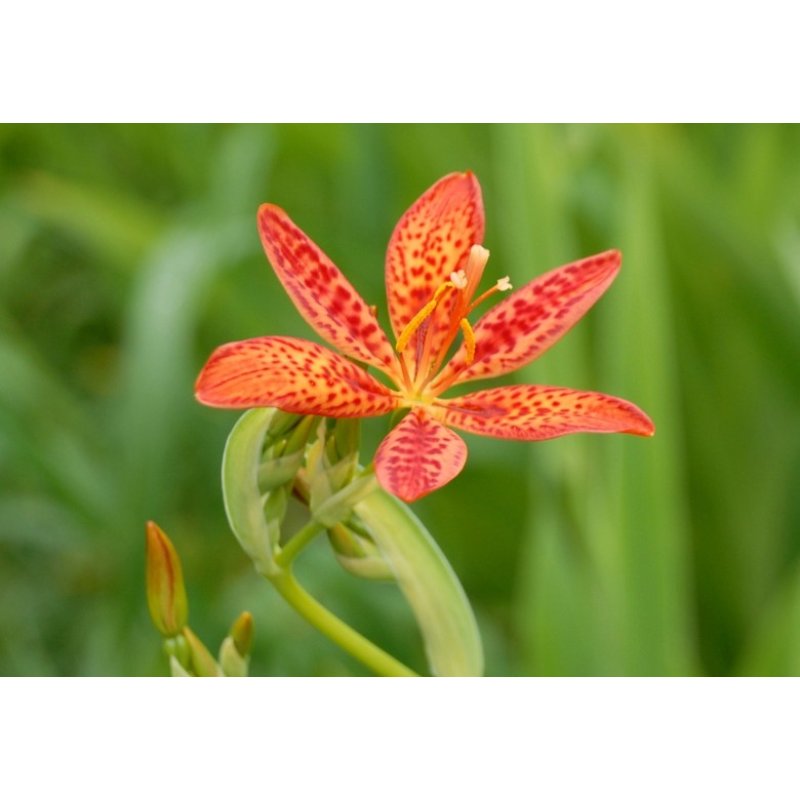
The leopard flower, or balloon flower, is a very decorative flower. It can be grown as a container plant, but also in the garden. The package contains 5 seeds.
 Wide range of quality products
Seeds, essential oils, growing supplies and exotic plants in one place
 Eco-friendly range
We prefer natural and gentle products
 Expert advice
We help you grow – guides, blog and personal support
 Delivery across the EU
PPL, DPD, GLS and local carriers – pickup point or home delivery
This lily-like flower belongs to the iris family. It's commonly known as Leopard Flower. This plant originates from Asia and reaches heights of up to 1 m. The plant blooms from mid-summer until September with orange-red flowers that have characteristic spots.
In garden architecture, this extraordinary perennial is grown for its unusual black berries that cluster in seed pods. In autumn, the seed pods burst open and provide a magnificent spectacle! In our regions, it's mostly grown as a portable balcony plant, as it doesn't tolerate severe frost well. Frost resistance down to -20°C.
In larger doses it can be toxic.
The plant requires sunny locations, soil should be permeable, nutritious, preferably neutral, rather moist but not waterlogged. In a dry sheltered spot, it can overwinter outdoors in open ground. Don't forget to insulate with a sufficient layer of conifer branches or straw to prevent the plant from freezing. It can be grown year-round as a potted plant.
Soak seeds for 24 hours in lukewarm water. Then sow in permeable substrate (crushed coconut fiber). After germination, plants are transplanted into permeable humus-rich soil. Sowing is done in February to March. At room temperature, germination takes approximately 14 days.
A sandy mixture of compost and hotbed soil is suitable. The substrate doesn't need to be very rich, but permeable - due to the watery nature of the rhizomes, they may rot if overwatered.
Apply fertilizer 1-2 times monthly. Use liquid complete fertilizer, especially during the flowering period.
Not affected by diseases or pests. During winter months, root rot may occur due to excessive watering.
Photo Sources:
By I, Brighterorange, CC BY 2.5, https://commons.wikimedia.org/w/index.php?curid=2430910
By Francisco Boratto - Own work, CC BY-SA 4.0, https://commons.wikimedia.org/w/index.php?curid=48705739
Data sheet
Your review appreciation cannot be sent
Report comment
Report sent
Your report cannot be sent
Write your review
Review sent
Your review cannot be sent
The leopard flower, or balloon flower, is a very decorative flower. It can be grown as a container plant, but also in the garden. The package contains 5 seeds.
check_circle
check_circle