
 Our products
 Aromatherapy - essential oils
 Essential oils
 Aroma lamps
 Aroma Diffusers
 Seeds
 Vegetables
 Herbs and spices
 Ornamental Plant Seeds
 Grass mixtures
 Sprouts and microgreens
 Growing supplies
 Cultivation and Gardening Supplies
 Hydroponics and indoor growing
 Protective equipment and gardening tools
 Exotic plants
 Exotic Fruit and Vegetables
 Exotic herbs
 Exotic trees and shrubs
 Ornamental exotic plants
 Roasted coffee
 Espresso coffee
 Ecological coffee preparation
 Thermal mugs and coffee cups
 Aeropress
 Thermos flasks and thermal mugs for coffee and tea
 Moka pot
 Filter coffee
 Coffee blends
 Accessories for coffee makers
 Water filtration
 Coffee grinders
 Cleaning the Coffee Maker
 Ecological Cleaning of Coffee Machines
 Coffee makers
 Coffee Preparation
 Coffee Accessories
 Food products
 For wildlife and pets
 Chocolate and others
 Hemp food products
 Natural cosmetics
 Hemp cosmetics
 Smoking supplies
 Bongs - water pipes
 Blunts and tubes
 E-liquids with Terpenes and CBD
 Grinders and Mills
 Papers and filters
 Smoking accessories
 Vaporizers
 Air fresheners
 CBD and CBG products
 CBD sprays
 CBD and CBN crystals
 CBD body and facial care
 Weeds
 CBD suppositories and capsules
 CBD oils and drops
 CBG oils and drops
 House and garden
 Fashion and Decoration
 Kitchen essentials and cooking
 Christmas Decorations and Accessories
 Gift Sets
 Bird feeders
 Seasonal and Special Tools
A practical guide to using comfrey oil in home care, including massage tips and comfrey spray.
Comfrey oil is one of the unassuming staples of home body care. You reach for it after a demanding day, a long walk, work in the garden or after sport – in short, whenever you want to treat yourself to a moment of calm and comfort. It is a gentle herbal macerate made from dried leaves of common comfrey that spreads pleasantly and suits massages, relaxation rituals and homemade cosmetics. In this article we will show you how to use comfrey oil in everyday body care, when the spray version makes sense and how to simply fit both forms into your daily routine.
Contents
- What comfrey oil is and how it is made
- When comfrey oil is most useful
- How comfrey oil relates to essential oils
- Comfrey oil after sport and physical strain
- How to massage: a simple step-by-step method
- Comfrey spray: when it makes sense and how to use it
- Oil vs. spray: a clear comparison
- DIY inspiration: an oil spray and a two-phase spray with hydrolat
- Safe use and practical warnings
- FAQ: the most common questions
What comfrey oil is and how it is made
Comfrey oil is an infused (macerated) herbal oil. In practice this means that dried leaves of common comfrey are left to slowly "rest" in a vegetable oil (often sunflower oil) for several weeks. The oil thus gains a gently herbal character and a pleasant texture for massages and homemade cosmetics.
During maceration, the dried comfrey leaves are steeped in a vegetable oil for several weeks. The result is a gentle herbal macerate with a pleasant texture, suitable for massages and regular care of strained parts of the body.
Want to get the most out of the oil? Keep it where you will really see it (bathroom/bedside table). With such "ritual" products, regularity matters most.
When comfrey oil is most useful
People look for comfrey oil mainly on days when they want to give the body comfort after strain. It need not be only sport. It is often long standing, cleaning, work in the garden, moving house, a longer walk or an "ordinary day" that tired you more than you expected.
The great thing is that using it is simple. You do not need any special equipment. A few drops and a few minutes of peace are enough. And even a short massage can be pleasant – especially when you take it as a moment for yourself, not as another task on your list.
"Attach" the massage to something you already do automatically – for example after a shower or before bed. That way it becomes a pleasant habit.

How comfrey oil relates to essential oils
Comfrey oil is sometimes confused with essential oils, but in fact they are two different things. Whereas essential oils are highly concentrated aromatic extracts used in drops, comfrey oil is a herbal macerate in a vegetable oil, intended for use in larger amounts – typically for massage or regular body care.
This is precisely why comfrey oil can serve as the base of a massage blend. If you wish, you can add a few drops of a suitable essential oil – purely for scent and atmosphere. The rule of gentle dosing and consideration for skin sensitivity always applies, however.
Comfrey oil after sport and physical strain
After sport, the body is often "revved up" and the mind keeps performing for a while. A gentle massage with oil is a simple way to slow down and switch to calm. Comfrey oil is traditionally used in the care of strained areas – typically the calves, thighs, shoulders, neck or lower back.
You do not need to massage for long. Even 3–5 minutes is fine if it is regular. And if you only exercise occasionally? No problem. The oil suits a longer walk, running around town or a physically demanding day just as well.
After strain, try a massage that is gentle and slow. It is not about "pushing" but about a pleasant ritual. Your body will tell you what feels good.

How to massage: a simple step-by-step method
You can easily do a massage with comfrey oil at home without stress. The ideal moment is when you feel warm and have at least a few minutes of peace. It works well, for example, after a shower, when your skin is warmed through.
1) Warm the oil in your palms
Drip a few drops into your palm and briefly rub your hands together. The oil warms up and becomes more pleasant. It also spreads more easily.
2) Massage slowly and with light pressure
For the legs, a stroke upwards is often recommended; for the shoulders, rather gentle circular movements. Stick to a simple rule: slowly rather than hard.
3) Give yourself a moment of calm
After the massage, take a break of a few minutes. Wrap yourself in a blanket, have a tea or simply sit down. This too is part of that "comfort after strain".
Mix comfrey oil with another vegetable oil (e.g. jojoba). The blend will be gentler and also suitable for a longer massage.
Comfrey spray: when it makes sense and how to use it
A comfrey spray is great when you want something quick and light. Oil is ideal for massage, but you do not always have the time (or the mood) to deal with a greasier feel. A spray suits travelling, a "quick" post-sport routine or any time you want simpler application.
In practice there are two common variants: an oil spray (pure oils in an atomiser) and a two-part spray, where the oil component is supplemented with floral water (hydrolat). With the second variant, bear in mind that oil and water do not mix on their own – which is why an emulsifier/solubiliser is used to help "bind" the blend.
Shake the spray before each use. It is a small thing, but it makes a huge difference to how the blend behaves on the skin.
Oil vs. spray: a clear comparison
| Form | When it suits | Why you will like it |
|---|---|---|
| Comfrey oil | Massages after strain, evening rituals, home rubs | Ideal for massage, glides well, easy to combine |
| Comfrey spray | Quick application, care on the go, lighter feel | Practical, quick, pleasant even on days when you have no time |
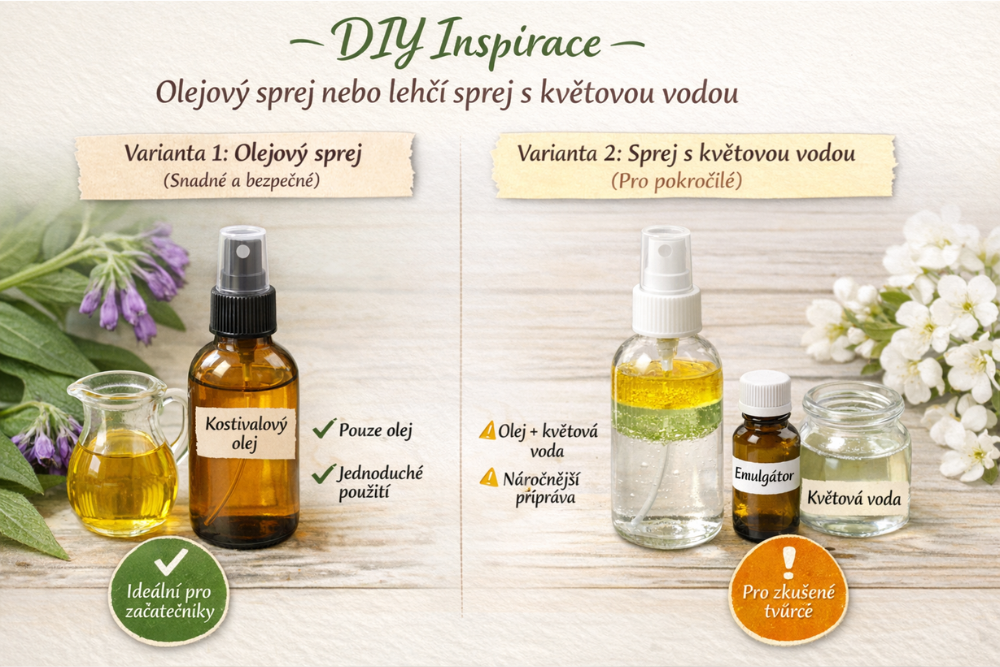
DIY inspiration: a simple oil spray or a lighter variant with floral water
Comfrey oil also works well in simple homemade cosmetics. It is not about making complicated products, though – often a small change of form is enough to make the oil more pleasant to use. You will most often come across two options: an oil in a spray and a lighter spray with floral water.
Variant 1: oil in a spray (the simplest and most reliable)
If you want a quick and carefree solution, choose an oil spray. Simply pour comfrey oil into a clean bottle with an atomiser – or you can soften it by adding another vegetable oil (for example jojoba).
This variant is popular mainly because it is stable, undemanding and safe. It contains no water, so you need not fear spoilage. Before use, just shake the bottle briefly and spray the oil straight onto the skin.
An oil spray is ideal for travelling, after sport or on days when you do not want to spread the oil with your palms.
Variant 2: a lighter spray with floral water (for the more advanced)
If you prefer a really light "mist" on the skin, you can reach for a combination of oil and floral water (hydrolat). This variant feels fresher, but it is also somewhat more demanding to prepare.
Because oil and water naturally do not mix, you need to use an emulsifier (a substance that binds the two components). Careful hygiene, clean utensils and correct storage are also important.
If you are only starting with homemade cosmetics, stick to the oil variant. It works great in practice and requires no complicated steps.
Safe use and practical warnings
Treat comfrey oil as a cosmetic product / a raw material for further processing. It is not intended for internal use. Avoid contact with the eyes, mucous membranes and sensitive areas.
If you have sensitive skin, first do a small test on a smaller area of the body. If irritation appears, stop using it and wash the area. For children, pregnant and breastfeeding women, it is always better to consult an aromatherapy or natural cosmetics specialist.
- Keep out of the reach of children.
- Do not use on large areas of skin without consideration and a patch test.
- In case of irritation, stop using it and rinse with water.
If you are just starting with essential oils, take a look at our overview: Safe use of essential oils. It will help you with dilution and the basic rules.