
 Our products
 Aromatherapy - essential oils
 Essential oils
 Aroma lamps
 Aroma Diffusers
 Seeds
 Vegetables
 Herbs and spices
 Ornamental Plant Seeds
 Grass mixtures
 Sprouts and microgreens
 Growing supplies
 Cultivation and Gardening Supplies
 Hydroponics and indoor growing
 Protective equipment and gardening tools
 Exotic plants
 Exotic Fruit and Vegetables
 Exotic herbs
 Exotic trees and shrubs
 Ornamental exotic plants
 Roasted coffee
 Espresso coffee
 Ecological coffee preparation
 Thermal mugs and coffee cups
 Aeropress
 Thermos flasks and thermal mugs for coffee and tea
 Moka pot
 Filter coffee
 Coffee blends
 Accessories for coffee makers
 Water filtration
 Coffee grinders
 Cleaning the Coffee Maker
 Ecological Cleaning of Coffee Machines
 Coffee makers
 Coffee Preparation
 Coffee Accessories
 Food products
 For wildlife and pets
 Chocolate and others
 Hemp food products
 Natural cosmetics
 Hemp cosmetics
 Smoking supplies
 Bongs - water pipes
 Blunts and tubes
 E-liquids with Terpenes and CBD
 Grinders and Mills
 Papers and filters
 Smoking accessories
 Vaporizers
 Air fresheners
 CBD and CBG products
 CBD sprays
 CBD and CBN crystals
 CBD body and facial care
 Weeds
 CBD suppositories and capsules
 CBD oils and drops
 CBG oils and drops
 House and garden
 Fashion and Decoration
 Kitchen essentials and cooking
 Christmas Decorations and Accessories
 Gift Sets
 Bird feeders
 Seasonal and Special Tools
In short: Plant ornamental grasses in spring (April–May), once the soil reaches at least 10 °C, in a sunny spot with well-draining soil. Water regularly for the first 4–6 weeks, after which most species cope with drought. Do not cut them in autumn: cut the tufts back to 10–15 cm in March–April and divide them every 3–5 years.
| Planting time | April–May, soil at least 10 °C |
|---|---|
| Watering after planting | 4–6 weeks |
| Spring pruning | March–April, down to 10–15 cm |
| Division | every 3–5 years |
| Spacing | 30–40 cm (fescue) to 80–120 cm (miscanthus) |
| Container size | at least 10 liters |
Ornamental Grasses -- the Jewel of Modern Gardens
Ornamental grasses have experienced an unprecedented boom in recent years and have become an indispensable part of modern garden designs. Their greatest advantage is movement -- they sway in the wind, create delicate rustling sounds, and give the garden a lively dynamic that no other plant can fully replace. They are usually low-maintenance, drought-resistant, and even after their above-ground parts dry out in winter, they retain impressive decorative value -- especially when covered with frost or snow.
Seeds of ornamental grasses and other ornamental plants can be found in the category seeds of ornamental plants.
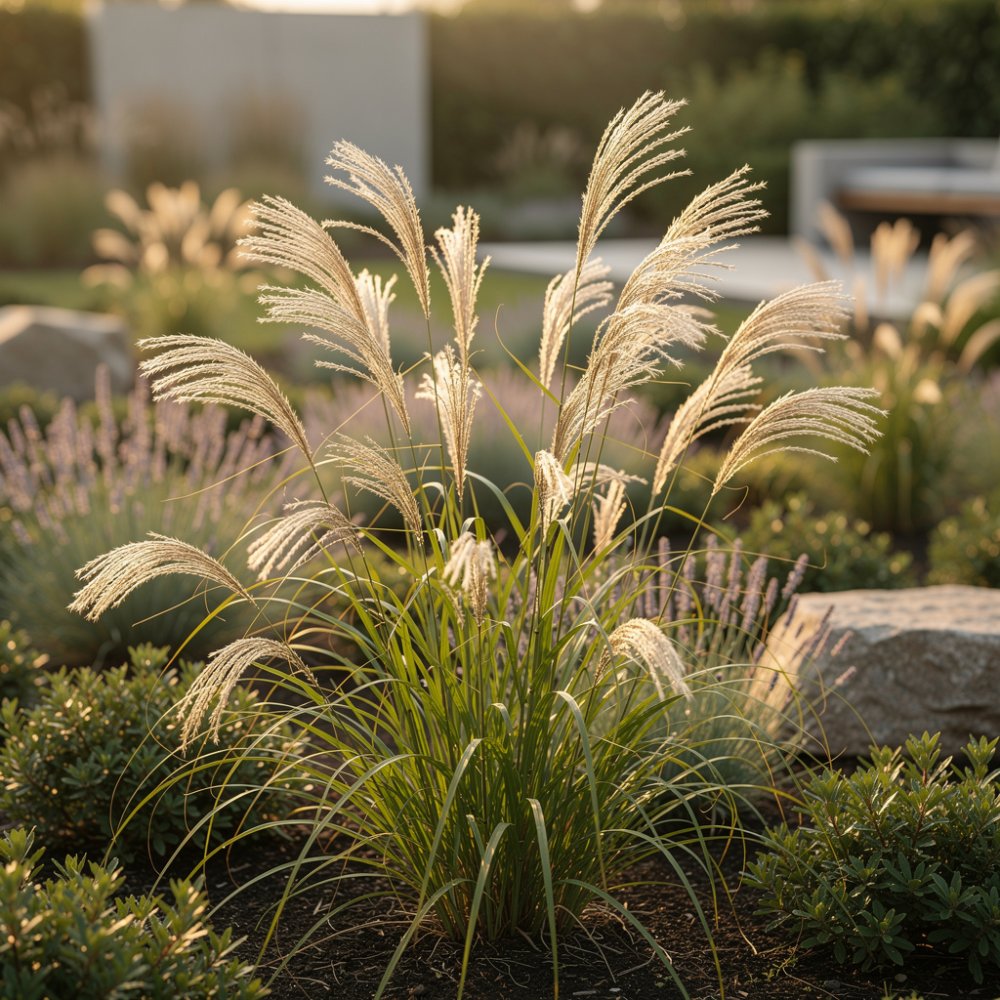
Most Popular Types of Ornamental Grasses
Miscanthus (Miscanthus)
Miscanthus is among the most striking ornamental grasses. They reach 150--300 cm and form dense, upright tufts with distinctive architectural silhouettes. In autumn they flower with decorative plumes that persist on the plant throughout winter and provide food for birds.
Recommended varieties:
- Miscanthus sinensis 'Gracillimus' -- narrow, elegant leaves with delicate silvery central rib, height 150--180 cm. Flowers late (October); in cooler locations it may not flower every year.
- Miscanthus sinensis 'Zebrinus' -- striking yellow horizontal banding on leaves, height 180--220 cm. An impressive specimen in every season.
- Miscanthus sinensis 'Morning Light' -- silver-edged leaves create an airy, light effect, compact growth to 150 cm. One of the most beautiful miscanthus varieties ever.
- Miscanthus x giganteus -- giant miscanthus reaching up to 300 cm. Suitable as a living wall, screen, or striking specimen in large gardens.
Location: Full sun, any well-draining soil. Miscanthus tolerates mild drought but thrives best in moderately moist, nutrient-rich soil. Spring fertilizing promotes abundant growth.
Pennisetum (Pennisetum)
Pennisetum is a medium-sized grass with beautiful, hairy spikes resembling fox tails. It is exceptionally photogenic; in late afternoon light it practically glows, which is why it is a favorite element of modern plantings and photographically attractive gardens.
Recommended varieties:
- Pennisetum alopecuroides 'Hameln' -- compact (60--80 cm), abundantly flowering, reliable in Czech conditions. The most popular and hardy variety for our climate.
- Pennisetum alopecuroides 'Little Bunny' -- miniature version (20--30 cm), ideal for containers, rock gardens, and front of borders.
- Pennisetum setaceum 'Rubrum' -- deep red leaves and dark spikes, aesthetically exceptional. Not frost-hardy in the Czech Republic -- grow as an annual or overwinter indoors at 5--10 °C.
Location: Full sun, warmth, well-draining soil. Pennisetum is heat-loving and requires a sheltered location, especially in cooler regions.
Fescue (Festuca)
Low, compact tufts forming perfectly regular hemispheres. Ideal for rock gardens, border edges, paving joints, and modern minimalist plantings. Blue-gray varieties look like natural stones and complement gravel areas beautifully.
Recommended varieties:
- Festuca glauca 'Elijah Blue' -- intensely blue, height 25--30 cm. The most popular blue grass for Czech gardens.
- Festuca glauca 'Beyond Blue' -- even deeper blue than 'Elijah Blue', somewhat more compact form.
- Festuca amethystina -- violet tint, finer leaves, height 30--40 cm. Suitable for natural steppe plantings.
Location: Full sun, dry and well-draining soil. Fescue cannot tolerate waterlogging -- it quickly dies in heavy clay soil. If necessary, add coarse gravel or perlite when planting.
Stipa (Stipa)
Stipa is a grass with exceptionally striking, long awns that wave in the wind like sea waves. In late afternoon or early morning light, when the low sun shines through them, they create an almost magical optical effect -- the garden literally glows.
Recommended varieties:
- Stipa tenuissima (Nassella tenuissima) -- the finest stipa, silky leaves, height 40--60 cm. Self-seeds readily, which can be both an advantage and a disadvantage.
- Stipa gigantea -- giant stipa with sparse, golden panicles reaching up to 200 cm. An striking specimen or prominent background for a border.
- Stipa barbata -- long, feathery awns, very decorative especially in movement, height 60--80 cm.
Location: Full sun, dry, well-draining soil. Stipa is a steppe plant adapted to nutrient-poor conditions -- overfertilizing and waterlogging it tolerates poorly.
Other Interesting Types
- Molinia (Molinia caerulea) -- elegant, drooping panicles, height 60--150 cm. Exceptionally tolerates partial shade and moist soil, suitable for ponds and wetland borders.
- Deschampsia (Deschampsia cespitosa) -- delicate airy panicles, tolerates shade and moisture better than other grasses. Height 60--100 cm. Excellent for shady gardens.
- Switchgrass (Panicum virgatum) -- upright, height 100--150 cm. Varieties such as 'Shenandoah' or 'Rotstrahlbusch' turn dramatically red in autumn.
Planting and Care
When to Plant
Plant ornamental grasses ideally in spring (April--May), once the soil warms to at least 10 °C. Heat-loving species such as pennisetum and miscanthus should definitely not be planted in autumn -- without adequate rooting they will not survive the first winter.
Site Preparation
Most ornamental grasses require well-draining soil. If you have heavy clay, work in coarse gravel, river sand, or perlite before planting at approximately a 1:3 ratio. Add compost sparingly -- overfertilized grass grows soft, becomes prostrate, and loses vigor and aesthetics.
Spacing
| Type | Spacing |
|---|---|
| Fescue | 30--40 cm |
| Pennisetum 'Hameln' | 50--60 cm |
| Stipa | 40--60 cm |
| Miscanthus | 80--120 cm |
Watering
After planting, water regularly until the plants become fully established (4--6 weeks). After that, most ornamental grasses can handle drought without problems and do not need watering. Exceptions are molinia and deschampsia, which prefer moderately moist conditions throughout the season.
Pruning
The key operation is spring pruning. Do not cut grasses in autumn -- dry leaves naturally protect the heart of the tuft from frost and at the same time create winter decoration, especially when covered with frost or snow.
In spring (March--April, just before new growth begins) cut the entire tuft down to 10--15 cm from the ground. For large miscanthus this is physically demanding work -- use a hedge trimmer or sheet metal shears, or tie the tuft with rope before cutting so it doesn't fall into the border.
Division
Rejuvenate grasses by division every 3--5 years once the center of the tuft begins to thin or die back. Dig up the tuft, divide it into smaller parts using a sharp knife or spade, and replant only the vital outer portions. Discard the old center on the compost. The ideal time is early spring, coinciding with pruning.
Combinations with Perennials
Ornamental grasses shine best when combined with perennials, creating natural, sustainable borders in so-called neo-prairie or steppe styles. Grasses provide movement, structure, and winter interest, while perennials provide colorful blooms.
Proven Combinations
- Blue fescue + lavender + sedum: Dry, sunny rock garden in silvery-blue tones with minimal maintenance.
- Pennisetum 'Hameln' + echinacea + rudbeckia: Classic prairie border in warm colors, attractive to pollinators.
- Miscanthus + asters + Japanese anemone: Autumn border with dramatic effect, peaking from September to November.
- Stipa + sage + yarrow: Low-maintenance steppe border, resistant to drought and heat.
- Molinia + hosta + astilbe: Semi-shaded border with fine texture and leaf contrast.
Composition Principles
- Grasses form the structural "skeleton" and background for flowering perennials.
- Place taller grasses (miscanthus, switchgrass) in the back or center of island borders.
- Place shorter grasses (fescue, pennisetum) at edges and in front of borders.
- Repeat groups (at least 3--5 of the same grass) for rhythm and natural appearance.
- Contrast textures: fine grass leaves versus large bold leaves of hosta or sedum.
In our e-shop you will find seeds of ornamental plants including ornamental grasses and perennials suitable for these combinations.
FAQ -- Frequently Asked Questions
Are Ornamental Grasses Invasive?
Some species can spread by self-seeding -- particularly Stipa tenuissima and certain miscanthus types. Prevention is simple: remove seed heads before ripening. Most cultivars are nonetheless well-behaved and easily controlled. Avoid invasive pampas grass (Cortaderia selloana), which in warmer regions can be truly problematic and is banned in some countries.
Do I Need to Cover Ornamental Grasses in Winter?
Most grasses recommended in this article are fully frost-hardy (zones 5--6) and do not need protection. Pennisetum 'Rubrum', however, overwinters poorly in the Czech Republic and should be moved to a cool space (5--10 °C). For newly planted first-year plants, lightly cover the tufts with conifer branches or dry leaves as preventive protection.
Why is the Center of the Tuft Dry and Brown?
The tuft is aging and naturally dies back in the center -- it is a sign that it is time for division. In spring dig up the tuft, divide it into smaller parts, and plant only the vital outer sections. Add the old center to compost. Regular division every 3--5 years prolongs plant life and maintains compact form.
Are Ornamental Grasses Suitable for Containers on a Balcony?
Yes, especially compact species are ideal for containers: blue fescue, pennisetum 'Hameln' or 'Little Bunny', Stipa tenuissima. Use a sufficiently large container (at least 10 liters) with good drainage. In winter wrap the container with insulating material or move it to a protected location -- roots in containers are more prone to freezing than roots planted in the ground.