
 Our products
 Aromatherapy - essential oils
 Essential oils
 Aroma lamps
 Aroma Diffusers
 Seeds
 Vegetables
 Herbs and spices
 Ornamental Plant Seeds
 Grass mixtures
 Sprouts and microgreens
 Growing supplies
 Cultivation and Gardening Supplies
 Hydroponics and indoor growing
 Protective equipment and gardening tools
 Exotic plants
 Exotic Fruit and Vegetables
 Exotic herbs
 Exotic trees and shrubs
 Ornamental exotic plants
 Roasted coffee
 Espresso coffee
 Ecological coffee preparation
 Thermal mugs and coffee cups
 Aeropress
 Thermos flasks and thermal mugs for coffee and tea
 Moka pot
 Filter coffee
 Coffee blends
 Accessories for coffee makers
 Water filtration
 Coffee grinders
 Cleaning the Coffee Maker
 Ecological Cleaning of Coffee Machines
 Coffee makers
 Coffee Preparation
 Coffee Accessories
 Food products
 For wildlife and pets
 Chocolate and others
 Hemp food products
 Natural cosmetics
 Hemp cosmetics
 Smoking supplies
 Bongs - water pipes
 Blunts and tubes
 E-liquids with Terpenes and CBD
 Grinders and Mills
 Papers and filters
 Smoking accessories
 Vaporizers
 Air fresheners
 CBD and CBG products
 CBD sprays
 CBD and CBN crystals
 CBD body and facial care
 Weeds
 CBD suppositories and capsules
 CBD oils and drops
 CBG oils and drops
 House and garden
 Fashion and Decoration
 Kitchen essentials and cooking
 Christmas Decorations and Accessories
 Gift Sets
 Bird feeders
 Seasonal and Special Tools
Grilling is one of the most popular summer activities and for many becomes a year-round hobby. It combines the joy of cooking, time in fresh air, and a social experience. Whether you're starting with your first kettle grill or operating a fully equipped outdoor kitchen, there's always room to improve your technique, equipment, and recipes.
In this guide, we'll compare different types of grills, show you how to prepare effective herbal marinades from your own garden, and advise you on designing a functional outdoor kitchen. Inspiration and equipment for grilling season can be found in Pestik.cz's range.
Types of Grills -- Which One is Right for You
The choice of grill fundamentally affects the taste of your food, cooking convenience, and overall operating costs. Each type has different strengths and suits a different cooking style.
Charcoal Grills
The charcoal grill is a classic that holds its place even in the age of modern alternatives. Smoke from quality hardwood charcoal imparts a characteristic flavor to meat that gas or electric grills cannot faithfully replicate.
Advantages:
- Authentic smoky flavor and aroma
- Lower purchase price
- Ability to reach very high temperatures
- Portability in kettle models
Disadvantages:
- Longer preheating time (20--30 minutes)
- More difficult temperature control
- Need to dispose of ash
- Higher operating costs (charcoal, starters)
Practical tips for charcoal grills:
- Choose quality hardwood charcoal or briquettes -- they burn longer and more evenly
- Create two temperature zones: direct heat for searing and indirect for slow cooking
- Don't move meat unnecessarily -- let it rest undisturbed to form a crust
- Invest in a digital thermometer with probe
Gas Grills
Gas grill enthusiasts appreciate them for regular grilling and maximum convenience. Quick preheating and precise temperature control allow consistent results regardless of experience level.
Advantages:
- Operating temperature reached in 5--10 minutes
- Precise control via individual burners
- Easy cleaning without ash
- Readily restarts repeatedly
Disadvantages:
- Higher purchase price
- Lack of typical smoky flavor
- Dependence on propane-butane tank
- Larger size and weight
When choosing a gas grill, opt for a model with at least two independent burners -- without the ability to create temperature zones, efficient grilling is severely limited.
Electric Grills
An electric grill provides a practical solution for balconies and terraces where open flame is restricted. Operation is minimal and cleaning is quick.
When to choose an electric grill:
- You live in an apartment with a balcony or small terrace
- Regulations prohibit open flames or gas appliances
- You require minimal smoke production
- You grill occasionally and in small portions
Ceramic Grills (Kamado)
Ceramic kamado-style grills come from Japanese tradition and represent the pinnacle of accessible grilling technology today. Thick ceramic walls ensure excellent heat insulation and even heat distribution throughout the grill.
Unique features:
- Extremely precise temperature control in the range of 80--400+ degrees
- Minimal charcoal consumption thanks to perfect insulation
- Multi-purpose use: grilling, smoking, baking bread, and pizza
- Lifespan of even decades with normal care
The only significant disadvantage is the high purchase price and considerable weight, which requires a solid and stable base.
Pellet Grills (Smokers)
Pellet grills combine the convenience of a gas grill with authentic wood flavor. They automatically meter wood pellets and electronically maintain the set temperature -- operation is very low-maintenance.
Ideal for:
- Low and slow technique -- slow smoking at low temperature
- Consistent and repeatable results without constant monitoring
- Experimenting with different woods (beech, hickory, cherry, apple) that significantly change the flavor profile
Herbal Marinades from the Garden
A herb bed is one of the most valuable tools for a grill master. Fresh herbs give marinades significantly more intense flavor and aroma than their dried counterparts -- and you can grow them even in a planter on a balcony.
Basic Marinating Principles
Every effective marinade relies on three components that fulfill different roles:
- Acid (lemon juice, vinegar, wine) -- breaks down muscle fibers and allows deeper penetration of flavors into the meat
- Oil (olive, rapeseed, sesame) -- carries aroma, protects the meat's surface from drying out, and facilitates crust formation
- Aromatic components (herbs, spices, garlic, ginger) -- form the flavor base of the entire marinade
Herbal Marinade Recipes
Mediterranean Marinade (chicken and pork):
- 4 tablespoons olive oil
- Juice from one lemon
- 3 cloves garlic, finely chopped
- Fresh rosemary, thyme, and oregano to taste
- Salt and freshly ground pepper
- Marinate 2--4 hours in the cold
Garlic Marinade with Basil (fish and vegetables):
- 3 tablespoons olive oil
- 2 tablespoons dry white wine
- Handful of fresh basil, roughly chopped
- 2 cloves garlic
- Pinch of chili flakes
- Marinate 30--60 minutes -- don't leave fish longer as the acid would begin to denature it
Honey-Mustard Marinade with Thyme (ribs and pork loin):
- 3 tablespoons liquid honey
- 2 tablespoons whole grain mustard
- 1 tablespoon soy sauce
- Fresh thyme, leaves stripped from stems
- Marinate 4--12 hours for optimal results
Herbal Butter (steaks and grilled bread):
- 100 g softened butter
- Fresh chives, parsley, and dill, finely chopped
- Pinch of sea salt and grated lemon zest
- Roll into plastic wrap to form a log and let firm up in the refrigerator -- place slices on hot meat just before serving
For grilling herbs, a small garden bed or balcony planter is sufficient. Rosemary, thyme, basil, oregano, and mint -- this five covers the vast majority of recipes and marinades.
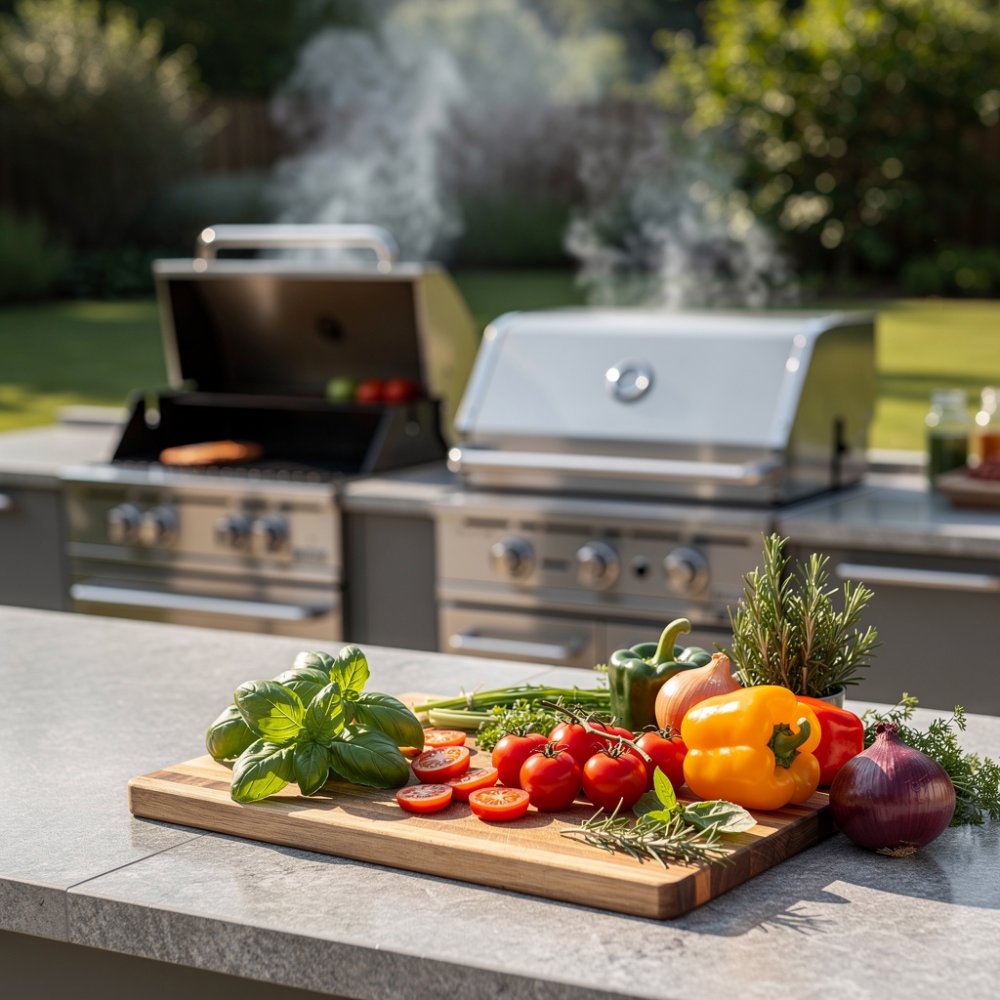
Outdoor Kitchen -- Grilling at a Professional Level
An outdoor kitchen is the natural culmination of a passion for grilling. It brings the comfort of an indoor kitchen to your garden and transforms grilling from an occasional activity into everyday pleasure.
Planning an Outdoor Kitchen
Before building, answer these key questions:
- Where? Ideally near the house for water and electric access, but not directly under windows or patio doors due to smoke and odor
- How large? Minimum functional work surface is 2.5 x 1.5 m, comfortable standard is 3--4 m length with plenty of storage space
- Covered? A pergola or shelter allows grilling in the rain and protects equipment from solar radiation
- Budget? From simple solutions with a grill and work surface (from 10,000 CZK) to a fully equipped kitchen with water supply (100,000 CZK and more)
Basic Outdoor Kitchen Equipment
Essential elements:
- Grill matching your cooking size and style
- Work surface from durable material (granite, stainless steel, large-format porcelain)
- Closed storage protected from the weather
- Quality lighting for safe evening grilling
Advanced elements:
- Sink with access to cold water, ideally also hot water
- Side burner for preparing sauces, sides, and boiling water
- Refrigerator or built-in cooling box for drinks and marinades
- Pizza or bread oven
- Integrated smoker or standalone unit
Materials for Outdoor Kitchen
An outdoor kitchen must withstand frost, rain, UV radiation, and temperature fluctuations year-round:
- Stainless steel: durable, hygienic, and easy to maintain -- most common choice for work surfaces and doors
- Natural stone (granite, slate): aesthetically pleasing, highly durable, ideal especially for work surfaces
- Brick and concrete: traditional and proven materials for structural bases
- Wood: pleasant natural appearance, but requires regular maintenance, impregnation, and corner joint protection
Everything you need for grilling season can be found in Pestik.cz's range.
Tips for Perfect Grilling
Regardless of grill type, several universal principles distinguish average results from truly excellent ones.
Meat Preparation
- Remove meat from the refrigerator 30--60 minutes before grilling so it heats evenly -- a cold center slows heat transfer and leads to uneven cooking
- Dry the surface with a paper towel -- a wet surface steams instead of searing and prevents crust formation
- Salt either just before placing on the grate, or a day in advance (dry salting overnight). Avoid salting an hour before grilling -- salt would draw juices to the surface without allowing them to reabsorb
- Rely on a digital thermometer with probe -- internal temperature is a more accurate indicator of doneness than estimated time
Temperatures and Times
| Food | Method | Grill Temperature | Internal Temperature |
|---|---|---|---|
| Steak (medium rare) | Direct heat | 250+ °C | 55 °C |
| Chicken breast | Indirect heat | 180 °C | 74 °C |
| Pork ribs | Indirect heat | 120 °C | 4--6 hours |
| Vegetables | Direct heat | 200 °C | 5--15 minutes |
| Fish (fillet) | Medium heat | 180 °C | 3--5 minutes/side |
Resting Meat
After removing meat from the grill, let it rest on a cutting board, loosely covered with foil. Muscle fibers relax and juices redistribute evenly throughout the piece -- the result is noticeably more succulent. Guideline time: 5 minutes for steaks, 10--15 minutes for larger pieces like roasts or chicken quarters.
Grilling Safety
Grilling is a safe activity when basic rules are followed:
- Place the grill on a stable, non-flammable surface (tiles, concrete, gravel)
- Maintain a minimum distance of 3 m from buildings, wooden structures, and flammable materials
- Never use gasoline, alcohol, or other liquid fuels for starting or heating charcoal
- Keep a powder or CO2 fire extinguisher on hand, or a bucket of sand
- Never leave a hot grill unattended, especially with children or pets nearby
- After grilling, let charcoal cool completely before disposal -- ash can remain hot for several hours
Frequently Asked Questions
What grill is best for a beginner?
For beginners, we recommend a medium-sized charcoal kettle grill (47--57 cm diameter). It's affordable, teaches you to work with temperature zones, and offers authentic grilling flavor. Anyone who masters temperature control on charcoal will adapt to any other grill type without trouble.
How long should I marinate meat?
It depends on the type of meat and the acidity of the marinade. Marinate fish and seafood for a maximum of 30--60 minutes -- longer contact with acid causes protein denaturation and makes meat mushy. Chicken meat needs 2--4 hours, pork and beef 4--24 hours. However, more time doesn't automatically mean better results -- too long in an aggressive acidic marinade actually damages the meat.
Can I grill in winter?
No problem. Winter grilling has its own charm and the popularity of year-round grilling season in the Czech Republic is growing. Expect longer preheating, slightly higher fuel consumption, and meat from the refrigerator will need more time to reach room temperature. Ceramic kamado grills are ideal for winter conditions -- their insulation minimizes the impact of outside temperature on grill performance.
How do I prevent meat from sticking to the grate?
Preheat the grate to high temperature, then coat it with a layer of oil using a silicone brush or crumpled paper towel held with tongs. Never spray oil directly over flame. Place meat only on a truly hot and oiled grate -- a properly prepared surface naturally facilitates meat release, sticking is usually a result of insufficient preheating.