
 Our products
 Aromatherapy - essential oils
 Essential oils
 Aroma lamps
 Aroma Diffusers
 Seeds
 Vegetables
 Herbs and spices
 Ornamental Plant Seeds
 Grass mixtures
 Sprouts and microgreens
 Growing supplies
 Cultivation and Gardening Supplies
 Hydroponics and indoor growing
 Protective equipment and gardening tools
 Exotic plants
 Exotic Fruit and Vegetables
 Exotic herbs
 Exotic trees and shrubs
 Ornamental exotic plants
 Roasted coffee
 Espresso coffee
 Ecological coffee preparation
 Thermal mugs and coffee cups
 Aeropress
 Thermos flasks and thermal mugs for coffee and tea
 Moka pot
 Filter coffee
 Coffee blends
 Accessories for coffee makers
 Water filtration
 Coffee grinders
 Cleaning the Coffee Maker
 Ecological Cleaning of Coffee Machines
 Coffee makers
 Coffee Preparation
 Coffee Accessories
 Food products
 For wildlife and pets
 Chocolate and others
 Hemp food products
 Natural cosmetics
 Hemp cosmetics
 Smoking supplies
 Bongs - water pipes
 Blunts and tubes
 E-liquids with Terpenes and CBD
 Grinders and Mills
 Papers and filters
 Smoking accessories
 Vaporizers
 Air fresheners
 CBD and CBG products
 CBD sprays
 CBD and CBN crystals
 CBD body and facial care
 Weeds
 CBD suppositories and capsules
 CBD oils and drops
 CBG oils and drops
 House and garden
 Fashion and Decoration
 Kitchen essentials and cooking
 Christmas Decorations and Accessories
 Gift Sets
 Bird feeders
 Seasonal and Special Tools
Your own water feature in the garden is the dream of many homeowners. Whether it's a family swimming pool for summer refreshment, an elegant decorative pond or a natural bathing biotope, water brings a new dimension to your garden. Besides relaxation and entertainment, a water element increases property value, improves microclimate and attracts useful wildlife, including frogs, dragonflies and birds.
In this guide we will compare types of pools and ponds, their advantages, disadvantages and costs, discuss proper water maintenance and advise how to choose a solution suited to your garden size and available budget. A complete range of products for bathing and water recreation can be found on the Pestik.cz website.
Types of Pools -- From Inflatable to Concrete
The choice of pool type depends on the size of your plot, budget, number of users and whether you are looking for a seasonal or year-round solution. Each category has clearly defined advantages and compromises.
Inflatable and Frame Pools
The most affordable options are inflatable and frame pools. They are suitable for families with small children and for those who want to use a pool only in summer months without permanent garden modifications.
Inflatable pools:
- Lowest purchase price (from a few hundred crowns)
- Installation without tools, one person can handle it in an hour
- Easy to disassemble and store off-season
- Limited lifespan (2--4 seasons depending on material quality)
- Small water volume and limited depth
Frame pools:
- Solid steel construction resistant to deformation
- Available in larger sizes (up to 7 x 3.5 m and 1.2 m depth)
- Lifespan of 5--10 years with proper storage and maintenance
- Assembly manageable by two people in an afternoon without special tools
- Compatible with filtration systems, solar heaters and covers
When choosing a pool from the frame pool category, pay attention to membrane thickness -- quality models have membranes at least 0.4 mm thick with reinforced seams. Cheaper versions are more prone to punctures from sharp objects in the ground.
In-Ground Pools
In-ground pools are a permanent solution that aesthetically blends with the garden and demonstrably increases property value. There are three main construction options:
Concrete pools:
- Highest lifespan (30+ years)
- Unlimited shape, size and depth according to wishes
- Highest purchase costs (from 300,000 CZK and up)
- Implementation takes weeks to months including concrete curing
- Usually requires building permit or notification
Fibreglass pools:
- Prefabricated shell installed by crane in 2--3 days
- Smooth gelcoat surface resists algae and facilitates cleaning
- Limited to available shapes and sizes from manufacturers
- Mid-price range (from 100,000 CZK for installation)
- Lifespan exceeds 20 years with proper care
Membrane pools:
- Steel or aluminium structure with inserted membrane
- Flexible floor plan without restrictions to standard shapes
- Lower cost than concrete construction for comparable volume
- Membrane renewed approximately every 10--15 years (cost 20,000--40,000 CZK)
Above-Ground Pools with Fixed Walls
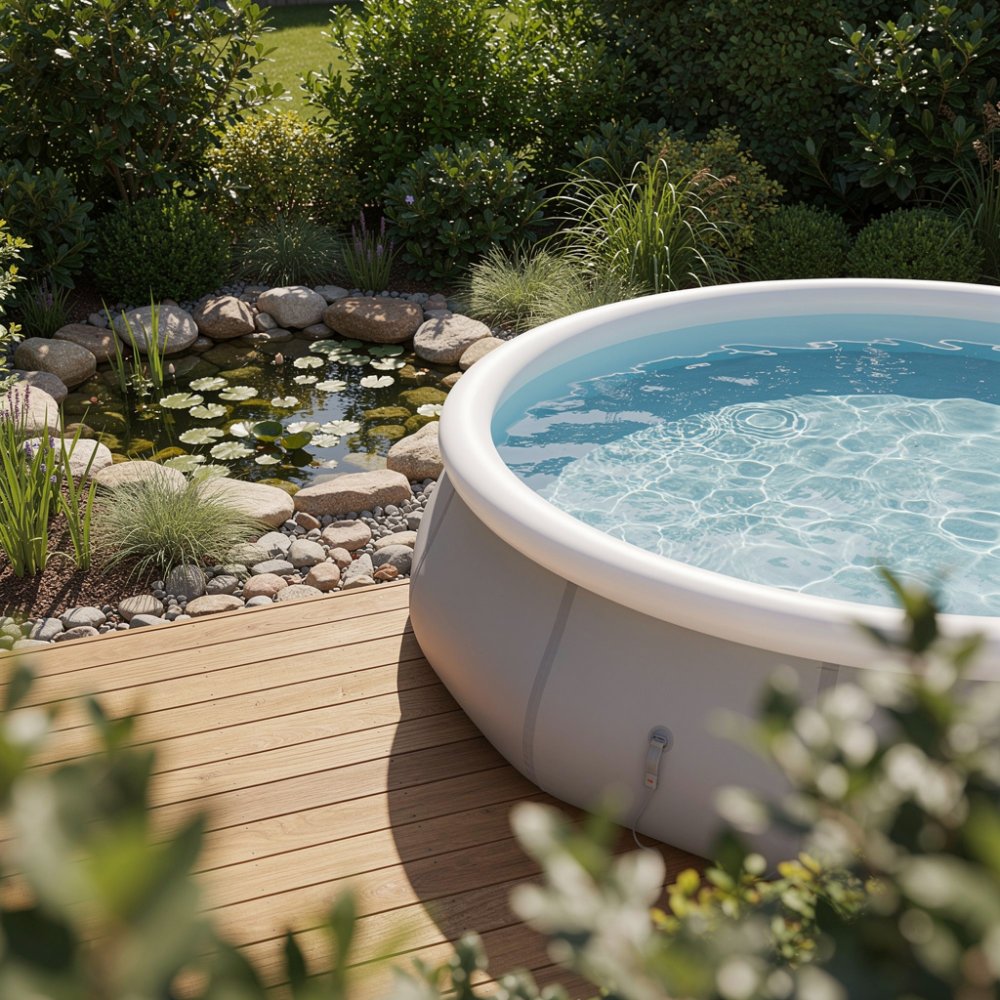
Above-ground pools with steel or wooden perimeter walls form a practical compromise between frame and in-ground solutions. They offer greater volume and more stable construction than frame models, while requiring no earthwork or building permits. Wooden versions (so-called wood pools) also harmonize well with the natural style of a garden.
Garden Ponds -- Decorative and Bathing
A pond gives your garden a natural character and becomes a centre of biodiversity. It attracts frogs, dragonflies, bumblebees and birds, and under proper conditions functions as a self-sufficient ecosystem with minimal operational demands.
Decorative Ponds
A decorative pond serves primarily aesthetic purposes and can be very small -- even a container with an area of 2 m2 will enliven a garden corner. The key to success is balance between plants, fish and filtration.
Basic elements of a decorative pond:
- Shaped membrane (EPDM or PVC) or preformed plastic container
- Biological or combined filtration system
- Pump ensuring circulation and oxygenation
- Band of aquatic plants divided by depth (see below)
- Optionally fish -- carp, goldfish or ornamental koi
The minimum depth for safe winter survival of fish without technical heating is 80 cm. For water lilies, you need the deepest part at least 60 cm below water level. If you plan both plant groups and fish, design the pond with a stepped bottom.
Bathing Ponds and Biotopes
A bathing pond, also called a natural biotope or swimming pond, combines the function of a pool with a natural appearance and biological water purification. Disinfecting chemicals are not used -- plants, substrate filters and microorganisms in the sediment clean the water.
Advantages of a bathing biotope:
- No chemicals -- water is gentle on skin and hair
- Year-round aesthetic element that doesn't look empty in winter
- Active support for garden biodiversity
- Low operating costs after the first two years when the ecosystem stabilizes
- Demonstrable positive effect on property value
Disadvantages and limitations:
- Higher initial investment than a pool of comparable size
- Need for larger overall area -- regeneration zone with plants takes up 50--60% of total area
- Water clarity does not match chemically treated pools, especially in spring
- Proper care of the plant zone requires basic gardening knowledge and regular biomass harvesting
Pool Water Maintenance
Proper water maintenance is essential for safe and enjoyable swimming throughout the season. Neglect leads to cloudiness, algae overgrowth and in extreme cases to dangerous bacteria.
Chemical Water Treatment
pH value is the starting parameter on which the effectiveness of all disinfection depends. The ideal range is 7.0--7.4. Below 7.0, metal parts corrode faster and water irritates eyes; above 7.6, chlorine disinfection effectiveness drops by tens of percent and water begins to cloud.
Disinfection is performed using one of these methods:
- Chlorine (granules or tablets): most effective and cheapest option, works over a wide pH range; poor dosing can irritate skin and eyes
- Active oxygen: gentler on skin, no characteristic odour, suitable for children and allergy sufferers; higher price and more careful dosing required
- Bromine: stable even at temperatures above 35 °C, recommended for hot tubs and covered pools
- Salt electrolysis: system continuously produces chlorine directly from table salt; higher equipment purchase price but lower chemical costs and gentler impact on skin
Always measure pH and disinfection at the same time of day -- ideally in the morning before first swimming. Test strips are quick but less accurate than drop tests or digital testers.
Filtration
The filtration system is the heart of every pool. Without continuous functioning filtration, even chemically treated water will deteriorate within 48 hours in summer temperatures.
- Sand filtration: most widespread type, proven by decades of practice; silica sand captures particles over 20--40 micrometres, regenerated by backwashing
- Cartridge filtration: compact and quiet, suitable for pools up to approximately 20 m3; replace or thoroughly rinse cartridge every 2--4 weeks
- Diatomite (DE) filtration: finest available method, captures particles from 3--5 micrometres including some bacteria; higher purchase price but outstanding water clarity
Operate filtration daily for 8--12 hours -- in hot summer weather and with more swimmers, rather toward the upper limit. A properly sized pump should filter the entire pool volume at least once every 6 hours.
Seasonal Maintenance
Season opening (April--May):
- Visual inspection of membrane, seals and all equipment
- Filling with clean water, ideally from mains with low calcium content
- Start filtration and balance pH before first disinfection
- Shock chlorination to eliminate microorganisms overwintering
Ongoing care during season:
- Daily pH and disinfection level measurement
- Regular removal of leaves, insects and debris from surface with skimmer or net
- Weekly check of total water hardness and algicide application at first signs of greenness
- Monthly backwash of sand filter or cartridge cleaning
Winterization (October):
- Lower water level approximately 20 cm below skimmer and return level
- Add winterizing preparation to prevent bacterial growth under cover
- Cover with rigid tarp or safety net
- Drain, clean and store pump, filter and heater in frost-free location
Pond Care -- Caring for the Water Ecosystem
Pond maintenance pursues a different goal than pool care. We do not aim for sterile water but stable biological balance where plants, animals and microorganisms regulate each other.
Aquatic Plants as Natural Filter
Plants are the foundation of a healthy pond -- they remove nitrates and phosphates that would otherwise feed algae. For optimal function, you need representation from all depth zones:
- Marginal plants (0--10 cm): irises, marsh marigold, water forget-me-not
- Shallow water plants (10--40 cm): common reed, bur-reed, arrowhead
- Deep water plants (40 cm and more): water lilies, yellow water-lily
- Floating plants: frogbit, duckweed -- avoid water hyacinth and parrot feather which are invasive in open environments
Floating leaves should cover approximately one-third of the water surface -- they shade the water, limit overheating and prevent mass algae growth. Remove dead biomass every autumn so decomposition doesn't overload the pond with nutrients.
Fighting Algae
Algae are a natural part of every aquatic environment and complete eradication is not the goal. They become a problem when they overgrow due to excess nutrients, overheating or insufficient filtration.
Prevention is always more effective than subsequent treatment:
- Limit nutrient input -- don't overfeed fish and prevent fertilizer runoff from adjacent beds into the pond
- Ensure adequate shading with a combination of aquatic plants and surrounding vegetation
- Regularly remove dead plant parts and fallen leaves
- Keep circulation pump running continuously
- Consider a UV sterilizer as filtration complement -- radiation destroys single-celled algae mechanically without chemicals
With significant algae overgrowth, manual removal with a rake or special brush helps, supplemented by short-term application of hydrogen peroxide-based preparations.
Water Safety
Safety measures are not optional extras -- they are basic responsibility for every water feature owner, especially in households with small children or near neighbouring properties.
- Fencing: pool or pond should be surrounded by a fence at least 1.1 m high with self-closing and self-latching lock opening outward
- Safety nets and rigid covers: load-bearing covers support a child's weight and prevent falls into water even with obscured view
- Water alarm: float or frame alarms detect water movement and immediately alert with audible signal
- Direct supervision rule: never leave children under 12 years old at an open water feature without an adult nearby
- Rescue equipment: rescue ring or telescopic rescue pole should be permanently accessible near the pool
Browse the complete range of products for bathing and water recreation and choose a solution that matches your garden and your needs.
Frequently Asked Questions
How much does pool operation cost per season?
Operating costs depend on water volume, frequency of use and chosen maintenance system. For a frame pool measuring 3 x 6 m, expect approximately 3,000--5,000 CZK annually for chemicals and pump electricity. An in-ground pool with sand filtration, heat pump and regular chemical care costs 8,000--15,000 CZK per year. A salt electrolizer can reduce these costs by 20--30%.
Do I need a building permit for a pool?
Permits are typically not required for above-ground and frame pools. For in-ground pools, it depends on dimensions and local conditions -- pools with footprint over 40 m2 or depth exceeding 1.5 m usually require at least notification. Always consult with your local building authority beforehand as regulations can vary by municipal plan.
How large should a bathing pond be?
The recommended minimum total area for a functional bathing biotope is 50 m2. The bathing zone comprises 40--50% of the area, the remaining part is for the regeneration zone with aquatic plants. For comfortable bathing by a family of four, plan for a bathing zone of at least 20 m2 and total depth of at least 1.5 m.
Can fish and swimming coexist in one pond?
Generally this combination is not recommended. Fish significantly increase nitrate and phosphate content in water, which accelerates algae growth and reduces overall water quality for bathing. A decorative pond with fish and a bathing biotope are therefore best designed as two separate reservoirs, possibly connected by an overflow through a plant filter zone.