
 Our products
 Aromatherapy - essential oils
 Essential oils
 Aroma lamps
 Aroma Diffusers
 Seeds
 Vegetables
 Herbs and spices
 Ornamental Plant Seeds
 Grass mixtures
 Sprouts and microgreens
 Growing supplies
 Cultivation and Gardening Supplies
 Hydroponics and indoor growing
 Protective equipment and gardening tools
 Exotic plants
 Exotic Fruit and Vegetables
 Exotic herbs
 Exotic trees and shrubs
 Ornamental exotic plants
 Roasted coffee
 Espresso coffee
 Ecological coffee preparation
 Thermal mugs and coffee cups
 Aeropress
 Thermos flasks and thermal mugs for coffee and tea
 Moka pot
 Filter coffee
 Coffee blends
 Accessories for coffee makers
 Water filtration
 Coffee grinders
 Cleaning the Coffee Maker
 Ecological Cleaning of Coffee Machines
 Coffee makers
 Coffee Preparation
 Coffee Accessories
 Food products
 For wildlife and pets
 Chocolate and others
 Hemp food products
 Natural cosmetics
 Hemp cosmetics
 Smoking supplies
 Bongs - water pipes
 Blunts and tubes
 E-liquids with Terpenes and CBD
 Grinders and Mills
 Papers and filters
 Smoking accessories
 Vaporizers
 Air fresheners
 CBD and CBG products
 CBD sprays
 CBD and CBN crystals
 CBD body and facial care
 Weeds
 CBD suppositories and capsules
 CBD oils and drops
 CBG oils and drops
 House and garden
 Fashion and Decoration
 Kitchen essentials and cooking
 Christmas Decorations and Accessories
 Gift Sets
 Bird feeders
 Seasonal and Special Tools
Water makes up 98% of the volume of filtered coffee and approximately 90% of espresso. Yet most people devote all their attention to selecting beans, adjusting the grinder, and brewing method, while water quality remains the most overlooked variable in the entire process. The same logic applies to the garden – irrigation water quality directly affects plant health, nutrient availability, and final harvest quality. On pestik.cz you will find a complete assortment for water filtration covering the needs of both coffee enthusiasts and demanding growers.
Why Water Quality Matters
Water and Coffee
The Specialty Coffee Association (SCA) defines precise parameters for ideal water for coffee preparation. These are not academic values – deviations from them will directly affect the taste of your cup.
| Parameter | Ideal Value | Acceptable Range |
|---|---|---|
| TDS (total mineralization) | 150 mg/l | 75-250 mg/l |
| Hardness (CaCO3) | 50-175 mg/l | 17-85 mg/l |
| pH | 7.0 | 6.5-7.5 |
| Sodium | under 10 mg/l | – |
| Chlorine | 0 mg/l | 0 mg/l |
Minerals in water are not merely unwanted impurities – they play an active role in extraction. Calcium helps release flavor compounds from the coffee matrix, magnesium brings out fruity and floral notes. Too low mineralization leads to a flat, characterless cup. Conversely, excessive mineralization causes a harsh, chalky taste and suppresses delicate aromas.
Chlorine, present in practically all tap water, is destructive to coffee even in trace amounts. It reacts with coffee compounds and imparts an unpleasant chemical note to your cup. Eliminating chlorine is therefore an absolute first step in any water treatment for coffee purposes.
Water and Garden
Plants are as sensitive to water quality as coffee, just for different reasons. Hard water with high calcium content gradually raises substrate pH, blocking the uptake of iron, manganese, and other micronutrients – plants then show signs of nutrient deficiency even when these nutrients are sufficiently present in the soil. Chlorinated water disrupts the balance of beneficial soil microorganisms, which are crucial for a healthy root system. Water high in sodium worsens soil structure and reduces its water retention capacity.
Particularly sensitive are indoor tropical plants, seedlings in early development stages, hydroponic systems, and plants requiring acidic substrate – azaleas, rhododendrons, blueberries, and camellias.
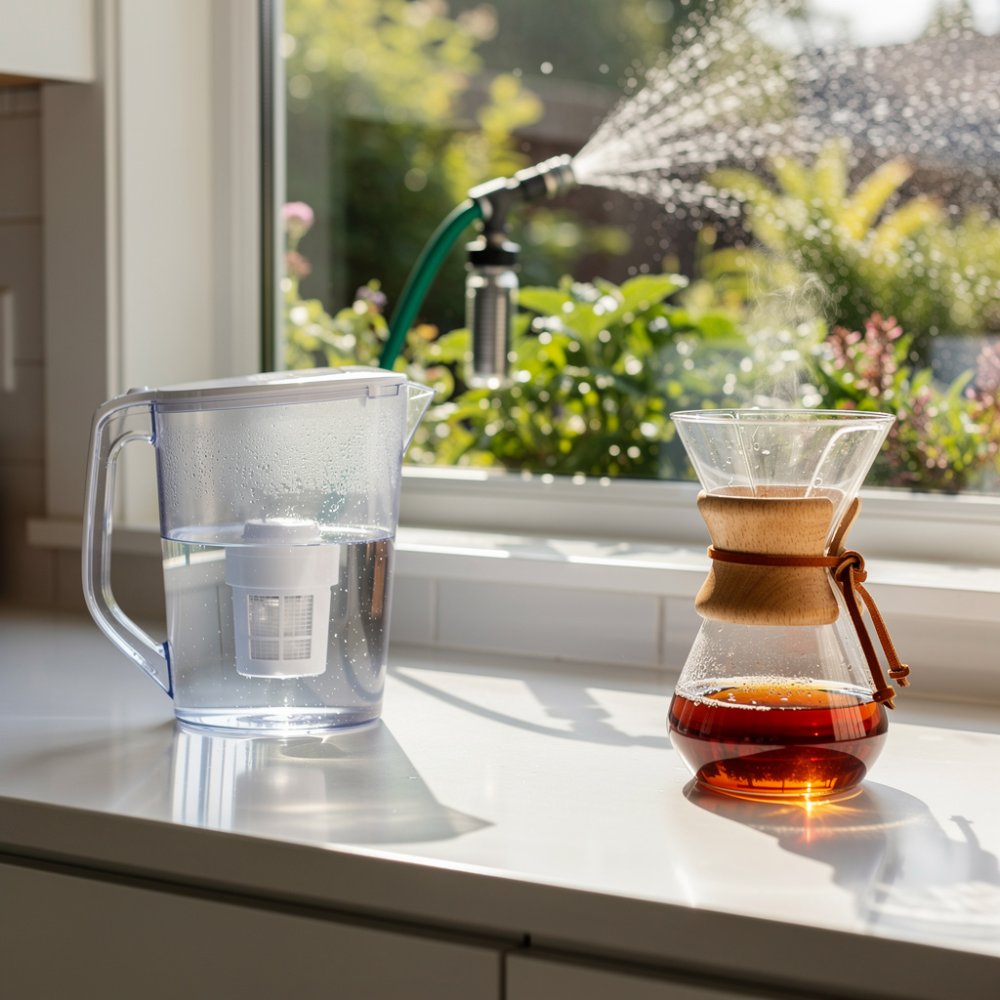
Filtering Pitchers – Most Accessible Solution
Filtering pitchers are the simplest and most cost-effective way to improve water quality without any structural modifications. They work on the principle of gravity filtration – water passes through a combined filter of activated carbon and ion exchange resin, with the entire process typically taking 3-7 minutes depending on volume and filter type.
What Filtering Pitchers Remove
- Chlorine and chloramines – eliminating chemical taste and odor, key for both coffee and sensitive plants
- Some calcium and magnesium – reducing overall water hardness, protecting coffee makers from limescale
- Heavy metals – lead, copper, mercury depending on the specification of the specific filter
- Organic impurities – pesticides and herbicides with more advanced multi-layer media filters
What Filtering Pitchers Don't Remove
Standard filtering pitchers do not remove bacteria, viruses, nitrates, fluorides, or most dissolved inorganic salts. For microbiological contamination removal or nitrate reduction, a more advanced system is necessary – reverse osmosis or UV sterilization.
How to Choose a Filtering Pitcher
When selecting, focus on container volume (1.5-3.5 liters depending on number of people), filtration speed, filter type and replacement filter availability, pitcher body material (BPA-free plastic or glass), and filter compatibility with your primary intended use.
For coffee preparation, look for pitchers that reduce hardness rather than completely eliminate it. Total mineral removal would lead to over-extracted, bitter, or empty-tasting coffee. Some manufacturers offer special barista cartridges calibrated to the optimal mineral profile for espresso or pour-over coffee – these filters are significantly more precise tools than standard variants.
Cartridge Filtration – System Under Sink or at Supply
Cartridge filtration represents a significant step above filtering pitchers. Filters are connected directly to the water supply line – most commonly under the sink or at the coffee maker supply – and work under pressure, providing higher flow rates and more stable filtration without the need for manual pouring.
Types of Cartridge Filters
Carbon filters form the foundation of every filtration system. Activated carbon with high surface area adsorbs chlorine, organic compounds, and some heavy metals. They do not change water minerality, making them suitable as a standalone solution for water with acceptable hardness.
Ion exchange filters reduce water hardness by exchanging calcium and magnesium ions for sodium or hydrogen ions. They are key to protecting coffee makers from limescale and extending their lifespan.
Combination filters unite activated carbon, ion exchange resin, and mechanical prefiltration in one cartridge. They are the most common choice for household coffee makers and small cafes, as they address both chlorine and hardness in one step.
Reverse osmosis (RO) represents the most thorough available filtration – the membrane removes 95-99% of all dissolved substances including ions, bacteria, and viruses. The resulting water is nearly distilled and must be remineralized for coffee preparation by adding precisely defined amounts of minerals. For hydroponics, RO water is an ideal starting point.
When to Replace a Cartridge
Cartridge lifespan depends on filter type, water hardness, and flow rate. Exceeding recommended intervals leads first to reduced effectiveness, and in extreme cases to the backward release of captured substances into the water.
| Filter Type | Lifespan | Approximate Volume |
|---|---|---|
| Carbon | 3-6 months | 500-2,000 liters |
| Ion exchange | 2-3 months | 300-1,000 liters |
| Combination | 2-4 months | 400-1,500 liters |
| RO membrane | 12-24 months | per manufacturer |
A complete range of replacement filters can be found at pestik.cz.
Water Treatment for Garden
Optimal irrigation water differs from ideal drinking water. Water treatment for garden use focuses primarily on pH, chlorine content, and overall mineralization.
Rainwater – Natural Choice
Rainwater is the ideal solution for most plants – it has low mineralization, naturally slightly acidic pH (5.5-6.5), and contains no chlorine or fluorides. Collection in barrels or underground tanks with coarse prefilter is an ecological and economical solution that also saves mains water. The only potential disadvantage may be contamination from polluted air in cities – in such cases, it is advisable to roughly prefilter the water before use.
How to Improve Tap Water for Plants
- Remove chlorine naturally – fill a watering can and let it stand 24 hours in an open container; chlorine will evaporate. A faster alternative is to add a small amount of vitamin C (ascorbic acid) – approximately 1 gram per 40 liters instantly dechlorinates the water.
- Lower pH for acid-loving plants – add undiluted apple cider vinegar (approximately 1 tablespoon per 4 liters) or citric acid. Always check the resulting pH with a pH meter or test strip.
- Temper the water – water at room temperature, never with direct cold tap water. Temperature shock damages delicate root hairs and slows nutrient uptake.
Hydroponic Systems and Water Quality
In hydroponics, the quality of source water is more critical than anywhere else, because plants derive all nutrients exclusively from the solution. The ideal starting point is water with mineralization below 100 ppm TDS, to which nutrients are added precisely according to the recipe for the specific cultivation. Hard water with high calcium and magnesium content not only complicates precise dosing, but can cause precipitation of phosphates and other nutrients, making them unavailable to plants.
For professional hydroponics, reverse osmosis is the standard starting point – pure water enables full control over nutrient solution composition without unwanted mineral interferences from the water supply.
Practical Guide – What to Choose
For Home Coffee Preparation
Basic Solution: Filtering pitcher with carbon or combination filter. Removes chlorine and partially reduces hardness. Investment: 300-800 CZK plus replacement filters.
Mid-Range Solution: Cartridge filter at coffee maker supply. Reliable and consistent filtration without manual filling, suitable for daily preparation. Investment: 1,000-3,000 CZK.
Premium Solution: Cartridge filter with remineralization or special barista filter calibrated to the optimal mineral profile for espresso or pour-over coffee. Investment: 3,000-8,000 CZK.
For Garden and Indoor Plants
Basic Solution: Let tap water stand 24 hours in an open container and temper to room temperature. Zero investment, significant improvement for sensitive plants.
Mid-Range Solution: Rainwater collection in a barrel with coarse prefilter. Investment: 500-2,000 CZK, most economical long-term option.
Premium Solution: Water treatment system with filtration and pH regulation for hydroponics and acid-loving plants – ideally RO-based with subsequent pH and EC correction.
Measuring Water Quality – Basic Tools
You don't need a laboratory to monitor water quality. Basic measuring tools are affordable and can be used by anyone:
- TDS meter (100-300 CZK) – measures total mineralization in ppm; essential for hydroponics and coffee enthusiasts
- pH meter (200-500 CZK) – measures acidity or alkalinity; more accurate alternative to test strips
- Hardness test strips (50-150 CZK per pack) – quick orientation test suitable for initial water quality assessment
- GH/KH drop test (100-300 CZK) – more accurate measurement of total and carbonate hardness, standard tool in aquatics and hydroponics
We recommend measuring your tap water quality before purchasing any filtration system. The results may surprise you – if your water meets SCA parameters and contains only minimal chlorine, a simple carbon filter may suffice instead of an expensive system.
Frequently Asked Questions
Is water from a filtering pitcher suitable for coffee preparation?
Yes, a filtering pitcher is a solid first step. It removes chlorine – the most harmful factor for coffee taste – and partially reduces hardness. For most home baristas, this is a fully sufficient solution. If you want more precise control over water mineral profile, consider a cartridge filter with adjustable softening or a special barista cartridge.
Can I water plants with water from a filtering pitcher?
Yes, filtered water is better for most plants than raw tap water. Particularly, chlorine elimination benefits soil microorganisms and sensitive species. However, be careful with filters based on sodium ion exchange – if they significantly increase the water's sodium content, regular watering may damage salinity-sensitive plants.
How often should I change the pitcher filter?
General recommendation is every 2-4 weeks or after filtering 100-150 liters – the exact interval depends on the specific filter type and your water hardness. Exceeding the recommended lifespan reduces filtration efficiency and in extreme cases may cause captured contaminants to be released back into the water. Always keep a supply of replacement filters on hand and follow manufacturer recommendations.
Is Hard Water Harmful to Plants?
It depends on the specific plant species. Most common garden plants tolerate hard water without problems. Complications arise with acid-loving species (azaleas, rhododendrons, blueberries), indoor tropical plants, and especially in hydroponic systems where high calcium and magnesium content disrupts the balance of the entire nutrient solution. If you have hard water and sensitive plants, filtration or regular rainwater collection is a sensible and effective solution.