
 Our products
 Aromatherapy - essential oils
 Essential oils
 Aroma lamps
 Aroma Diffusers
 Seeds
 Vegetables
 Herbs and spices
 Ornamental Plant Seeds
 Grass mixtures
 Sprouts and microgreens
 Growing supplies
 Cultivation and Gardening Supplies
 Hydroponics and indoor growing
 Protective equipment and gardening tools
 Exotic plants
 Exotic Fruit and Vegetables
 Exotic herbs
 Exotic trees and shrubs
 Ornamental exotic plants
 Roasted coffee
 Espresso coffee
 Ecological coffee preparation
 Thermal mugs and coffee cups
 Aeropress
 Thermos flasks and thermal mugs for coffee and tea
 Moka pot
 Filter coffee
 Coffee blends
 Accessories for coffee makers
 Water filtration
 Coffee grinders
 Cleaning the Coffee Maker
 Ecological Cleaning of Coffee Machines
 Coffee makers
 Coffee Preparation
 Coffee Accessories
 Food products
 For wildlife and pets
 Chocolate and others
 Hemp food products
 Natural cosmetics
 Hemp cosmetics
 Smoking supplies
 Bongs - water pipes
 Blunts and tubes
 E-liquids with Terpenes and CBD
 Grinders and Mills
 Papers and filters
 Smoking accessories
 Vaporizers
 Air fresheners
 CBD and CBG products
 CBD sprays
 CBD and CBN crystals
 CBD body and facial care
 Weeds
 CBD suppositories and capsules
 CBD oils and drops
 CBG oils and drops
 House and garden
 Fashion and Decoration
 Kitchen essentials and cooking
 Christmas Decorations and Accessories
 Gift Sets
 Bird feeders
 Seasonal and Special Tools
Voda je pro rostliny stejně nepostradatelná jako světlo a živiny. Příliš málo jí způsobuje vadnutí, přebytek vede k hnilobě kořenů a houbovým chorobám. Správný způsob zavlažování se odvíjí od velikosti zahrady, druhu pěstovaných plodin, dostupnosti vody a vašeho časového fondu. Tento průvodce vás provede celým spektrem metod – od klasické konve přes kapkové systémy až po plně automatizované řízení s chytrými senzory.
Basic principles of proper watering
Než přejdeme k technice, zopakujme pravidla, která platí bez ohledu na zvolenou metodu:
- Water at the roots, not on the leaves – constantly wet leaves provide fertile ground for fungi and fungal diseases
- Water in the morning – plants have all day to utilize the water they receive and leaves have time to dry before evening
- Water less frequently but abundantly – deep watering forces roots to grow deeper where the soil remains moist even during drought
- Mulch – a layer of mulch 5–10 cm reduces soil evaporation by 50–70% and also suppresses weeds
- Adjust to soil composition – sandy soil allows water to pass through quickly and requires shorter but more frequent watering; clay soil retains it longer
- Monitor the weather – do not water after heavy rain; on tropical days, check moisture daily
How much water do plants need?
| Crop | Water requirement (l/m²/week) | Critical period |
|---|---|---|
| Tomatoes | 20–30 | Flowering and fruit ripening |
| Peppers | 15–25 | Flowering |
| Cucumbers | 25–35 | Entire growing season |
| Lettuce | 15–20 | Entire growing season |
| Strawberries | 15–25 | Flowering and ripening |
| Lawn | 20–30 | July–August |
| Fruit trees | 30–50 | June–August |
The stated values are approximate. Actual requirements depend on temperature, solar radiation, wind, and soil type. In hot and dry summers, feel free to exceed these values by about a third.
Manual watering
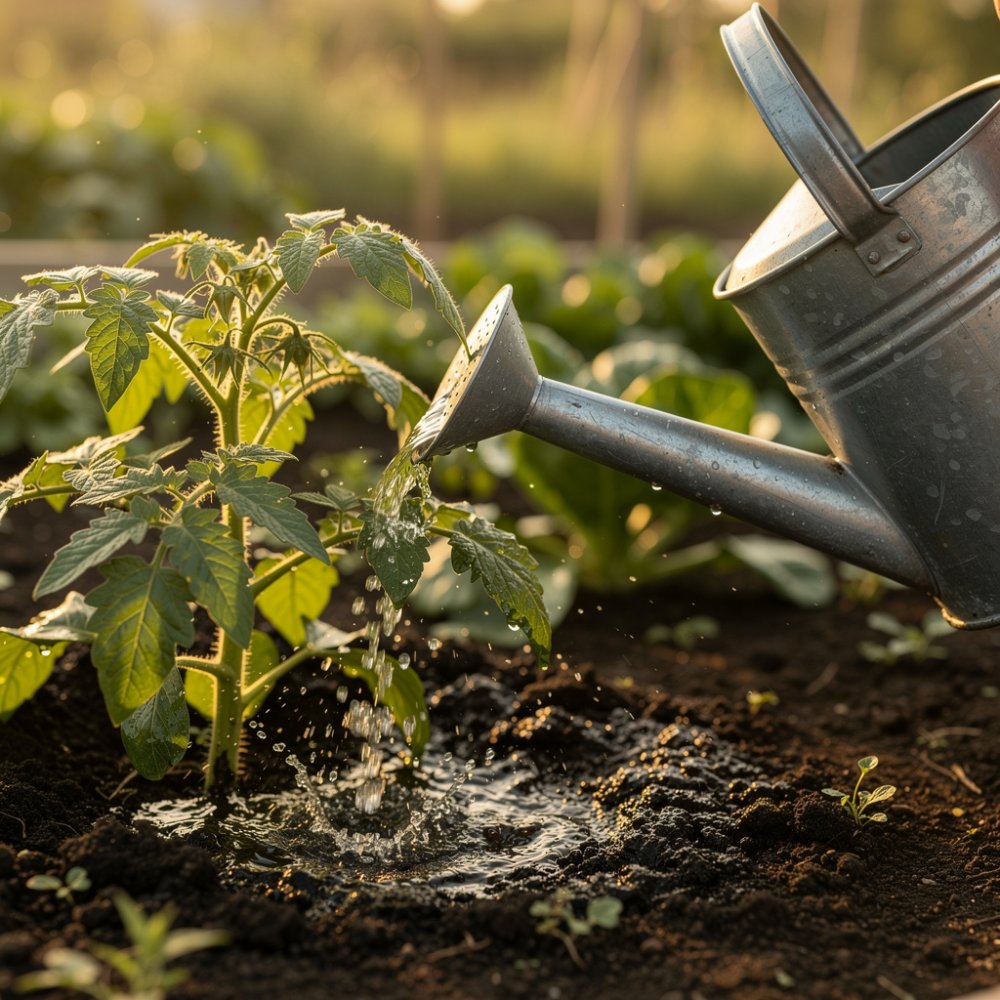
Watering can
The oldest and simplest method. Ideal for small gardens, balconies, terraces and greenhouses where direct contact with each plant helps identify any problems early.
Advantages: Precise dosage control, zero installation costs, you see each plant up close
Disadvantages: Time-consuming, practically unusable for larger areas
Tips for efficient watering can use:
- Choose a can with a fine rose (spray head) for seedlings and young plants – a strong stream can wash the substrate away from roots
- A can with a narrow spout allows targeted watering directly at the root zone without wetting the leaves
- Plastic cans are lighter and easier to handle; metal (galvanized or stainless steel) lasts significantly longer
- In the watering cans and sprayers category you'll find cans from 1 to 12 liters for every use
Garden hose
A universal tool for medium and large gardens. With the right nozzle, it covers everything from gentle watering of seedlings to washing garden furniture.
Types of hoses:
- Standard – diameter 1/2" or 3/4", a reliable choice for everyday watering
- Flexible (retractable) – expand to full length under water pressure, contract when turned off and store easily
- Professional (multi-layer) – reinforced hoses resistant to twisting, abrasion and UV radiation, suitable for daily intensive use
Recommended accessories:
- Shower nozzle with adjustable spray – from fine rain for seedlings to strong jet for larger plants
- Oscillating or rotating sprinkler – for even lawn watering without repositioning
- Quick couplers – facilitate hose and accessory switching and extend their lifespan
In the garden hoses section you'll find hoses of various lengths and diameters including complete accessories.
Drip irrigation
Drip irrigation is one of the most efficient available methods – it delivers water exactly where the plant needs it, directly to the root zone, and almost nothing is lost to evaporation. Compared to spray watering, it saves 30–50% of water.
How a drip system works
Water flows under low pressure (0.5–2 bar) through main tubing to emitters – drippers that release precisely metered amounts of water into the soil, typically 2, 4 or 8 liters per hour. The soil is saturated gradually and evenly, without puddles and without unnecessary wetting of the surface between plants.
System components
| Component | Function | Note |
|---|---|---|
| Main tubing | Water distribution from source to beds | PE tube 16–25 mm |
| Drip tape | Integrated emitters every 20–33 cm | For rows and row crops |
| Drippers (point) | Supplying individual plants | Adjustable 0–40 l/h |
| Micro-sprayers | Cover larger areas | For shrubs, densely planted beds |
| Filter | Protection of emitters from clogging | Disk or mesh, min. 120 mesh |
| Pressure regulator | Reduce pressure to 1–1.5 bar | Protects emitters from overload |
| Couplers, T-joints, shutoffs | Branching and section shutoff | Standard 16 mm diameter |
Netafim – professional pressure irrigation
Netafim is the global leader in drip irrigation with more than fifty years of experience in demanding agricultural conditions worldwide. Their systems are characterized by:
- Compensated drippers – maintain constant flow regardless of pressure fluctuations or line length, so all plants receive equal amounts of water
- Anti-drain mechanism – when the system is switched off, prevents uncontrolled water leakage from the tubing
- Self-cleaning function – silicone membrane seals minimize clogging risk even with lower quality water
- Long lifespan – with proper installation and winter maintenance, Netafim systems work reliably for 10–15 years
For gardeners, the ideal starter solution is micro-capillary distribution, which anyone can install without expert knowledge and easily adapt to any bed shape.
Installing a drip system – step by step
- Plan the layout – sketch out your beds, plant spacing and water source location; determine how many zones you'll need
- Main tubing – lay PE tube from the source along the beds, secure it with clips or stones
- Drip tape – connect it to the main line via T-joints or holes made with a punch
- Point drippers – for trees and shrubs, run microtube from the main line to the root zone of each plant
- Filter and pressure regulator – install as the first components right after the water tap or timer
- Flush the system – before covering, open the ends of the hoses and let the system flush for 2–3 minutes
- Mulching – cover the hoses with organic mulch; it protects against UV radiation, maintains moisture and provides thermal insulation in winter
Watering automation
Timers and control units
Automation turns a daily chore into a reliable, worry-free system. Set the program once and the system takes care of everything else – including your vacation.
| Type | Function | Suitable for |
|---|---|---|
| Mechanical timer | Rotary, 0–120 min setting | Occasional use, hoses |
| Digital timer | Programmable, battery powered | 1–2 zones, drip system |
| Smart control unit | Wi-Fi, sensors, mobile app | Multiple zones, complex garden |
| Solar unit | Solar panel with battery | Locations without power access |
In the watering control section you'll find timers from simple mechanical models to smart systems with full smartphone control.
Example weekly program for summer watering:
- Vegetable beds: 6:00 AM, 30 minutes, daily (drip system)
- Lawn: 5:00 AM, 45 minutes, every other day (oscillating sprinkler)
- Fruit trees: 7:00 AM, 60 minutes, 2× weekly (drip system with point drippers)
Soil moisture sensors
The smartest addition to any automatic system. The sensor continuously measures actual soil moisture and triggers watering only when truly needed – not according to a fixed schedule. The result is water savings and a healthier root system without overwatering.
- Tensiometer – measures soil water tension, i.e., how hard the plant has to work to get water; precise and proven professional method
- Capacitive sensor – measures moisture based on soil electrical capacity; affordable choice for hobby growers
- Integration with control unit – the sensor automatically stops or starts watering based on actual soil conditions, not just the clock
Rainwater collection and use
Why collect rainwater?
- Financial savings – rainwater is free, unlike mains water
- Better for plants – it's soft, naturally warm and contains no chlorine or calcium that gradually salinizes soil
- Ecological choice – reduces runoff into sewers and contributes to water retention in the landscape
- Independence – even during water restrictions in dry summers you have your own supply
How to assemble a collection system
- Gutter downspout – channel rainwater from house, garage or greenhouse roof into a tank using a downspout
- Inlet filter – catches leaves, twigs and coarse debris before they enter the tank
- Tank – watering tanks are available from 100 liters to multikiloiter underground cisterns
- Outlet tap – a gravity system works without power if the tank is positioned higher than the usage point; otherwise a pump is needed
- Pump – for connection to an automatic drip system you need stable pressure provided by a garden pump
How much water will you collect?
With average annual rainfall in the Czech Republic (600–700 mm) you'll collect approximately 50,000–60,000 liters of water per year from a 100 m² roof. This fully covers the needs of a medium-sized garden of 200–300 m² throughout the season.
| Tank volume | Reserve with normal use | Suitable for |
|---|---|---|
| 200–300 l | 1–2 weeks | Balcony, small garden |
| 500–1000 l | 3–4 weeks | Medium garden |
| 2000–5000 l | Entire season supply | Large garden, beds and lawn |
Water barrels and tanks are a practical and financially accessible solution for smaller gardens where there's no space or need for a larger tank.
Comparison of watering methods
| Method | Efficiency | Installation cost | Maintenance | Automation | Suitable for |
|---|---|---|---|---|---|
| Watering can | 90% | 100–500 CZK | None | No | Balcony, herbs, transplanting |
| Hose + sprinkler | 50–60% | 500–2,000 CZK | Low | Partial | Lawn, beds |
| Drip system | 90–95% | 2,000–8,000 CZK | Medium | Yes | Beds, greenhouse, fruit trees |
| Micro-sprayers | 70–80% | 1,500–5,000 CZK | Medium | Yes | Shrubs, densely planted beds |
| Soaker hose | 80–85% | 500–2,000 CZK | Low | Partial | Beds, hedges |
| Underground drip | 95% | 5,000–15,000 CZK | Low | Yes | Lawn (professional installation) |
Most common watering mistakes
- Shallow watering – surface wetting stimulates roots to grow at the surface where they're unprotected in the first drought
- Evening watering – leaves don't dry overnight and become ideal ground for fungi and bacteria
- Wetting foliage – especially with tomatoes, cucumbers, roses and strawberries leads to sunscald or mildew
- Neglecting mulch – bare soil loses moisture through evaporation up to three times faster than mulched soil
- Same program for all crops – tomatoes, lettuce and fruit trees have fundamentally different water and frequency requirements
- Neglected filter – a clogged filter restricts flow and causes uneven watering; check it at least every 14 days
Watering specific crops
Tomatoes
Require regular and even watering – sudden swings between drought and overwatering cause fruit cracking and blossom end rot. In summer months expect 2–3 liters per plant daily, equivalent to a 4 l/h dripper running 30–45 minutes. Never wet the foliage – prevention of late blight and early blight starts with proper watering.
Lawn
Lawn needs 20–30 l/m² once or twice weekly, not daily surface wetting which wastes water and encourages shallow rooting. Water early morning so grass dries before evening. In hot, dry summers it's acceptable to let the lawn brown temporarily – it will recover at the first rain.
Container plants
Substrate in pots dries much faster than garden soil, so they require more frequent checking and watering. Planters with built-in self-watering reservoirs significantly reduce watering frequency and are ideal for busy growers. Always check moisture before watering by inserting a finger – if the substrate is dry 2 cm below the surface, it's time to water.
Frequently asked questions (FAQ)
How do you know if a plant needs water?
Insert your finger 3–5 cm into the soil. If it's dry, water it. Be careful – wilted leaves don't automatically mean thirst. Overwatering causes identical symptoms because roots in waterlogged soil can't absorb oxygen or water. Always check soil moisture first, then decide.
Is drip irrigation suitable for lawns?
Underground drip irrigation is technically the most efficient method even for lawns, but installation is expensive and labor-intensive. For most gardeners an oscillating or rotating sprinkler connected to a hose with a digital timer is fully adequate, affordable and easily moveable.
How much does an automatic watering system cost?
A simple drip system for a 10–20 m² bed with digital timer costs approximately 2,000–4,000 CZK. Complete garden automation with multiple zones, moisture sensors and smart control unit ranges from 10,000 to 30,000 CZK. The investment typically pays for itself within 2–3 seasons through water savings and saved time.
Can I use rainwater in a drip system?
Yes, rainwater is ideal for drip systems due to its low calcium content. However, a quality filter (disk, minimum 120 mesh) at the system inlet is essential because rainwater may contain organic particles capable of clogging emitters. Check and flush the filter regularly and flush the entire system once per season.
How do I winterize a watering system?
Before the first frost disconnect and store the timer and filter somewhere dry. Blow remaining water from tubing with a compressor or let it drain by gravity by opening the lowest point of the system. Drip tape stored under mulch or in the ground usually survives even harsh frosts without issues; above-ground tubing and plastic couplers are frost-sensitive and crack when water freezes.
Sources and further reading
- Netafim.com – global leader in drip irrigation, technical documentation and guides
- RHS – Watering – scientifically-based recommendations from the Royal Horticultural Society
- NKZ.cz – Zavlažování – practical advice tailored to Czech climate conditions