
 Our products
 Aromatherapy - essential oils
 Essential oils
 Aroma lamps
 Aroma Diffusers
 Seeds
 Vegetables
 Herbs and spices
 Ornamental Plant Seeds
 Grass mixtures
 Sprouts and microgreens
 Growing supplies
 Cultivation and Gardening Supplies
 Hydroponics and indoor growing
 Protective equipment and gardening tools
 Exotic plants
 Exotic Fruit and Vegetables
 Exotic herbs
 Exotic trees and shrubs
 Ornamental exotic plants
 Roasted coffee
 Espresso coffee
 Ecological coffee preparation
 Thermal mugs and coffee cups
 Aeropress
 Thermos flasks and thermal mugs for coffee and tea
 Moka pot
 Filter coffee
 Coffee blends
 Accessories for coffee makers
 Water filtration
 Coffee grinders
 Cleaning the Coffee Maker
 Ecological Cleaning of Coffee Machines
 Coffee makers
 Coffee Preparation
 Coffee Accessories
 Food products
 For wildlife and pets
 Chocolate and others
 Hemp food products
 Natural cosmetics
 Hemp cosmetics
 Smoking supplies
 Bongs - water pipes
 Blunts and tubes
 E-liquids with Terpenes and CBD
 Grinders and Mills
 Papers and filters
 Smoking accessories
 Vaporizers
 Air fresheners
 CBD and CBG products
 CBD sprays
 CBD and CBN crystals
 CBD body and facial care
 Weeds
 CBD suppositories and capsules
 CBD oils and drops
 CBG oils and drops
 House and garden
 Fashion and Decoration
 Kitchen essentials and cooking
 Christmas Decorations and Accessories
 Gift Sets
 Bird feeders
 Seasonal and Special Tools
Greenhouses, Polytunnels and Cold Frames – Which One to Choose for Your Garden
Greenhouses, polytunnels and cold frames – which one to choose for your garden
Extend the growing season, protect heat-loving plants from spring frosts, grow tomatoes without mildew – a covered growing space makes all this possible. But which type should you choose? Greenhouses, polytunnels and cold frames differ in price, durability and what you can grow in them. This guide will help you select the right structure, materials and equipment, and show you how to get the most out of them throughout the year.
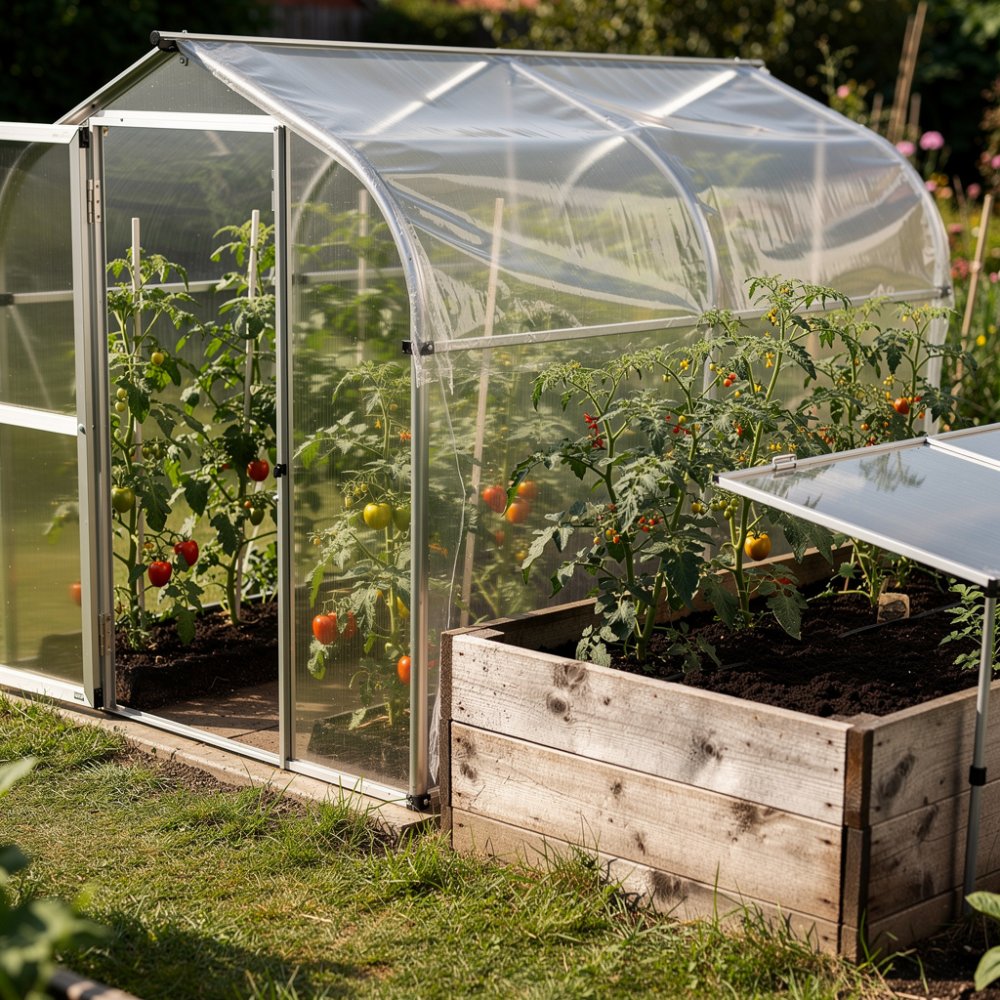
Why Grow Under Cover?
A covered growing space offers benefits that an outdoor bed can never provide:
- Extended season – start growing 4–8 weeks earlier and extend harvest by 4–6 weeks in autumn
- Protection from bad weather – rain, hail, wind and late spring frosts are no longer a problem
- Environment control – you have full control over temperature, humidity and watering
- Fewer diseases – potato blight on tomatoes spreads through wet leaves; under a roof they stay dry
- Higher and more stable yields – consistent conditions lead to better quality and quantity of fruit
- Exotic crops – peppers, aubergines, melons, cucumbers or basil ripen safely even in Czech climate
Types of Covered Growing Spaces
Greenhouses
A greenhouse is a permanent structure with a solid frame made of aluminium, steel or wood and a transparent covering of glass or polycarbonate. It is the most expensive option, but also the most durable and efficient for year-round growing.
Advantages:
- Excellent thermal insulation, especially with double-wall polycarbonate
- High resistance to wind and snow load
- Possibility of year-round operation with heating
- Lifespan of 20–30 years or more
- Aesthetic value for your garden
Disadvantages:
- Higher purchase price
- Requires a quality foundation – concrete pads or perimeter frame
- Legal conditions – greenhouses up to 40 m² of footprint and 5 m height are classified as minor structures (no permit required, but you must meet legal conditions)
In the selection of greenhouses on Pestik.cz you will find models from compact balcony structures to spacious garden greenhouses for demanding growers.
Polytunnels
A polytunnel consists of steel or aluminium arches covered with polyethylene (PE) or PVC film. It offers excellent value for money, especially for larger growing areas.
Advantages:
- Significantly lower purchase price than a greenhouse
- Quick and easy assembly
- Large interior volume for reasonable money
- Relatively easy to relocate
- Good light transmission
Disadvantages:
- Shorter film lifespan – 3–5 years for standard PE, 7–10 years for UV stabilised variants
- Poorer thermal insulation and greater temperature fluctuations compared to a greenhouse
- Lower wind resistance and snow load capacity
- Less representative appearance
In the polytunnel category on Pestik.cz you will find models in various arch lengths and diameters.
Cold Frames
A cold frame is a low structure 30–60 cm tall with a transparent lid, designed primarily for raising seedlings and gradually hardening them off. It can be portable or permanently built into a bed.
Advantages:
- Very low price
- No building requirements
- Creates effective microclimate for germination and early growth
- Ideal for hardening off seedlings before moving to the bed
- Extends season for lettuce, radishes and corn salad
Disadvantages:
- Limited space and height prevent growing tall plants
- Cannot be used for tomatoes, cucumbers or other climbing plants
- Manual ventilation requires daily attention – on sunny days you must open the lid
Portable and foldable cold frames are a practical addition to any garden and a great starting point for beginner growers.
Comparison of Covering Materials
| Feature | Tempered Glass | Double-wall Polycarbonate | UV Stabil. PE Film | PVC Film |
|---|---|---|---|---|
| Light transmission | 90–92% | 80–85% | 85–90% | 80–85% |
| Insulation (U-value) | 5.8 W/m²K | 3.0–3.6 W/m²K | 6.0+ W/m²K | 5.5+ W/m²K |
| Lifespan | 30+ years | 15–20 years | 3–5 years | 5–7 years |
| Hail resistance | Low (shatters) | High (200× stronger than glass) | Medium (punctures) | Medium |
| Weight | High | Low | Very low | Low |
| Price per m² | 300–600 CZK | 200–400 CZK | 30–80 CZK | 50–120 CZK |
| Maintenance | Cleaning | Cleaning, monitor UV degradation | Replacement after 3–5 years | Replacement after 5–7 years |
Glass – Classic for Demanding Growers
Tempered safety glass offers the best light transmission and virtually unlimited lifespan. Unlike plastics, it does not cloud from UV radiation or condensate on internal surfaces. However, expect higher weight requiring a more robust frame and risk of breakage from impact.
Polycarbonate – Best Value for Money
Double-wall (cellular) polycarbonate is now the most common material for garden greenhouses. The air gap between the walls provides significantly better thermal insulation than plain glass – heating energy consumption can be up to 50% lower. The material is lightweight, resistant to hail and easy to cut and install. The disadvantage is gradual yellowing and loss of transparency from UV radiation – quality sheets with UV protective coating significantly slow this process.
PE Film – Economical Option for Polytunnels
Polyethylene film with UV stabiliser is the standard for polytunnels. It is the cheapest, lightest and in basic versions lasts 3–5 years. Modern reinforced or multi-layer PE films achieve a lifespan of 7–10 years and better withstand wind damage.
Choosing the Right Size
Recommended Minimum Dimensions
| Purpose | Minimum Area | Recommended Area | Ridge Height |
|---|---|---|---|
| Seedling raising | 2–4 m² | 4–6 m² | 1.5 m |
| Tomatoes + peppers (2 people) | 6–8 m² | 10–12 m² | 2.0 m |
| Year-round growing (family) | 12–15 m² | 18–25 m² | 2.2–2.5 m |
| Semi-professional operation | 25+ m² | 40–60 m² | 2.5–3.0 m |
Rule of thumb: Larger rather than smaller. The vast majority of growers regret after the first season that they didn't choose a more spacious structure. Extra space also allows better air circulation, which naturally reduces the risk of fungal disease.
Width: Minimum 2.5 m for two beds and a walkway. For comfortable work with a wheelbarrow or carriers we recommend a width of 3–4 m.
Location: Orient the longer axis east–west to maximise sun exposure throughout the day. Avoid shade from buildings, fences and trees. Access to water and electricity will greatly simplify growing.
Foundation and Anchoring
Types of Foundations
- Concrete pads – the most stable solution for permanent greenhouses. A concrete point under each frame post ensures wind resistance and protection against frost heave.
- Concrete strip – perimeter foundation approximately 30 × 30 cm is ideal for larger greenhouses and allows better sealing of the bottom edge.
- Steel foundation frame – anchored to the ground with ground screws. Quick assembly without concreting, sufficient stability for small and medium structures.
- No foundation – acceptable only for smaller polytunnels anchored with steel pegs. Less stable and more prone to movement in strong wind.
Building Regulations
According to the new Building Act (effective from 1 July 2024), greenhouses fall into the category of minor structures if they meet these conditions:
- Footprint up to 40 m²
- Height up to 5 m
- No basement
- Minimum 2 m distance from neighbouring property boundary
Minor structures do not require a building permit or approval. However, you must comply with the above limits, territorial plan compliance and any rules for the area (protected areas, national parks etc.).
Ventilation – Key to Successful Growing
Overheating is a much more common problem in Czech climate than undercooling. On a summer sunny day, temperature in a closed greenhouse without ventilation can exceed 50 °C – a level at which tomato pollen dies, leaves wilt and fungi spread rapidly. Proper ventilation is therefore an investment that directly translates to yield.
Types of Ventilation
| Type | Principle | Advantages | Disadvantages |
|---|---|---|---|
| Roof vents | Manual or automatic | Hot air naturally rises and escapes | Manual opening/closing required |
| Side vents | Manual or automatic | Cross-flow, cooler air intake | Less effective than roof vents |
| Doors | Manual | Simple, no cost | Insufficient for larger areas |
| Automatic openers | Wax piston (temperature triggered) | Maintenance-free, no electricity required | Slower response to temperature changes |
| Forced ventilation | Electric fan with thermostat | Precise and rapid control | Requires power supply |
Rule: Ventilation area should be at least 20% of greenhouse floor area. For a 10 m² greenhouse this means at least 2 m² of openable surfaces combining roof vents and doors.
Automatic openers based on wax piston principle (e.g. Univent) are a cost-effective and reliable choice. When the set temperature is reached, usually 20–25 °C, the wax piston expands and automatically opens the vent – without electricity or supervision.
Heating
For year-round use or reliable protection against spring and autumn frosts, heating is essential. Properly sized heating can easily extend the season by 3–4 months.
| Heating Type | Investment | Operating Costs | Output | Suitable for |
|---|---|---|---|---|
| Electric immersion heater | Low | High | 1–3 kW | Small greenhouses, backup heating |
| Infrared heater | Medium | Medium | 0.5–2 kW | Targeted local heating |
| Paraffin heater | Low | Medium | 1–2 kW | Greenhouses without electricity |
| Underfloor heating | High | Low (heat pump) | Variable | Large greenhouses with permanent operation |
| Compost heat | None | None | Moderate | Cold frames and raised beds |
Tip: A thermostat is essential – unnecessarily overheated greenhouse increases running costs and weakens plants. Maintain minimum night temperature of 5–7 °C for frost-hardy crops (lettuce, spinach, corn salad) or 12–15 °C for heat-loving varieties (tomatoes, peppers, cucumbers). Double film or bubble insulation placed on the inside of walls will reduce heat loss by 30–40% and quickly pay for itself through reduced heating investment.
Shading
In summer, excessive sunlight can be as damaging as spring frost. Overheated plants stop growing, drop flowers and become more susceptible to pests.
- Shade cloth (50–70%) – spread over the roof or inside the greenhouse, shading level can be adjusted as needed
- Shade paint – white preparation applied to glass or polycarbonate reflects sunlight; easily washed off in autumn
- External blinds or film – the most effective solution as it traps heat before it even enters the greenhouse
- Climbing plants – luffas, bean runners or cucumbers grown along the south wall provide natural and productive shading
What to Grow and When – Seasonal Calendar
Spring (March–May)
| Month | Seedling Raising (in heated space) | Direct Sowing or Planting |
|---|---|---|
| March | Tomatoes, peppers, aubergines, kohlrabi | Radishes, lettuce, spinach |
| April | Cucumbers, courgettes, squash, melons | Dill, rocket, cabbage turnip |
| May | Basil, celery | Beans, corn (in polytunnel) |
Summer (June–August)
Main season for heat-loving crops – tomatoes, peppers, cucumbers, aubergines and melons. The key to success is regular ventilation, adequate watering and protection from overheating. In tropical heat shorten watering to early morning hours so leaves dry before night.
Autumn (September–November)
| Month | Sowing or Planting | Harvesting |
|---|---|---|
| September | Lettuce, spinach, corn salad | Tomatoes, peppers (picking) |
| October | Garlic (in bed) | Last cucumbers and aubergines |
| November | – | Lettuce, spinach, corn salad |
Winter (December–February)
In an unheated greenhouse, frost-hardy crops survive: corn salad, winter spinach, garlic and parsley. In a heated space with minimum temperature around 10 °C you can successfully grow herbs, cut lettuce and microgreens – and begin raising the most demanding varieties as early as February.
Accessories You'll Appreciate
- Growing tables and shelves – efficiently use vertical space and allow raising more seedlings
- Automatic drip irrigation with timer – saves time and prevents uneven watering; choose from watering category
- Digital thermometer and hygrometer with min/max memory – overview of conditions at night and in your absence is invaluable
- Garden textiles – mulching beds inside the greenhouse suppresses weeds, retains soil moisture and slows evaporation
- Gutter and rain barrel – collecting rainwater from the greenhouse roof saves tap water and plants prefer it to chlorinated mains water
Frequently Asked Questions (FAQ)
Is glass or polycarbonate better?
For most gardeners, double-wall polycarbonate is the optimal choice. It has better thermal insulation, is lighter, safer if broken and much more resistant to hail. Choose glass if you want maximum light transmission, prefer classic aesthetic appearance and don't mind the higher weight or breakage risk.
How large a greenhouse do I need for a family?
For a typical four-person family we recommend a greenhouse of 10–15 m². If you plan year-round growing or want plenty of space for seedling raising plus fruiting plants, consider 18–25 m². In the greenhouse selection you will find models in a full range of sizes.
Do I need a building permit for a greenhouse?
Greenhouses up to 40 m² footprint and 5 m height fall under minor structures and do not require a building permit. However, you must maintain a minimum 2 m distance from the property boundary and verify compliance with your local territorial plan.
Is a polytunnel worth it compared to a greenhouse?
A polytunnel is the right choice if you need large covered space for the lowest investment and plan regular film replacement. For professional vegetable growing with emphasis on area, a polytunnel with quality UV stabilised film is an excellent solution. If you seek year-round operation, aesthetics and long lifespan without repeated costs, choose a greenhouse.
How do I prevent greenhouse overheating in summer?
Combine roof vents, side windows, shade cloth and regular watering. Automatic vent openers are affordable and work reliably without electricity. In extreme heat, spraying the floor with water helps – evaporation significantly reduces air temperature inside the structure.
Sources and Further Reading
- RHS – Greenhouses – Royal Horticultural Society, expert guide to growing under cover
- NKZ.cz – Our Beautiful Garden, practical advice for Czech gardeners
- CZECHBUILDINGS.cz – Minor Structures – current information on building regulations and conditions for minor structures