
 Our products
 Aromatherapy - essential oils
 Essential oils
 Aroma lamps
 Aroma Diffusers
 Seeds
 Vegetables
 Herbs and spices
 Ornamental Plant Seeds
 Grass mixtures
 Sprouts and microgreens
 Growing supplies
 Cultivation and Gardening Supplies
 Hydroponics and indoor growing
 Protective equipment and gardening tools
 Exotic plants
 Exotic Fruit and Vegetables
 Exotic herbs
 Exotic trees and shrubs
 Ornamental exotic plants
 Roasted coffee
 Espresso coffee
 Ecological coffee preparation
 Thermal mugs and coffee cups
 Aeropress
 Thermos flasks and thermal mugs for coffee and tea
 Moka pot
 Filter coffee
 Coffee blends
 Accessories for coffee makers
 Water filtration
 Coffee grinders
 Cleaning the Coffee Maker
 Ecological Cleaning of Coffee Machines
 Coffee makers
 Coffee Preparation
 Coffee Accessories
 Food products
 For wildlife and pets
 Chocolate and others
 Hemp food products
 Natural cosmetics
 Hemp cosmetics
 Smoking supplies
 Bongs - water pipes
 Blunts and tubes
 E-liquids with Terpenes and CBD
 Grinders and Mills
 Papers and filters
 Smoking accessories
 Vaporizers
 Air fresheners
 CBD and CBG products
 CBD sprays
 CBD and CBN crystals
 CBD body and facial care
 Weeds
 CBD suppositories and capsules
 CBD oils and drops
 CBG oils and drops
 House and garden
 Fashion and Decoration
 Kitchen essentials and cooking
 Christmas Decorations and Accessories
 Gift Sets
 Bird feeders
 Seasonal and Special Tools
In short: Marjoram is grown as an annual because frost around -1 °C kills it: sow it on the surface in March to early April at 18–22 °C and harvest just before flowering, usually in July. Sage is a hardy perennial surviving -15 to -20 °C. It needs full sun, well-draining limy soil and spring pruning by 1/3 to 1/2.
| Marjoram germination | 18–22 °C, 10–21 days |
|---|---|
| Marjoram frost tolerance | killed at around -1 °C |
| Marjoram spacing | 20–25 cm |
| Sage frost hardiness | -15 to -20 °C |
| Sage spacing | 40–50 cm |
| Drying temperature | 25–35 °C, dried herbs keep 1–2 years |
Marjoram and sage belong to herbs that took root in Czech cuisine and folk medicine centuries ago and continue to hold their irreplaceable place today. Marjoram is the soul of Czech jitrnice (liver sausage), jaterničky (liver pâté), and bramboračka (potato soup), while sage is an inseparable part of herbed butter, roasted poultry, and hot tea for sore throat. Both herbs are undemanding to grow, reward with abundant harvests, and smell pleasantly. In this article, you will learn how to grow them successfully in Czech conditions, which varieties to choose, and how to use them in the kitchen as well as natural remedies. Seeds of both herbs can be found in the Marjoram and Sage sections on Pestik.cz.
Marjoram (Origanum majorana)
Basic Characteristics
Marjoram is a close relative of oregano but with a finer, sweeter, and more distinctly floral taste. It originates from the Mediterranean and is grown in Czech conditions as an annual – it does not overwinter outdoors and is killed by temperatures around -1 °C.
- Type: Annual (in the Czech Republic)
- Height: 20–40 cm
- Flowers: Small white to pinkish, in round knotted spikes
- Scent: Sweetly spicy, warm, with notes of thyme and oregano
- Origin: Mediterranean, Middle East
Growing Marjoram
Sowing
Marjoram has tiny seeds and slow germination – pre-growing on a windowsill is essential:
- Timing: March to early April
- Substrate: Fine seed-starting mix
- Depth: Surface sowing – do not bury seeds, just press them lightly into the substrate
- Germination temperature: 18–22 °C
- Germination time: 10–21 days (requires patience)
- Transplanting outdoors: After the last frost (after May 15), when there is no risk of frost
Site Selection
- Light: Full sun – marjoram requires warmth for full aroma development
- Soil: Well-draining, light, slightly limy. Heavy clay soils are unsuitable.
- Plant spacing: 20–25 cm
Watering and Fertilizing
- Water sparingly – marjoram tolerates drought better than waterlogging
- Soil saturation is the most common cause of failure, especially with transplanted seedlings
- Fertilizing: minimal – compost worked into the soil before planting is completely sufficient. Overfertilized marjoram has significantly weaker aroma.
Care During the Season
- Hoe and weed regularly – marjoram grows slowly when young and does not tolerate weed competition
- Pinch off the tops to encourage bushier, more compact growth
- Monitor the weather forecast – if frost threatens (even in May), cover plants with non-woven fabric
Harvesting and Drying Marjoram
When to Harvest
- Before flowering – as soon as the first flower buds appear (typically July)
- At this point, leaves and stems contain the highest concentration of essential oils
How to Harvest
- Cut entire stems approximately 5 cm above the ground
- A vigorous plant will resprout after cutting and may provide a second, lighter harvest
Drying – The Key to Flavor
Marjoram is an herb that is significantly better when dried than fresh. Drying concentrates the aroma and makes it more refined.
- Tie stems into small bundles
- Hang them upside down in a dark, airy, and dry space
- Temperature 25–35 °C, without direct sunlight
- After 1–2 weeks, crumble dry leaves and flowers from the stems
- Store in a dark, airtight container – properly dried marjoram lasts 1–2 years
Marjoram in Czech Cuisine
Marjoram is the most Czech spice – it is used in traditional recipes that define our gastronomy:
| Dish | Use |
|---|---|
| Jitrnice and jaternice (liver sausage) | Essential spice – without marjoram it just isn't the same |
| Liver pâté | 1 teaspoon dried marjoram per 500 g |
| Bramboračka (potato soup) | Classic potato soup – marjoram is irreplaceable here |
| Bean soup | Add at the end of cooking to preserve aroma |
| Braised meat | Beef, pork – 1 teaspoon in the sauce |
| Mushrooms (fried, braised) | Excellent combination, especially with porcini |
| Poultry stuffing | With bread, egg, and marjoram |
Tip: Add dried marjoram at the end of cooking (last 5–10 minutes) – prolonged heat processing causes it to lose aroma.
Medicinal Use of Marjoram
- Digestion: Alleviates bloating, intestinal cramps, and loss of appetite
- Colds: Inhalation from a decoction opens airways and relieves nasal congestion
- Headaches: Compresses from marjoram decoction applied to the forehead
- Joints and muscles: Marjoram oil (macerate) on aching and tired areas
- Relaxation: Mild sedative effects – marjoram tea before bed promotes restful sleep
Sage (Salvia officinalis)
Basic Characteristics
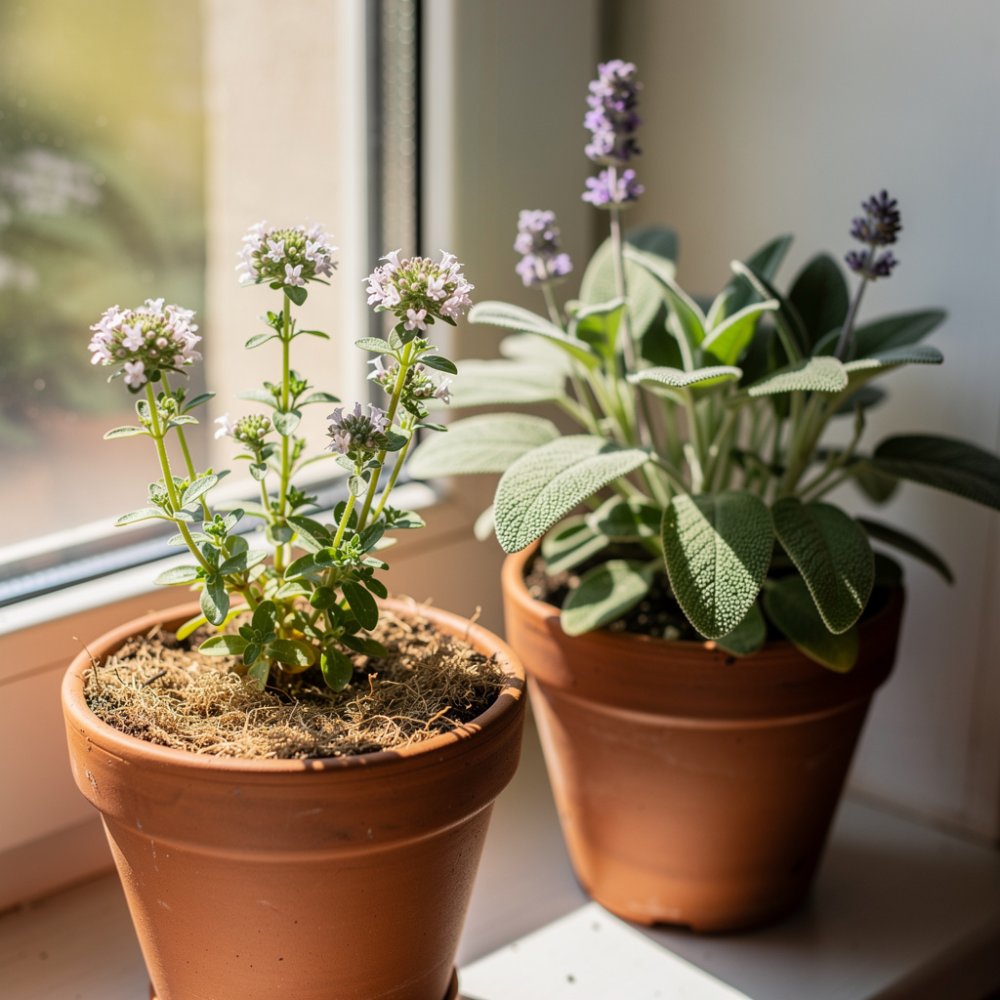
Sage is a semi-evergreen shrub with silvery-green, velvety leaves and striking violet flowers. Unlike marjoram, it is a perennial that reliably overwinters in the Czech Republic. The Latin name Salvia comes from "salvare" (to save, heal) – which aptly suggests its historical significance in herbalism.
- Type: Evergreen semi-shrub (perennial)
- Height: 30–70 cm
- Flowers: Violet to blue, May–June
- Scent: Spicy, camphoraceous, mildly bitter
- Frost hardiness: Very good (-15 to -20 °C)
Sage Varieties
| Variety | Latin Name | Leaves | Main Use |
|---|---|---|---|
| Garden sage | S. officinalis | Silvery-green, velvety | Kitchen, herbalism |
| Purple sage | S. off. 'Purpurascens' | Dark purple | Decorative + edible |
| Tricolor sage | S. off. 'Tricolor' | Green-white-pink | Decorative + edible |
| Golden sage (Icterina) | S. off. 'Icterina' | Yellow-green | Decorative + edible |
| Pineapple sage | S. elegans | Light green, pineapple scent | Desserts, teas, beverages |
| Clary sage | S. sclarea | Large, hairy | Essential oil, liqueurs |
| White sage | S. apiana | Silvery-white | Ritual smudging, fragrance |
For kitchen and herbalism: Garden sage (S. officinalis) – the most versatile choice for every garden.
For balcony planters: Purple, Tricolor, or Icterina – attractive color combination and fully edible varieties.
For desserts and beverages: Pineapple sage – tropical aroma; however, it does not overwinter in the Czech Republic and is grown as an annual.
Growing Sage
Sowing and Planting
- From seed: March–April (pre-growing). Germination 10–21 days at 18–20 °C.
- From seedlings: Plant in spring after the last frost – much simpler and faster.
- Cuttings: June–August. Semi-hardwood cuttings 8–10 cm long root in perlite in 3–4 weeks.
- Spacing: 40–50 cm; the shrub will eventually spread considerably
Site Selection
- Light: Full sun
- Soil: Well-draining, limy, preferably dry. Sage does not tolerate waterlogging.
- Ideal location: Rock garden, raised bed, south-facing wall of house
Watering and Fertilizing
- Sparing watering – let the soil dry out well between waterings
- Fertilize minimally – spring compost is sufficient
- In a pot, water 1–2 times weekly in summer; significantly reduce in winter
Pruning Sage
Regular pruning is key to maintaining compact shape and preventing unwanted lignification:
- Spring pruning (March–April): Cut old shoots by 1/3 to 1/2
- Always prune just above a place where you see new green growth
- Do not prune into old bare wood – sage will have difficulty regrowing from it
- Remove dead and damaged twigs
- Every 4–5 years consider rejuvenation pruning or replacement with a new plant from cuttings
Overwintering
Garden sage overwinters in the Czech Republic without problems and requires no special protection. In extremely cold or windy locations, mulching the base of the shrub with leaves or straw is sufficient.
Decorative varieties (Tricolor, pineapple) are less frost-hardy – consider covering with non-woven fabric or overwintering in a pot in a bright room.
Harvesting Sage
- Harvest continuously from May to October
- Pinch off individual leaves or cut entire sprigs
- Never remove more than 1/3 of the shrub at once to maintain its vitality
- Leaves are most aromatic before flowering (May)
- After flowering, they are still usable but slightly more bitter in taste
Drying Sage
Sage dries excellently and preserves its aroma well after drying:
- Tie sprigs into bundles or lay individual leaves on a screen
- Dry in shade at a temperature of 25–35 °C
- Store dry leaves whole – crush them only immediately before use
- In a dark airtight container, they last 1–2 years
Sage in the Kitchen
| Dish | Recipe / Tip |
|---|---|
| Sage butter | Fry leaves in butter until crispy – serve on gnocchi, ravioli, or pasta |
| Saltimbocca | Veal escalopes + prosciutto + sage leaf, fried in butter – Italian classic |
| Roasted poultry | Place fresh leaves under the skin of chicken before roasting |
| Pumpkin risotto | Sage fried in butter as an aromatic topping |
| Sage tea | Pour 3–5 leaves with boiling water, let steep for 10 minutes – gargle or drink |
| Fried leaves | Fry whole leaves in tempura batter – crispy herbal chips |
| Bean salad | Add freshly chopped leaves just before serving |
Medicinal Use of Sage
Sage is one of the oldest medicinal herbs in the European tradition:
- Sore throat: Gargling with sage decoction – antiseptic and anti-inflammatory effects with clinically proven efficacy
- Excessive sweating: Sage tea reduces sweat production, which is recognized by conventional medicine
- Digestion: Stimulates bile production and digestive juices, alleviates bloating
- Memory and concentration: Studies suggest positive effects on cognitive function, similar to rosemary
- Menopause: Clinical studies confirm alleviation of hot flashes with regular use
Caution: Sage contains thujone, which in high doses (especially concentrated essential oil) can be toxic. Typical culinary use and tea preparation are completely safe.
Common Traits and Differences Between Marjoram and Sage
| Property | Marjoram | Sage |
|---|---|---|
| Plant type | Annual (in Czech Republic) | Perennial |
| Frost hardiness | None – dies at frost | Excellent (-15 to -20 °C) |
| Site | Full sun, warmth | Full sun |
| Soil | Well-draining, light | Well-draining, limy |
| Watering | Sparing | Sparing |
| Dried vs. fresh | Dried is significantly better | Both excellent |
| Czech cuisine | Sausage, potato soup | Fried leaves, roasted poultry |
| Companion planting | Attracts pollinators | Repels cabbage whites and aphids |
Companion Planting
Marjoram
- Attracts pollinators thanks to nectar-rich flowers
- Good neighbors: Tomatoes, peppers, zucchini – like oregano, it favorably influences growth of surrounding plants
- Plant it at the edge of a vegetable bed where it gets plenty of sun
Sage
- Repels: Cabbage whites, aphids, and carrot flies
- Attracts: Bees and bumblebees thanks to striking violet flowers
- Good neighbors: Cabbage, broccoli, carrots, tomatoes, strawberries
- Poor neighbors: Cucumbers – sage has allelopathic effects on them and suppresses their growth
- Let sage flower at least partially – bees seek it out and the flowers are also edible
Growing in Planters and Pots
Both herbs are excellent for container growing on balconies or patios:
| Parameter | Marjoram | Sage |
|---|---|---|
| Container size | Min. 3 liters | Min. 5–10 liters |
| Substrate | Well-draining, with perlite added | Well-draining, with sand or gravel added |
| Drainage | Essential (clay pellets on bottom) | Essential |
| Location | South-facing windowsill or balcony | South-facing windowsill or balcony |
| Overwintering | Annual – resow in spring | Outdoors or in bright room |
Frequently Asked Questions (FAQ)
What is the difference between marjoram and oregano?
Marjoram (Origanum majorana) has a finer, sweeter, and more floral taste and is grown in the Czech Republic as an annual. Oregano (Origanum vulgare) is sharper, more intense, and overwinters as a perennial. Czech cuisine favors marjoram, while Italian cuisine prefers oregano. Both belong to the same genus and are closely related.
Can sage grow in partial shade?
Sage prefers full sun but can tolerate light partial shade with at least 4–5 hours of direct sunlight daily. In shade, however, it produces fewer essential oils, which means weaker aroma, fewer flowers, and lower medicinal potential.
How long does sage live?
A sage shrub will maintain its vitality for 4–6 years with regular pruning. After that, it gradually becomes woody and loses vigor – replace it with a new plant from cuttings or a seedling.
Is pineapple sage edible?
Yes – pineapple sage (Salvia elegans) has a distinctive tropical aroma and works well in desserts, fruit salads, beverages, and teas. In the Czech Republic, it does not overwinter – grow it in a pot and move it to a bright room for winter.
When is the best time to harvest marjoram?
Just before flowering (typically July) – at this time, leaves and stems contain the highest concentration of essential oils and the taste is most intense. Cut entire stems approximately 5 cm above the ground.
Sources
- RHS – Growing Marjoram and Oregano
- RHS – Growing Sage
- The Old Farmer's Almanac – Sage
- Bylinky pro všechny – Majoranka
- Bylinky pro všechny – Salvej
- Pestik.cz – Marjoram
- Pestik.cz – Sage