
 Our products
 Aromatherapy - essential oils
 Essential oils
 Aroma lamps
 Aroma Diffusers
 Seeds
 Vegetables
 Herbs and spices
 Ornamental Plant Seeds
 Grass mixtures
 Sprouts and microgreens
 Growing supplies
 Cultivation and Gardening Supplies
 Hydroponics and indoor growing
 Protective equipment and gardening tools
 Exotic plants
 Exotic Fruit and Vegetables
 Exotic herbs
 Exotic trees and shrubs
 Ornamental exotic plants
 Roasted coffee
 Espresso coffee
 Ecological coffee preparation
 Thermal mugs and coffee cups
 Aeropress
 Thermos flasks and thermal mugs for coffee and tea
 Moka pot
 Filter coffee
 Coffee blends
 Accessories for coffee makers
 Water filtration
 Coffee grinders
 Cleaning the Coffee Maker
 Ecological Cleaning of Coffee Machines
 Coffee makers
 Coffee Preparation
 Coffee Accessories
 Food products
 For wildlife and pets
 Chocolate and others
 Hemp food products
 Natural cosmetics
 Hemp cosmetics
 Smoking supplies
 Bongs - water pipes
 Blunts and tubes
 E-liquids with Terpenes and CBD
 Grinders and Mills
 Papers and filters
 Smoking accessories
 Vaporizers
 Air fresheners
 CBD and CBG products
 CBD sprays
 CBD and CBN crystals
 CBD body and facial care
 Weeds
 CBD suppositories and capsules
 CBD oils and drops
 CBG oils and drops
 House and garden
 Fashion and Decoration
 Kitchen essentials and cooking
 Christmas Decorations and Accessories
 Gift Sets
 Bird feeders
 Seasonal and Special Tools
Lavender is among the most beloved ornamental and medicinal herbs. Silver foliage, violet spikes, and intoxicating fragrance can transform even a small flowerbed into a Mediterranean garden – even in Czech conditions. Yet growing lavender in Czechia is not without challenges: unsuitable varieties, heavy soil, or improper pruning reliably lead to disappointment. In this guide, you will discover which varieties and cultivars are most suitable for Czech gardens, how to properly plant, prune, propagate, and overwinter lavender, and how to use its flowers in the kitchen, cosmetics, and around the home. Seeds and seedlings of lavender can be found in the Lavender section on Pestik.cz.
Lavender Varieties
The genus Lavandula includes over 40 species. For Czech growers, three main groups matter:
1. Lavandula angustifolia – True Lavender
- Frost Hardiness: Best (-15 to -20 °C, some cultivars to -25 °C)
- Height: 30–60 cm
- Flowers: Violet, blue, pink, or white depending on cultivar
- Fragrance: Delicate, floral, sweet – highest quality essential oil
- Uses: Aromatherapy, cosmetics, culinary use, fragrant sachets
- For Czechia: Unquestionably the best choice – most frost-resistant
Best Cultivars for Czechia:
| Cultivar | Height | Color | Notes |
|---|---|---|---|
| Hidcote | 30–40 cm | Dark violet | Compact, very popular, excellent frost hardiness |
| Munstead | 40–50 cm | Medium violet | Proven classic, reliable, suitable for containers |
| Dwarf Blue | 25–30 cm | Blue-violet | Miniature, ideal for pots |
| Ellagance Purple | 35–45 cm | Deep violet | Grown from seed, uniform growth |
| Alba | 40–50 cm | White | Unconventional white lavender |
| Rosea | 40–50 cm | Pink | Romantic, delicate appearance |
2. Lavandula x intermedia – Lavandin
- Frost Hardiness: Moderate (-10 to -15 °C)
- Height: 60–90 cm
- Flowers: Large violet spikes on long stems
- Fragrance: Pronounced, camphoraceous – intended primarily for essential oil production
- Uses: Fragrant sachets, drying mixes, crafts, industrial oil production
- For Czechia: Possible in warmer regions in protected locations
Cultivars:
- Grosso – most widespread, intense fragrance, large spikes
- Provence – classic Provençal type
- Phenomenal – newer cultivar with improved frost hardiness
3. Lavandula stoechas – French Lavender
- Frost Hardiness: Low (-5 to -8 °C)
- Height: 40–70 cm
- Flowers: Characteristic "rabbit ears" – decorative bracts at the spike tip
- Fragrance: Weaker, more camphoraceous than true lavender
- For Czechia: Container-only – must be brought indoors for winter. Decorative variety, but outdoor overwintering is impossible.
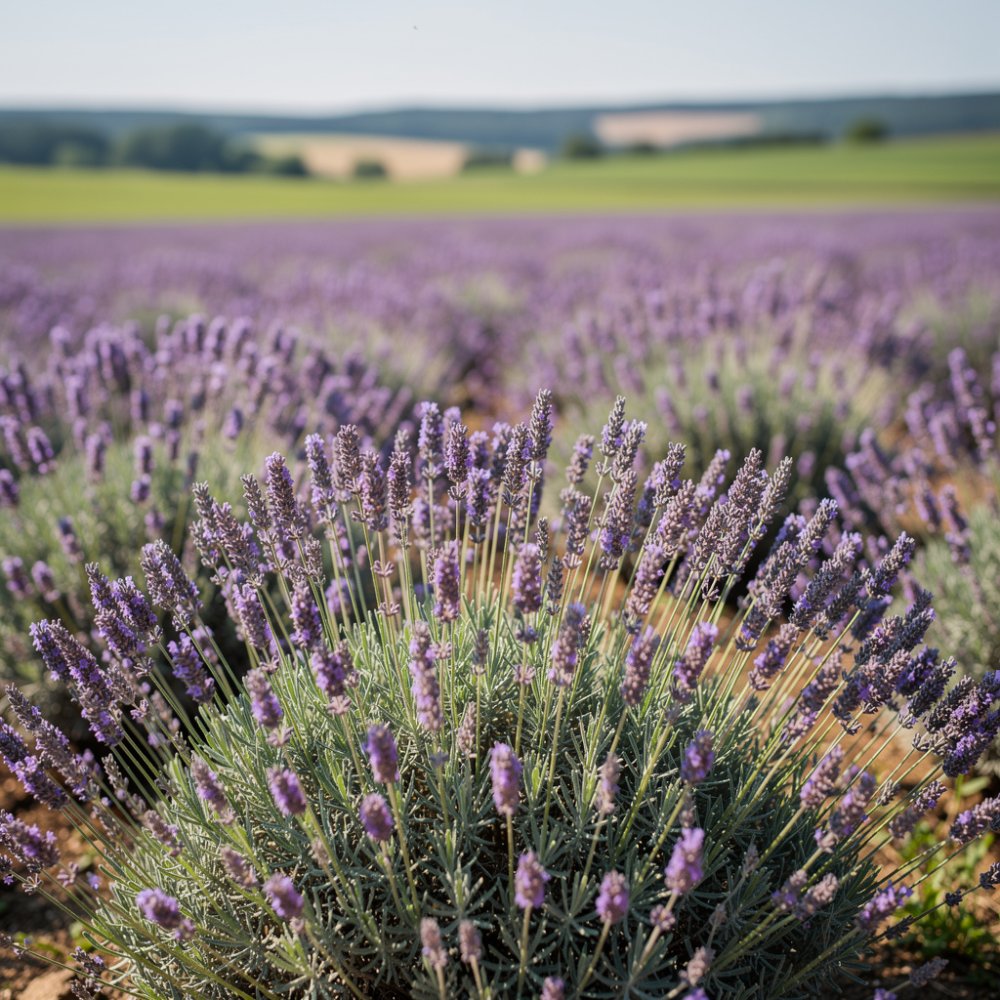
Growing Lavender – Step by Step
Site Selection
Location is absolutely crucial for success with lavender in Czechia:
- Full sun – at least 6–8 hours daily
- South-facing exposure – ideally near a south-facing wall or on a southern slope
- Protected from north winds – cold winter winds are among lavender's greatest enemies
- Elevated terrain – gentle slope where water drains. Never in depressions or waterlogged spots!
Soil – Most Important Factor
Most failures with lavender in Czechia stem from poorly prepared soil:
- Well-draining – absolute priority. In heavy, clayey soil, lavender inevitably dies.
- Calcareous – optimal pH 6.5–8.0. Adjust acidic soil with liming.
- Rather poor – do not fertilize! Rich soil promotes lush growth but reduces aromatic content and frost hardiness.
- Site Preparation: Mix at least one-third fine gravel, perlite, or coarse sand into the planting hole.
Planting
- Timing: Spring (April–May) – the plant has the whole season to establish roots before winter
- Spacing: 40–60 cm depending on cultivar
- Depth: Plant at the same level as in the pot – never deeper
- After Planting: Water once thoroughly, then water sparingly
Watering
- Sparing – lavender tolerates drought much better than waterlogging
- Water only during prolonged dry spells and for newly planted specimens
- Established plants (2+ years) usually need no watering at all
- In containers, water approximately once weekly in summer, always letting the substrate dry between waterings
Fertilizing
- Minimal or none – in poor soil, lavender produces the most intense aroma
- If you wish to fertilize, small amounts of compost in spring or light application of dolomitic lime suffice
- Nitrogen-based fertilizers cause soft, lush growth prone to winter dieback
Pruning Lavender – Key to Longevity
Proper pruning is the most important cultivation operation for lavender. Without regular pruning, the plant becomes woody over 3–5 years, collapses, and dies.
Annual Pruning Plan
1. Spring Pruning (March–early April)
- When: As soon as new green shoots appear at the base of the plant (typically in March)
- How: Cut all shoots back by one-third to one-half
- Essential Rule: Prune into green wood – at least 2–3 cm of foliage must remain below every cut
- Never cut into old, bare, grey-brown wood – lavender will not regrow from it
- Purpose: Promotes new compact growth and prevents woodiness
2. Summer Pruning After Flowering (July–August)
- When: As soon as flowers begin to fade, or immediately after harvest
- How: Remove faded flower spikes and lightly reshape the shrub into a mounded form
- Purpose: Prevents seed formation (which unnecessarily depletes the plant) and promotes weak second blooming
Common Pruning Mistakes
| Mistake | Consequence |
|---|---|
| Skipping pruning | Woodiness and collapse within 3–5 years |
| Pruning into old wood | Plant will not regrow – bare woody branches remain permanent |
| Pruning too late in spring | Delayed flowering, smaller harvest |
| Pruning in autumn | New growth fails to mature and freezes |
Shaping
The goal is a mounded, hemispherical shape – compact, dense, with no bare wood in the center. Each year after pruning, the shrub should be slightly smaller than before but noticeably denser and sturdier.
Propagating Lavender
Cuttings (Recommended)
The most reliable method – preserves all mother plant characteristics.
- Timing: July–September (semi-woody cuttings)
- Collect 10–12 cm shoots grown in the current season
- Remove lower leaves (on two-thirds of length)
- Insert into moist perlite or perlite + peat mix
- Place in partial shade, cover with plastic film to maintain moisture
- Rooting occurs within 3–6 weeks
- Plant out in spring
Layering
An easy method suitable for beginners – pin a lower branch to the ground, cover with soil at mid-length (leave the tip free), and weight with a stone. After 2–3 months, the branch roots. Then separate from the mother plant and transplant.
Seed Sowing
Possible, but slow with variable results:
- Stratify seeds 2–4 weeks in the refrigerator before sowing
- Germination takes 14–28 days at 18–20 °C
- Seedlings grow slowly – flowering occurs only in the second year
- Cultivars do not come true from seed (exceptions: Ellagance, Lavender Lady)
Overwintering Lavender in Czechia
Outdoors (Lavandula angustifolia)
- Key to winter survival is well-draining soil – root waterlogging in winter is more dangerous than frost itself
- In autumn, apply a layer of gravel mulch at the base (not bark mulch – it retains moisture)
- During extreme frosts below -15 °C, cover with non-woven fabric
- Do not prune in autumn – existing foliage protects new growth
In Containers
- Move to a bright, cool room (2–8 °C) – an unheated winter garden or bright garage are ideal
- Water minimally, approximately once every 3–4 weeks, only so the substrate doesn't completely dry out
- Do not move to a heated apartment – the combination of heat, dry air, and lack of light reliably kills the plant
Lavandin and Stoechas
- Lavandin: Overwinter like angustifolia, but with lower frost hardiness – suitable only for warmer regions or container cultivation
- Stoechas: Always in containers, always move indoors for winter
Harvesting Lavender
When to Harvest
- For sachets and drying: When approximately one-third of the flowers on the spike have opened – essential oil content is highest at this point
- For bouquets: At the same phenological stage – dried flowers remain unchanged for months
- For culinary use: Fresh or dried flowers anytime during blooming
How to Harvest
- Cut entire flower stems including part of the stem (10–15 cm)
- Harvest in the morning after dew has dried
- Tie into small bundles of 10–15 stems each
- Hang upside down in a dark, airy space
- After 1–2 weeks of drying, strip dried flowers from the spike over a bowl
Uses for Lavender
In the Kitchen
Lavender is gaining more admirers in Czech cuisine – its floral, slightly sweet flavor suits surprisingly many recipes:
| Recipe | Method |
|---|---|
| Lavender Sugar | Alternate layers of dried flowers and granulated sugar, let sit 2 weeks |
| Lavender Syrup | Sugar and water in 1:1 ratio, add handful of flowers, simmer and strain |
| Lavender Cookies | Add 1 teaspoon dried flowers to dough |
| Lavender Ice Cream | Infuse flowers in cream, strain and freeze |
| Provençal Spice Mix | Lavender, thyme, rosemary, oregano, and savory in equal proportions |
| Lavender Honey | Infuse flowers in liquid honey for 2 weeks |
Warning on Dosage: Lavender in the kitchen functions as a perfume – less is always more. Start with a knife tip and add to taste.
In Cosmetics
- Lavender Oil: Infused oil – cover dried flowers with base oil (jojoba, almond), infuse 4–6 weeks in light
- Bath Salts: Coarse salt, dried flowers, and several drops of essential oil
- Facial Tonic: Flower decoction cleanses pores and soothes sensitive skin
- Hair Rinse: Add flower decoction to final rinse – hair gains shine and delicate fragrance
Around the Home
- Sachets for Cupboards: Dried flowers in linen bags repel moths and smell pleasant
- Mosquito Repellent: Plants on the terrace or dried bundles near windows
- Fragrant Decorations: Dried bouquets, potpourri
- Sleep Support: A sachet with lavender under the pillow measurably improves sleep quality
Medicinal Uses
- Aromatherapy: Essential oil has relaxing effects, helps with insomnia and anxiety relief
- Headaches: Apply diluted essential oil to temples
- Minor Wounds: Antiseptic and anti-inflammatory effects (decoction compresses)
- Insect Bites: A drop of essential oil on the bite site reduces itching and swelling
Lavender as a Companion Plant
Lavender serves important ecological functions in the garden:
- Attracts Pollinators: Bees and bumblebees love lavender – a single shrub can attract dozens of pollinators daily
- Repels Aphids: Natural repellent – plant near roses
- Repels Moths and Mosquitoes: Oils in leaves and flowers
- Good Companions: Roses, rosemary, thyme, oregano, sage
- Poor Companions: Moisture-loving plants – their conflicting soil and watering needs lead to compromises benefiting neither
Most Common Problems
Woodiness
Cause: Skipped regular pruning. Solution: Spring and summer pruning without exception every year. A severely woody plant cannot be rejuvenated – replace with a new one.
Browning and Drying
Cause: Root waterlogging, fungal disease. Solution: Improve drainage, significantly reduce watering, and possibly transplant to more porous substrate.
Weak Flowering
Cause: Insufficient light, overly rich soil, or skipped pruning. Solution: Move to sunnier location, do not fertilize, and follow pruning schedule.
Winter Dieback
Cause: Unsuitable cultivar, heavy soil, winter waterlogging. Solution: Choose Lavandula angustifolia cultivars, improve drainage by adding gravel, and mulch the plant in autumn.
Frequently Asked Questions (FAQ)
Which lavender is best for Czechia?
Lavandula angustifolia, especially cultivars Hidcote and Munstead. They are most frost-hardy, compact, and reliably flower even in cooler locations. For larger areas or sachet production, consider lavandin Grosso – only in warmer regions.
How often should I prune lavender?
Twice yearly: 1) Spring pruning in March–April – cut back by one-third to one-half always into green wood. 2) After flowering in July–August – remove faded spikes and lightly reshape. Never prune in autumn.
Why is my lavender browning and dying?
Most commonly waterlogging – heavy clayey soil retains water. Lavender requires absolutely well-draining location. Mix in gravel, sand, or perlite. Second common cause is pruning into old wood, from which the plant will not regrow.
Can I grow lavender in a container?
Yes, and for many growers, this is the most practical solution – the plant can easily be moved indoors for winter. Use porous substrate with one-third perlite, container with adequate drainage holes (at least 5 liters), and water sparingly. Excellent choice for a balcony or terrace.
Is lavender oil toxic to cats?
Yes – lavender essential oil is toxic to cats as they lack the liver enzyme needed to process terpenes. Do not apply essential oil where cats can reach it. The plant itself in the garden is harmless – cats naturally avoid it.
Sources
- RHS – Lavender: How to Grow
- RHS – Pruning Lavender
- The Old Farmer's Almanac – Growing Lavender
- Downderry Nursery – Lavender Growing Guide
- Bylinky pro všechny – Levandule
- Pestik.cz – Lavender seeds and seedlings