
 Our products
 Aromatherapy - essential oils
 Essential oils
 Aroma lamps
 Aroma Diffusers
 Seeds
 Vegetables
 Herbs and spices
 Ornamental Plant Seeds
 Grass mixtures
 Sprouts and microgreens
 Growing supplies
 Cultivation and Gardening Supplies
 Hydroponics and indoor growing
 Protective equipment and gardening tools
 Exotic plants
 Exotic Fruit and Vegetables
 Exotic herbs
 Exotic trees and shrubs
 Ornamental exotic plants
 Roasted coffee
 Espresso coffee
 Ecological coffee preparation
 Thermal mugs and coffee cups
 Aeropress
 Thermos flasks and thermal mugs for coffee and tea
 Moka pot
 Filter coffee
 Coffee blends
 Accessories for coffee makers
 Water filtration
 Coffee grinders
 Cleaning the Coffee Maker
 Ecological Cleaning of Coffee Machines
 Coffee makers
 Coffee Preparation
 Coffee Accessories
 Food products
 For wildlife and pets
 Chocolate and others
 Hemp food products
 Natural cosmetics
 Hemp cosmetics
 Smoking supplies
 Bongs - water pipes
 Blunts and tubes
 E-liquids with Terpenes and CBD
 Grinders and Mills
 Papers and filters
 Smoking accessories
 Vaporizers
 Air fresheners
 CBD and CBG products
 CBD sprays
 CBD and CBN crystals
 CBD body and facial care
 Weeds
 CBD suppositories and capsules
 CBD oils and drops
 CBG oils and drops
 House and garden
 Fashion and Decoration
 Kitchen essentials and cooking
 Christmas Decorations and Accessories
 Gift Sets
 Bird feeders
 Seasonal and Special Tools
In short: All three want full sun (6–8 hours daily), light well-draining poor soil and pH 6.5–7.5. Thyme and oregano overwinter outdoors down to -25 °C; rosemary only to -10 to -15 °C, so grow it in a pot of at least 10 litres and overwinter it in a bright room at 5–10 °C.
| Light | Full sun, minimum 6–8 hours daily |
|---|---|
| Soil pH | 6.5–7.5 (slightly alkaline), poor and well-draining |
| Frost hardiness | Rosemary -10 to -15 °C; thyme and oregano down to -25 °C |
| Rosemary overwintering in a pot | Container from 10 litres, bright room at 5–10 °C, water once every 2–3 weeks |
| Cuttings | Rosemary 10–15 cm, rooting 4–8 weeks; thyme and oregano 8–10 cm, 3–4 weeks |
| Pruning | Spring cut back by 1/3, never into bare old wood |
Rosemary, Thyme, Oregano – Mediterranean Herbs in Your Czech Garden
Mediterranean herbs form the heart of every herb garden. Rosemary, thyme, and oregano share a love of full sun, well-draining soil, and moderate watering. On the rocky slopes of Provence, Tuscany, and Greek islands they grow wild – and surprisingly, they thrive in the Czech Republic too. You just need to understand their requirements and adapt the conditions. This guide addresses each herb individually: from sowing through overwintering to culinary and medicinal uses. You'll find seeds and seedlings of all three on Pestik.cz in the sections Rosemary, Thyme, and Oregano.
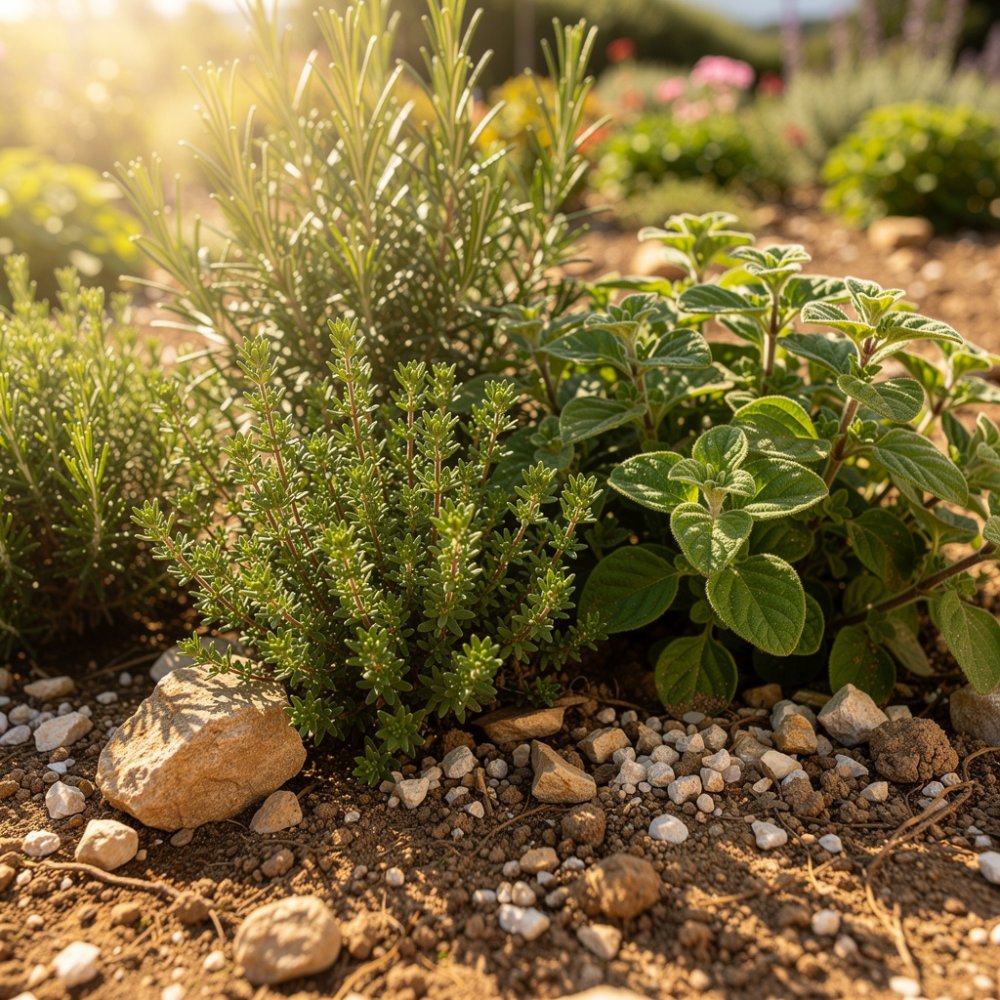
Common Features of Mediterranean Herbs
Before we dive into individual herbs, let's summarize their key shared requirements:
| Feature | Requirement |
|---|---|
| Light | Full sun (minimum 6–8 hours daily) |
| Soil | Light, well-draining, chalky, preferably poor |
| Watering | Moderate – tolerate drought better than moisture |
| Fertilizing | Minimal – poor soil = stronger aroma |
| Soil pH | 6.5–7.5 (slightly alkaline) |
| Drainage | Absolutely crucial – waterlogging = plant death |
| Companion planting | Excellent together, good with tomatoes and cabbage |
The golden rule of Mediterranean herbs: The harsher the conditions (drought, full sun, poor soil), the more intense the aroma. Plants under stress produce more essential oils as a natural protective mechanism.
Rosemary (Salvia rosmarinus)
Basic Characteristics
Rosemary is an evergreen aromatic semi-shrub that grows up to 1.5 m in warmer regions. Growing it in the Czech Republic is quite manageable, but it requires respect for its Mediterranean origin – particularly regarding overwintering and site selection.
- Type: Evergreen semi-shrub
- Height: 30–120 cm (in Czechia typically 40–60 cm)
- Flowers: Blue-violet, March–May
- Fragrance: Intense, camphoraceous, resinous
- Frost hardiness: -10 to -15 °C (depends on variety and site conditions)
Growing Rosemary
Site
The best place for rosemary in Czechia is a south-facing house wall – reflected heat, protection from north wind, and natural water drainage away from the foundation. Stone or brick walls accumulate heat during the day and act as a heat reservoir for surrounding plants in winter.
Soil
Light, well-draining, chalky. Mix fine gravel or perlite into the planting hole (approximately 1/3 of volume). Rosemary suffers in heavy clay soil and will freeze in winter due to water pooling around the roots.
Sowing and Planting
- From seeds: Very slow and unreliable (germination 2–4 weeks at 20–25 °C, uneven). Not recommended for beginners.
- From seedlings: Recommended method. Plant in spring after the last frosts (after the Frozen Saints).
- Cuttings: The most reliable propagation method – details below.
Watering
Moderate. Let the soil dry completely between waterings. Rosemary tolerates prolonged drought – excess moisture damages it far more than water shortage. In a pot, water approximately 1–2 times weekly in summer, only rarely in winter.
Pruning
- Spring pruning (March–April): Cut back shoots by 1/3 and shape the shrub into a compact form
- After flowering: Light shaping prune to maintain density
- Never prune into old, bare wood – rosemary won't regrow from it
- Regular pruning prevents woodiness and maintains an attractive shrub shape long-term
Overwintering Rosemary in Czechia
This is the key question for every Czech rosemary grower.
Outdoors (suitable for warmer regions – southern Moravia, the Polabí region, Prague and surroundings):
- Plant in a protected, south-facing location against a wall
- Well-draining soil is more important than temperature alone – root waterlogging in winter causes freezing even with mild frosts
- Mulch the root zone (with dry leaves, straw, or gravel)
- When harsh frosts are forecast (below -10 °C), cover with horticultural fleece
In a pot (recommended for most of the Czech Republic):
- Grow in a container with a volume of at least 10 liters
- Place outside in a sunny spot during summer
- For winter, move to a bright, cool room (5–10 °C) – unheated winter garden, bright garage, or hallway
- Water minimally (approximately once every 2–3 weeks)
- Rosemary suffers in overheated kitchens – dry air, heat, and insufficient light lead to gradual decline
Propagation by Cuttings
- Timing: July–September
- Cut 10–15 cm semi-woody shoots
- Remove lower leaves (on 2/3 of the cutting length)
- Dip the lower end in rooting hormone (powder type)
- Insert into moist perlite or perlite + peat mixture (1:1)
- Place in warmth (20 °C), partial shade, covered with foil or a plastic bottle
- Rooting takes 4–8 weeks
- Pot up only in spring
Culinary Uses of Rosemary
| Dish | Usage |
|---|---|
| Roasted lamb | Insert sprigs into the meat before roasting |
| Chicken thighs | Sprinkle with chopped leaves |
| Roasted potatoes | With olive oil and garlic |
| Focaccia | Press sprigs into dough before baking |
| Rosemary oil | Macerate sprigs in olive oil for 2 weeks |
| Grilled meat | Use a bundle of sprigs as an aromatic brush for marinade |
Practical tip: Rosemary tolerates long cooking – add it at the start of heat treatment. Always remove woody sprigs before serving.
Medicinal Uses
- Memory and concentration improvement – rosemary aroma demonstrably stimulates cognitive function (Newcastle University study)
- Antioxidant effects – rosmarinic acid and carnosol are powerful natural antioxidants
- Anti-inflammatory – for rheumatic pain in baths or compresses
- Blood circulation – stimulates peripheral circulation
Thyme (Thymus vulgaris)
Basic Characteristics
Thyme is a low evergreen semi-shrub with tiny aromatic leaves. It overwinters reliably in Czechia and ranks among the hardiest herbs available – an ideal choice for beginning gardeners.
- Type: Evergreen semi-shrub
- Height: 15–30 cm
- Flowers: Tiny, purple to pink, June–July
- Fragrance: Spicy, warm, mildly camphoraceous
- Frost hardiness: Excellent, down to -25 °C
Thyme Varieties
| Variety | Latin Name | Characteristics | Uses |
|---|---|---|---|
| Garden thyme | Thymus vulgaris | Classic culinary, 20–30 cm | Meat, sauces, bouquet garni |
| Lemon thyme | Thymus citriodorus | Citrus aroma, yellow-green leaves | Fish, tea, desserts |
| Wild thyme | Thymus serpyllum | Creeping, wild, fragrant | Ground cover, tea |
| Orange thyme | Thymus 'Fragrantissimus' | Orange-spicy | Desserts, tea |
| Silver Queen thyme | Thymus x citriodorus | Silver-variegated leaves | Decorative and edible |
Growing Thyme
Sowing
- Timing: March–May (surface sow – seeds germinate in light)
- Germination temperature: 18–20 °C
- Germination: 14–21 days – be patient, thyme isn't in a hurry
- Easier alternative: Division or cuttings
Site and Soil
- Full sun – on a rockery, path edge, or dry bed
- Light, well-draining, chalky soil; mix in gravel or coarse sand
- Thyme can't tolerate waterlogging – that's practically the only way to kill it
Watering and Fertilizing
- Minimal watering – only during extreme drought
- Don't fertilize. Thyme in poor soil produces more essential oils, meaning more intense aroma and flavor.
Pruning
- Spring pruning (March–April): Cut back by 1/3, remove dry and woody parts
- After flowering: Light shaping prune
- Regular pruning prevents woodiness and extends plant life to 5–10 years
- Don't prune into bare wood – thyme won't regrow from it
Thyme Propagation
Division: Spring or fall. Dig up the entire clump, divide it, and replant – fastest method.
Cuttings: June–August. Cut 8–10 cm semi-woody shoots and root them in perlite (3–4 weeks).
Layering: Pin a stem to the ground, cover with soil, and let it root. Once rooted, cut from the parent plant. Easiest method for absolute beginners.
Culinary Uses of Thyme
- Bouquet garni – classic bundle (thyme + bay leaf + parsley) for soups and braised dishes
- Herbes de Provence – thyme + rosemary + oregano + lavender + savory
- Braised meat – beef, lamb, rabbit
- Sauces – tomato, cream, béchamel
- Marinades – with olive oil, garlic, and lemon zest
Practical tip: Thyme tolerates long cooking – add it at the beginning. Dried thyme is more intense than fresh, which is the opposite of most other herbs.
Medicinal Uses
- Against cough – thymol is an active ingredient in many natural cough syrups
- Antiseptic – disinfects respiratory tract during colds
- Thyme tea – 1 teaspoon dried thyme per cup of boiling water, steep 10 minutes; ideal for cough and colds
- Baths – for rheumatism and muscle tension
Oregano (Origanum vulgare)
Basic Characteristics
Oregano is a vigorous perennial that overwinters without problems in Czechia. It forms dense mats of aromatic leaves and in summer adorns itself with tiny white to pink flowers, eagerly visited by bees and butterflies.
- Type: Perennial
- Height: 30–60 cm
- Flowers: White to pink, July–August
- Fragrance: Warm, peppery, mildly bitter
- Frost hardiness: Excellent, down to -25 °C
Oregano Species and Varieties
| Variety | Characteristics | Uses |
|---|---|---|
| Wild oregano | Mild flavor | Tea, universal seasoning |
| Hot & Spicy oregano | Intense, peppery | Pizza, Italian cuisine |
| Greek oregano | Strongest aroma, compact shrub | Greek and Turkish recipes |
| Golden oregano | Yellow-green leaves, milder | Decorative and edible |
| Marjoram oregano | Marjoram hybrid, sweeter | Universal use |
Growing Oregano
Sowing
- Timing: March–May (surface sow)
- Germination temperature: 18–20 °C
- Germination: 7–14 days
- Seeds are very fine – sow thinly and evenly, or mix with sand for easier spreading
Site and Soil
- Full sun, warm location
- Well-draining, chalky soil – same requirements as thyme
- In partial shade, oregano will grow but its aroma will be significantly weaker
Watering
- Moderate – oregano tolerates drought better than excess moisture
- Overwatering leads to weak aroma and root rot risk
Maintenance
- In spring, cut old dry stems to the ground – new shoots will emerge from the root ball
- Divide clumps every 3–4 years for rejuvenation and to maintain vigor
- Oregano spreads gradually – if you don't want expansion, harvest before seeds mature
Oregano Propagation
- Division: Spring – easiest method. Dig up, divide, replant.
- Cuttings: June–August, 8–10 cm shoots, rooting in perlite approximately 3–4 weeks.
- Sowing: Reliable but requires care due to seed fineness.
Culinary Uses of Oregano
| Dish | Usage |
|---|---|
| Pizza | Sprinkle with dried oregano just before baking |
| Greek salad | Fresh leaves crumbled directly into salad |
| Tomato sauce | Add dried oregano at the start of cooking |
| Grilled meat | Marinade with oregano, olive oil, and lemon |
| Bruschetta | Fresh or dried oregano on toasted bread with tomatoes |
Important fact: Oregano is among the rare herbs where dried is more intense than fresh. Drying concentrates essential oils. Dry in shade with good ventilation and store in a dark container – properly dried oregano keeps its aroma for 2–3 years.
Medicinal Uses
- Antibacterial – carvacrol and thymol are powerful natural antiseptics with proven effects
- Anti-inflammatory – for colds, sore throats, and upper respiratory infections
- Oregano oil – concentrated extract used in alternative medicine (follow recommended dosing)
- Oregano tea – for cough, colds, and digestive troubles
Mediterranean Herbs as Companion Plants
The trio of rosemary, thyme, and oregano are valuable companions to other garden plants.
What They Protect
| Herb | Repels | Good Neighbors |
|---|---|---|
| Rosemary | Cabbage moth, carrot fly, mites | Cabbage, beans, carrot |
| Thyme | Mites, cabbage white, aphids | Cabbage, tomatoes, strawberries |
| Oregano | Aphids, potato beetles | Tomatoes, peppers, cucumbers |
Mutual Neighbors
Rosemary, thyme, and oregano get along excellently – they share the same requirements for light, water, and soil. Plant them together in a Mediterranean herb bed or stony raised bed with gravel drainage.
Add to them: Lavender, sage, marjoram – the entire Mediterranean palette in one place.
Don't plant together: Moisture-loving herbs like mint, lemon balm, or parsley – they have completely opposite watering and soil moisture requirements.
Mediterranean Herb Bed – Instructions
Raised Bed
Ideal solution for Czech conditions:
- Frame: Stone, brick, or wooden raised bed (height 30–40 cm)
- Drainage: Bottom layer of gravel or clay pellets (10 cm)
- Substrate: Garden soil + 1/3 gravel + 1/3 coarse sand – substrate must not be too rich
- Orientation: South or southwest
- Planting: Rosemary in back (tallest), oregano in middle, thyme in front (shortest). Spacing 30–40 cm.
- Mulching: Fine gravel (not bark) – retains heat, maintains drainage, limits weeds
Spiral Herb Bed
A classic permaculture design that naturally creates different microclimatic zones:
- Top of spiral (dry, sunny): Rosemary, thyme, oregano, lavender
- Middle of spiral: Sage, marjoram, savory
- Bottom of spiral (more moist, cooler): Parsley, chives, mint (ideally in a container sunk into the bed)
Seasonal Calendar for Mediterranean Herbs
| Month | Rosemary | Thyme | Oregano |
|---|---|---|---|
| March | Spring pruning, sowing (unreliable) | Spring pruning, sowing | Cut dry stems, sowing |
| April | Plant seedlings | Planting, division | Planting, division |
| May | Flowering, harvesting | Harvesting | Vigorous growth |
| June | Harvesting | Harvesting before flowering | Harvesting |
| July | Cuttings | Flowering, cuttings | Main harvest before flowering |
| August | Cuttings | Harvesting, cuttings | Second harvest |
| September | Last harvest | Harvesting | Last harvest |
| October | Move container indoors | Mulching | Cut stems back |
| November–February | Winter dormancy (bright room) | Evergreen, dormancy | Underground dormancy |
Frequently Asked Questions (FAQ)
Does rosemary overwinter outdoors in Czechia?
It depends on location and site conditions. In southern Moravia, Prague, and the Polabí region yes – in a protected spot against a south-facing wall, in well-draining soil with mulch. In cooler areas (Bohemian Highlands, foothills) we recommend growing in a pot and moving to a bright, cool room for winter.
What's the difference between oregano and marjoram?
Oregano (Origanum vulgare) is a perennial, frost-hardy herb with intense and sharp flavor. Marjoram (Origanum majorana) is an annual in Czechia (doesn't overwinter) with finer, sweeter taste. They're close relatives. Read more in the article Marjoram and Sage.
Can Mediterranean herbs grow in a window box on a balcony?
Absolutely – for many growers it's actually the best option. Use sufficiently large containers (minimum 5 liters per plant), well-draining substrate with gravel added, and ensure full sun. Move indoors to a bright, cool room for winter.
Is dried thyme and oregano better than fresh?
Yes – both herbs are more aromatic when dried because drying concentrates essential oils. This is the direct opposite of basil or dill, which lose aroma when dried. Rosemary maintains excellent aroma in both fresh and dried form.
How often should I prune thyme and oregano?
Thyme: spring pruning (cut back by 1/3) and light pruning after flowering. Oregano: cut dry stems to the ground in spring and make 2–3 major harvests during the season (cut 5 cm above ground). Both plants reward regular pruning with bushier and more compact growth.
Sources
- RHS – Growing Rosemary
- RHS – Growing Thyme
- RHS – Growing Oregano
- The Old Farmer's Almanac – Growing Rosemary
- University of Maryland Extension – Herb Gardening
- Pestik.cz – Rosemary
- Pestik.cz – Thyme
- Pestik.cz – Oregano