
 Our products
 Aromatherapy - essential oils
 Essential oils
 Aroma lamps
 Aroma Diffusers
 Seeds
 Vegetables
 Herbs and spices
 Ornamental Plant Seeds
 Grass mixtures
 Sprouts and microgreens
 Growing supplies
 Cultivation and Gardening Supplies
 Hydroponics and indoor growing
 Protective equipment and gardening tools
 Exotic plants
 Exotic Fruit and Vegetables
 Exotic herbs
 Exotic trees and shrubs
 Ornamental exotic plants
 Roasted coffee
 Espresso coffee
 Ecological coffee preparation
 Thermal mugs and coffee cups
 Aeropress
 Thermos flasks and thermal mugs for coffee and tea
 Moka pot
 Filter coffee
 Coffee blends
 Accessories for coffee makers
 Water filtration
 Coffee grinders
 Cleaning the Coffee Maker
 Ecological Cleaning of Coffee Machines
 Coffee makers
 Coffee Preparation
 Coffee Accessories
 Food products
 For wildlife and pets
 Chocolate and others
 Hemp food products
 Natural cosmetics
 Hemp cosmetics
 Smoking supplies
 Bongs - water pipes
 Blunts and tubes
 E-liquids with Terpenes and CBD
 Grinders and Mills
 Papers and filters
 Smoking accessories
 Vaporizers
 Air fresheners
 CBD and CBG products
 CBD sprays
 CBD and CBN crystals
 CBD body and facial care
 Weeds
 CBD suppositories and capsules
 CBD oils and drops
 CBG oils and drops
 House and garden
 Fashion and Decoration
 Kitchen essentials and cooking
 Christmas Decorations and Accessories
 Gift Sets
 Bird feeders
 Seasonal and Special Tools
In short: Eat only flowers you grew yourself without pesticides – never those from florists or garden centres, where systemic insecticides cannot be rinsed off. Remove stamens, pistils and the bitter white petal base, rinse in cold water and use within 24 hours of harvesting. Reliable types for beginners are nasturtium, calendula and pansy.
| Best harvest time | Early morning, after dew dries and before midday heat |
|---|---|
| Freshness after picking | Use within 24 hours; 2 to 5 days in a sealed container in the fridge |
| Drying temperature | 35 to 40 °C, in thin layers in shade or a dryer |
| Candied flowers drying | 24 to 48 hours at room temperature, keep for several months |
| Sun requirement | At least 6 hours of direct light daily (balcony: 4 to 6 hours) |
| Elderflower syrup ratio | 30 clusters, 1.5 l water, 1 kg sugar, 2 lemons, 30 g citric acid |
Flowers on a plate are not an invention of modern gastronomy. Our great-grandmothers added elderflower to pancakes, marigold petals colored soups with a golden hue, and lavender sugar was a staple in the kitchen long before the era of social media. Edible flowers enrich dishes with color, aroma, flavor and nutrients – from distinctly peppery nasturtium through sweet pansies to borage with its refreshing cucumber note. You can easily grow the vast majority of them in your garden, on a balcony or even on a sunny windowsill from seeds at Pestík.cz. This guide introduces 15 of the most popular varieties, guides you through their cultivation, culinary use and – most importantly – safe consumption.
Safety Rules – Read First
Before you taste anything, remember the basic rules:
- Eat only flowers you have grown yourself without pesticides, herbicides and synthetic fertilizers – or flowers explicitly certified as "edible" (culinary grade).
- Never consume flowers from florists, garden centers or public flower beds. They are treated with systemic insecticides, spray glosses and products that cannot be rinsed with water.
- Eat only varieties you can safely identify. If in any doubt, refrain – some poisonous plants look remarkably like edible ones.
- Start with small amounts. Even with completely safe varieties, an allergic reaction may occur, especially in people sensitive to pollen.
- Before consumption, remove stamens and pistils (they tend to be bitter), and in larger flowers also the calyx and stem.
- Gently rinse each flower in cold water and dry on paper towels.
Poisonous Flowers – NEVER Eat
| Plant | Toxic Substance | Risk |
|---|---|---|
| Foxglove (Digitalis) | Digitoxin, digoxin | Fatal – cardiac arrest |
| Lily of the Valley (Convallaria) | Convallatoxin | Fatal – cardiac arrhythmia |
| Oleander (Nerium) | Oleandrin | Fatal – cardiotoxic |
| Monkshood (Aconitum) | Aconitine | Fatal – neuromuscular paralysis |
| Datura (Datura) | Scopolamine, atropine | Hallucinations, coma |
| Hydrangea (Hydrangea) | Hydrangin (cyanogenic) | Nausea, vomiting |
| Buttercup (Ranunculus) | Ranunculin | Blisters in mouth, digestive problems |
| Periwinkle (Vinca) | Vincristine | Toxic |
| Sweet Pea (Lathyrus) | Lathyrin | Neurotoxic (not to be confused with edible peas) |
| Ornamental Nightshade / Tomato Flower | Solanine | Mildly toxic |
Golden Rule: If you are not 100% sure, don't eat it.
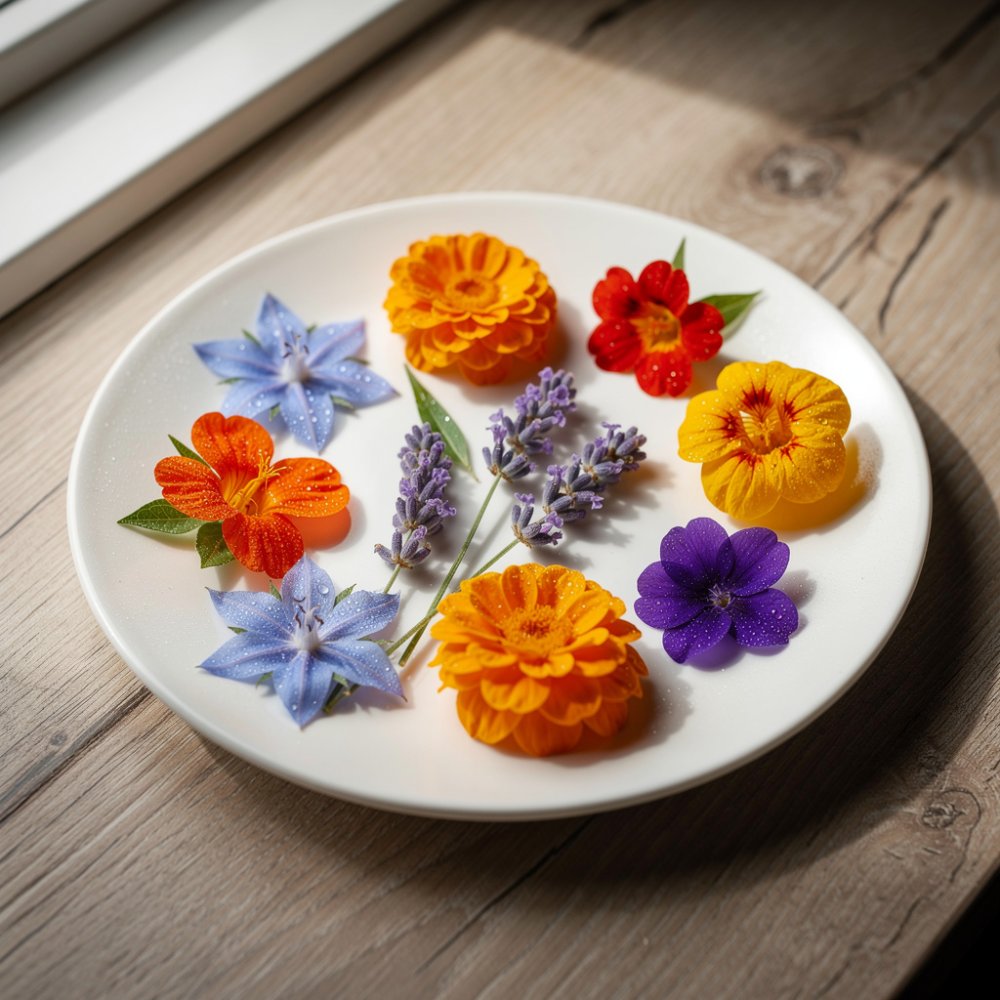
Top 15 Edible Flowers for Your Garden
1. Nasturtium (Tropaeolum majus)
Flavor: Distinctly peppery – reminiscent of arugula and radish at once
Edible parts: Flowers, leaves, buds, immature seeds
Culinary use: Salads, sandwiches, garnish for main courses. Immature buds pickled in vinegar work as an excellent caper substitute – hence the nickname "poor man's capers."
Cultivation: Direct sowing in May on a sunny spot into rather poor soil. Overfertilizing encourages leaf growth at the expense of flowering. Climbing varieties are ideal for planters and trellises; compact types for flower beds.
Colors: Yellow, orange, red, salmon, cream
Nasturtium is also practical from a plant protection perspective – planted near vegetables it effectively repels aphids. Companion planting in its simplest form.
2. Pansy and Violet (Viola)
Flavor: Gently sweet, slightly herbaceous
Edible parts: Whole flower
Culinary use: Visually striking decoration for cakes and desserts, candied as confectionery, frozen into ice cubes or added to salads
Cultivation: Seedling preparation in March or direct sowing in April. Thrive in partial shade and full sun, in evenly moist soil. As biennials they flower from early spring to fall and tolerate mild frosts.
Colors: Complete color spectrum – white, yellow, orange, blue, purple and multicolored combinations
Pansy seeds at Pestík.cz offer dozens of varieties – from single colors to classic "face" patterns.
3. Carnation (Dianthus)
Flavor: Sweetly spicy, reminiscent of cloves – the name Dianthus means "divine flower" after all
Edible parts: Petals; remove the white base of the petals, it tends to be bitter
Culinary use: Flavoring for desserts, homemade syrups and liqueurs, preparation of scented sugar or cocktail garnish
Cultivation: Sunny location, well-draining, ideally calcareous soil. Undemanding perennial that rewards minimal care with abundant flowering.
Colors: Pink, red, white, bicolor combinations
Carnation seeds are an excellent basis for an edible ornamental flower bed.
4. Pot Marigold (Calendula officinalis)
Flavor: Mildly peppery, slightly bitter, spicy
Edible parts: Petals
Culinary use: As "poor man's saffron" it colors rice, soups and pasta in a golden-orange hue. Used in teas, salves and herbal oils.
Cultivation: Direct sowing in April on a sunny spot; tolerates cooler weather. Sow once – thanks to reliable self-seeding it returns every year on its own.
Colors: Yellow, orange
5. Borage (Borago officinalis)
Flavor: Fresh, distinctly cucumber-like
Edible parts: Blue star-shaped flowers, young leaves
Culinary use: Unparalleled garnish for lemonades, gin and tonics and cocktails. Frozen into ice cubes creates an elegant decoration; petals coated in sugar are a natural candy.
Cultivation: Direct sowing in April through May, sunshine, well-draining drier soil. A strong attractant for pollinators – bees love it. Reliable self-seeding.
Colors: Intense cobalt blue (rarely pink)
6. Lavender (Lavandula)
Flavor: Strongly aromatic, sweet-spicy, distinctly floral
Edible parts: Flowers, to a lesser extent leaves
Culinary use: Lavender sugar, butter, cookies, ice cream, panna cotta, chocolate pralines or Provençal seasoning. Important note: lavender is intense – in excessive amounts it easily overpowers other flavors.
Cultivation: Full sun, well-draining, calcareous soil. A hardy Mediterranean herb that appreciates cutting into living wood after flowering.
Colors: Purple, blue, pink, white
7. Rose (Rosa)
Flavor: Floral, sweet, aromatic – intensity depends on the variety; most fragrant are usually old garden and English roses
Edible parts: Petals; remove the white base of each petal
Culinary use: Rose water, Turkish delight, jams, syrups, aromatic teas, cake decoration and garnish for glasses
Cultivation: Sunny location, nutrient-rich well-draining soil. Exclusively consume untreated roses from your own garden.
Colors: Full range from white to dark red
8. Sweet Violet (Viola odorata)
Flavor: Sweet, intensely perfumed
Edible parts: Flowers, young leaves
Culinary use: Candied violets are a classic of French pastry tradition; they are also used in syrups, liqueurs and as dessert decoration.
Cultivation: Partially shaded, evenly moist location. A hardy wild-growing plant that spreads via above-ground runners and requires virtually no care.
Colors: Dark purple, white
9. Chamomile (Matricaria chamomilla)
Flavor: Gently apple-like, soothing, slightly herbal
Edible parts: Whole flower heads
Culinary use: Chamomile tea is an undisputed classic; it is also used in syrups, panna cotta and herbal blends
Cultivation: Sunny location, undemanding regarding soil. Direct sowing from April; reliable self-seeding.
Colors: White petals, yellow center
10. Chives (Allium schoenoprasum)
Flavor: Gently onion-like with a subtle garlic note
Edible parts: Purple spherical flowers (ideally divided into individual florets), shoots
Culinary use: Herbal butter, cheese spreads, salad dressings, curd sauces – and as an elegant garnish for hot dishes
Cultivation: Sun to partial shade, moist soil. Undemanding perennial herb that overwinters and re-emerges on its own every spring.
Colors: Light purple, pink
11. Cornflower (Centaurea cyanus)
Flavor: Mildly sweet, slightly spicy
Edible parts: Petals (inner tubular florets are bitter, better suited for teas)
Culinary use: Visually striking decoration for salads and desserts, tea blends, addition to herbal liqueurs – natural blue color is a rarity in gastronomy
Cultivation: Direct sowing in April on a sunny spot with poor soil. Reliable self-seeding.
Colors: Classic vivid blue, but also pink, white and purple
12. Sunflower (Helianthus annuus)
Flavor: Petals have a mildly bitter tone; buds resemble artichokes
Edible parts: Petals, buds (blanched), seeds
Culinary use: Buds blanched in salted water as mini-artichokes; petals in salads. We describe seeds and their uses in more detail in our article on sunflowers
Cultivation: Full sun, direct sowing on site in May
Colors: Yellow, orange, brick-red, red
13. Hibiscus and Marigold (Hibiscus / Tagetes)
Hibiscus (Hibiscus sabdariffa) – calyces taste distinctly like cranberries and are the base of the Mexican beverage agua de jamaica, but also work well as a hot tea, in cocktails or in jams.
Marigold (Tagetes) – culinarily useful are exclusively Tagetes tenuifolia varieties (signet marigold) with small flowers; large-flowered ornamental marigolds have no place in food. Petals have a bitter, spicy flavor and color dishes golden-orange similar to saffron.
14. Elder Flower (Sambucus nigra)
Flavor: Sweetly honeyed, intensely aromatic
Edible parts: Whole clusters; stalks and branches are mildly toxic – remove them
Culinary use: Elderflower syrup and lemonade are Czech classics. Whole clusters coated in batter and fried in butter are an easy summer dessert. Used in liqueurs and marmalades.
Cultivation: Shrub or small tree that grows even wild. In the garden you will appreciate cultivars like 'Haschberg' or decorative 'Black Beauty.'
Harvest period: May through June
15. Squash and Pumpkin Flower (Cucurbita)
Flavor: Delicate, mildly sweet, almost neutral – ideal base for fillings and batter
Edible parts: Preferably harvest male flowers (without a fruit-bearing ovary at the stem base); leave female flowers for fruit production
Culinary use: Italian "fiori di zucca" fried in light batter is a Roman cuisine classic. Also excellent stuffed with ricotta and parmesan or gently grilled.
Cultivation: Zucchini, pattypan squash, pumpkin – sow on warm, sunny site in May
Colors: Vivid yellow, orange
Overview Table – Edible Flowers at a Glance
| Flower | Flavor | Flowering Period | Difficulty | Main Use |
|---|---|---|---|---|
| Nasturtium | Peppery | June–October | Easy | Salads, pickled buds |
| Pansy | Sweet, delicate | March–November | Easy | Decoration, candying |
| Carnation | Spicy, clove-like | June–September | Easy | Syrups, desserts |
| Marigold | Peppery, bitter | June–October | Easy | Food coloring, teas |
| Borage | Cucumber-like, fresh | June–September | Easy | Beverages, ice cubes |
| Lavender | Sweet-spicy | June–August | Medium | Sugar, baking, syrups |
| Rose | Floral, sweet | June–September | Medium | Rose water, jam, decoration |
| Sweet Violet | Sweet, perfumed | March–April | Easy | Candying, syrups |
| Chamomile | Gently apple-like | May–August | Easy | Tea, desserts |
| Chives | Gently onion-like | May–June | Easy | Butters, spreads, dressings |
| Cornflower | Sweet, spicy | June–September | Easy | Decoration, teas, liqueurs |
| Sunflower | Mildly bitter | July–September | Easy | Salads, buds as artichokes |
| Black Elder | Honeyed, aromatic | May–June | Shrub | Syrup, lemonade, batter |
| Squash Flower | Delicate, neutral | June–September | Easy | Frying, stuffing |
| Hibiscus | Cranberry-tart | July–September | Medium | Tea, cocktails, jams |
Growing Edible Flowers – Practical Tips
Site Selection
Most edible flowers thrive in full sun (at least 6 hours of direct light daily) – this applies to nasturtium, marigold, borage, cornflower and lavender. Partial shade is tolerated without problems by pansies, violets and chamomile. If growing on a balcony, south or southwest exposure is ideal.
Soil and Fertilizing
Grow edible flowers exclusively in soil free of chemical sprays and synthetic fertilizers. Use compost, vermicompost and certified organic fertilizers. Keep in mind that overfertilized, excessively rich soil in nasturtium, cornflower or marigold promotes leaf growth at the expense of flowering.
Watering
Water regularly but sparingly – overwatering does more harm than short-term drought. Water at the roots, not over the leaves and flowers, which reduces the risk of fungal disease.
Flower Harvesting
- Harvest early in the morning, after dew dries but before midday heat – aromatic compounds are most concentrated then
- Select freshly open flowers; fading or overripe ones have less pronounced flavor and poorer texture
- Consume as soon as possible – ideally within 24 hours of harvesting
- For short-term storage in the refrigerator: wrap in damp paper towels and place in a sealed container; will last 2 to 5 days this way
Preservation
- Drying: Lavender, marigold, chamomile, cornflower and rose petals. Dry in thin layers in shade or in a dryer at 35–40 °C.
- Candying: Pansies, violets, rose petals. Brush each flower thinly with lightly beaten egg white, coat evenly with fine sugar and allow to dry completely on a rack.
- Freezing into ice cubes: Borage, cornflower, pansy. Place flower in ice cube tray, cover with cooled boiled water and freeze – the result is an elegant beverage decoration.
- Syrups and flavored oils: Lavender, elder, rose, hibiscus. Pour hot sugar solution over plant material and let steep for 12 to 24 hours; then strain and bottle.
Recipes with Edible Flowers
Elderflower Syrup (Classic)
- 30 full elder flower clusters, 1.5 liters water, 1 kg sugar, 2 lemons, 30 g citric acid
- Shake the flowers but do not rinse (pollen carries the aroma). Pour boiling water over them, add lemon slices and citric acid. Cover and let steep for 24 hours. Strain through cloth, add sugar and bring to a boil while stirring constantly. Boil for 5 minutes, bottle into sterilized jars.
Salad with Edible Flowers
- Base: arugula, young spinach, thin radish slices, toasted walnuts, crumbled goat cheese
- Flowers: nasturtium (flowers and leaves), pansies, cornflowers
- Dressing: 3 tablespoons olive oil, juice of half a lemon, 1 teaspoon honey, salt and freshly ground pepper – mix everything and dress the salad just before serving
Candied Violets
- Fresh violets without stems, 1 egg white (lightly beaten), fine caster sugar
- Brush a thin layer of white onto each flower from all sides with a brush; immediately sprinkle with sugar and shake off excess. Place on parchment paper and dry at room temperature for 24 to 48 hours. Store finished candied violets in a dry sealed container – they will keep for several months.
Frequently Asked Questions (FAQ)
Can I eat flowers from ordinary garden centers?
No. Ornamental flowers from commercial garden centers and florists are almost without exception treated with systemic pesticides that penetrate plant tissue and cannot be rinsed with water. Consume exclusively self-grown flowers without chemical treatment, or purchase products with "edible flowers" certification.
Are edible flowers nutritious?
Yes, in amounts proportional to their consumption. They contain vitamins C, A and K, minerals, antioxidants and polyphenols. Marigold is rich in carotenoids, borage in gamma-linolenic acid, nasturtium in vitamin C. The nutritional benefit is rather supplementary, though the antioxidant potential in several varieties is significant.
Can edible flowers cause allergies?
Yes. Caution is warranted especially in people with pollen allergies, particularly when consuming flowers from the daisy family – this includes marigold, chamomile, cornflower and sunflower. Always start with small amounts and monitor your body's reaction.
Which flowers are best for beginners?
Nasturtium, marigold and pansy – they flower reliably, are easy to grow and have pleasantly pronounced flavors. All you need is a bag of seeds and a patch of garden or balcony planter.
Can I grow edible flowers on a balcony?
Absolutely. A planter planted with nasturtium, pansies, borage and carnation creates a miniature edible garden even on a small balcony. Key factors are sun (at least 4 to 6 hours daily) and quality organic substrate without synthetic fertilizers.