
 Our products
 Aromatherapy - essential oils
 Essential oils
 Aroma lamps
 Aroma Diffusers
 Seeds
 Vegetables
 Herbs and spices
 Ornamental Plant Seeds
 Grass mixtures
 Sprouts and microgreens
 Growing supplies
 Cultivation and Gardening Supplies
 Hydroponics and indoor growing
 Protective equipment and gardening tools
 Exotic plants
 Exotic Fruit and Vegetables
 Exotic herbs
 Exotic trees and shrubs
 Ornamental exotic plants
 Roasted coffee
 Espresso coffee
 Ecological coffee preparation
 Thermal mugs and coffee cups
 Aeropress
 Thermos flasks and thermal mugs for coffee and tea
 Moka pot
 Filter coffee
 Coffee blends
 Accessories for coffee makers
 Water filtration
 Coffee grinders
 Cleaning the Coffee Maker
 Ecological Cleaning of Coffee Machines
 Coffee makers
 Coffee Preparation
 Coffee Accessories
 Food products
 For wildlife and pets
 Chocolate and others
 Hemp food products
 Natural cosmetics
 Hemp cosmetics
 Smoking supplies
 Bongs - water pipes
 Blunts and tubes
 E-liquids with Terpenes and CBD
 Grinders and Mills
 Papers and filters
 Smoking accessories
 Vaporizers
 Air fresheners
 CBD and CBG products
 CBD sprays
 CBD and CBN crystals
 CBD body and facial care
 Weeds
 CBD suppositories and capsules
 CBD oils and drops
 CBG oils and drops
 House and garden
 Fashion and Decoration
 Kitchen essentials and cooking
 Christmas Decorations and Accessories
 Gift Sets
 Bird feeders
 Seasonal and Special Tools
Soil is a living organism. Every year vegetables extract nutrients from it, rain leaches nitrogen, sun dries the surface, and machinery compacts the structure. The result is beds that produce worse year after year. Green manure is the oldest and at the same time the most elegant answer to this problem – you sow plants that will feed the soil, aerate it, protect it from erosion, and prepare it for the next season. Without synthetic fertilizers, without chemicals, for a fraction of the price of industrial products. All you need is a bag of green manure seeds and a thoughtful plan.
What is green manure and how does it work
Green manure is an agrotechnical method in which you grow plants not for harvest, but exclusively to improve the soil. The plants create abundant aboveground biomass and an extensive root system, and you then work them back into the soil – dig them in, mulch them, or mow them down – back into the earth. As the biomass decomposes, organic matter, macronutrients and trace elements are released, creating humus, which is the foundation of long-term soil fertility.
Main benefits of green manure
| Benefit | How it works |
|---|---|
| Nitrogen enrichment | Legumes (clover, vetch, lupine) bind atmospheric nitrogen through nodule bacteria on roots |
| Improved structure | Roots create channels, aerate and loosen soil to depth |
| Increased humus content | Worked-in biomass decomposes into humus – a binder of soil particles and a nutrient reservoir |
| Weed suppression | Dense growth shades the soil surface and prevents weed seeds from germinating |
| Erosion protection | Roots stabilize soil, aboveground parts dampen the impact of raindrops and wind force |
| Interruption of disease cycle | Species unrelated to vegetables (phacelia, sweet alyssum) do not transmit specific pathogens |
| Support for soil life | Root exudates feed microorganisms, earthworms, and mycorrhizal fungi |
| Nitrogen capture before winter | Plants capture free mineral nitrogen that rain would otherwise leach into groundwater |
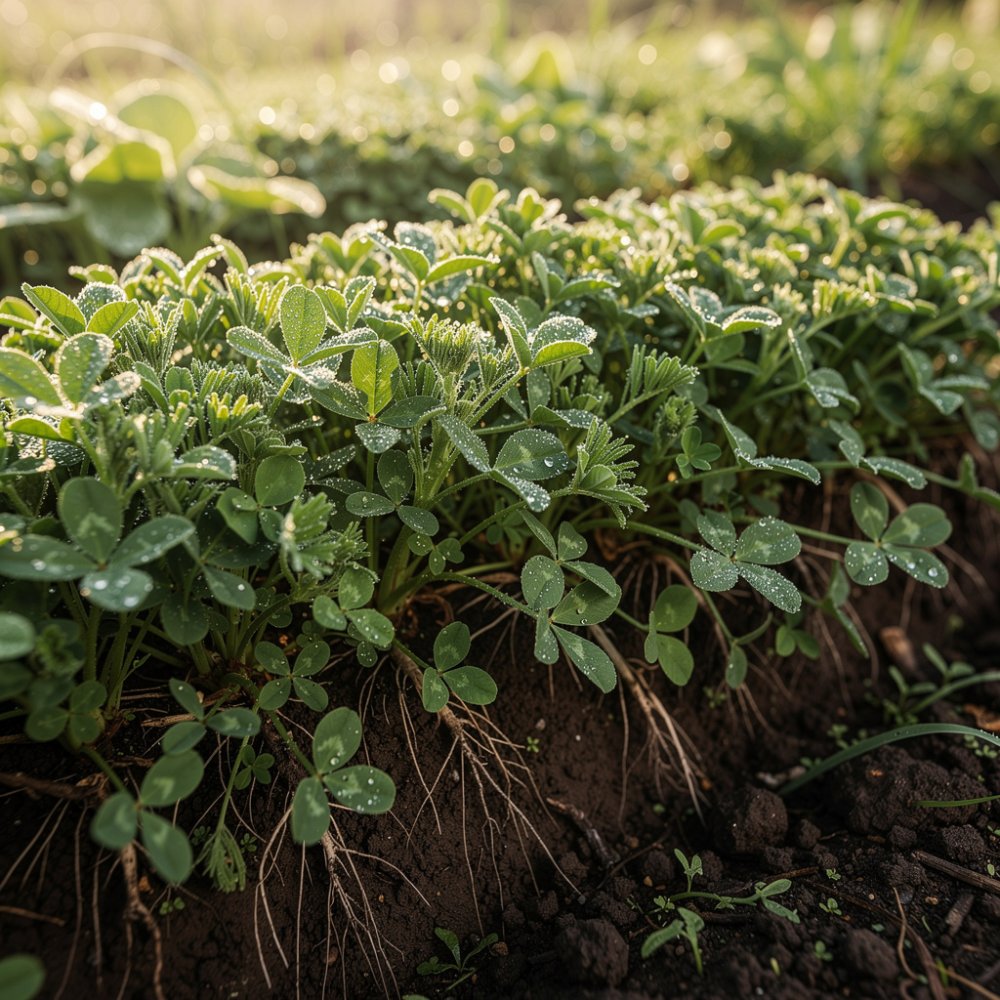
Overview of green manure plants
Legumes – nitrogen fixers
Legumes are a key element of green manure. Through symbiosis with nodule bacteria of the genus Rhizobium on roots, they convert atmospheric nitrogen (N2) into forms directly available to plants. After working in, they release 40–200 kg N/ha into the soil – completely free and without energy-intensive industrial production.
| Plant | Sowing | Biomass | N fixation | Note |
|---|---|---|---|---|
| Incarnate clover | August–September | High | 80–150 kg/ha | Winter cover crop, decorative red flowers, excellent forage |
| White clover | March–September | Medium | 50–100 kg/ha | Perennial, ideal as undercover in orchards and vineyards |
| Spring vetch | March–April | High | 80–150 kg/ha | Fast-growing, climbing – sow with cereal for support, work in before full bloom |
| Winter vetch | August–September | Very high | 100–200 kg/ha | Reliably overwinters, work in early spring |
| Lupine | April–May | High | 100–200 kg/ha | Deep taproot loosens even heavy soils, tolerates acidic conditions |
| Field pea | March–April | Medium | 40–80 kg/ha | Quick establishment, excellent preceding crop for warm-season vegetables |
| Alfalfa | April–May | Very high | 150–300 kg/ha | Perennial, roots penetrate up to 5 m deep |
Deep-rooted plants – biological tiller
These species do not fix atmospheric nitrogen, but their vigorous roots penetrate deep into the subsoil, mechanically loosen compacted soil, and upon dying leave behind a network of permanent channels that significantly improve drainage, aeration, and water capillarity.
| Plant | Sowing | Root depth | Growth rate | Note |
|---|---|---|---|---|
| Phacelia | April–September | 60–90 cm | Very fast (germinates in 30 days) | Universal catch crop, unrelated to any vegetables, excellent forage |
| White mustard | April–September | 60–100 cm | Very fast | Nematocidal effect – suppresses root-knot nematodes, excellent sanitation crop |
| Oil radish | July–September | Up to 150 cm | Fast | So-called biodriller – vigorous taproot breaks through heavy clay horizons |
| Spring rapeseed | April–May | 80–120 cm | Medium | Summer catch crop; winter types overwinter and are worked in spring |
| Buckwheat | May–August | 40–60 cm | Fast | Mobilizes less accessible phosphorus, excellent forage, frost-sensitive |
| Sunflower | May–June | Up to 200 cm | Medium | Produces enormous biomass, attracts pollinators and beneficial insects |
Grasses and cereals
| Plant | Sowing | Benefit | Note |
|---|---|---|---|
| Winter rye | September–October | Dense root network suppresses weeds, reliable winter soil cover | Work in early spring, ideally at boot stage when biomass is most abundant |
| Smooth brome | August–September | Deep roots, suitable as perennial undercover | Proven solution for grass strips in orchards |
| Italian ryegrass | April–August | Rapid soil greening, dense sod suppressing weeds | Can be used as cover crop throughout growing season |
Mixtures – best results
Individual species perform their function reliably, but properly assembled mixtures deliver synergistic results. A combination of legume with non-legume ensures nitrogen fixation and mechanical soil loosening simultaneously, while plants of different heights provide better erosion protection. Proven mixtures from Pestík.cz green manure:
| Mixture | Composition | When to sow | For which soil |
|---|---|---|---|
| Summer universal | Phacelia + mustard + pea | June–August | All soil types |
| Winter cover | Winter vetch + winter rye | August–September | All soil types, overwinters reliably |
| For heavy and clay soils | Oil radish + lupine + phacelia | July–August | Clay and structurally compacted soils |
| Forage | Phacelia + buckwheat + clover | May–July | Lighter soils, deliberate pollinator support |
| Preceding crop for warm-season vegetables | Vetch + pea + mustard | Fall of previous year | Preparation of beds for tomatoes, peppers and eggplant |
When to sow green manure
Spring sowing (March–May)
- Suitable species: Spring vetch, pea, lupine, phacelia, buckwheat
- Incorporation timing: 6–8 weeks after sowing, at the latest at early flowering
- Ideal use: Beds to be occupied by summer vegetables from June to July
Summer catch crops (June–August)
- Suitable species: Phacelia, white mustard, oil radish, buckwheat
- Procedure: Sow immediately after harvesting early vegetables – peas, lettuce, radishes or early potatoes
- Incorporation: In fall before the first frosts, or leave over winter – mustard and phacelia will freeze and create natural protective mulch
Fall and winter sowing (August–October)
- Suitable species: Winter vetch, incarnate clover, winter rye, winter rapeseed
- Incorporation timing: Early spring (March–April), at least 2–3 weeks before sowing or transplanting vegetables
- Ideal use: Beds left fallow over winter – key protection against erosion and leaching of mineral nitrogen into groundwater
Incorporation rule
Incorporate green manure at full bloom or just before – at that time the nutrient content in aboveground biomass is highest and the carbon-to-nitrogen ratio is most favorable for rapid decomposition. After incorporation, wait at least 2–3 weeks before further sowing or transplanting. Freshly incorporated biomass temporarily binds soil nitrogen in the bodies of microorganisms (so-called nitrogen hunger), which could slow germination or establishment of transplanted plants.
How to incorporate green manure
Method 1: Digging in (classical)
Mow the crop, let it wilt for 1–2 days, and dig it in with a spade or cultivator to a depth of 10–15 cm. Incorporation that is too deep slows decomposition – organic matter decomposes fastest in the aerobic zone of the top 15 cm. Suitable for larger beds and structurally heavy soils.
Method 2: Mulching (no-dig)
Mow the crop and leave the biomass on the surface. Cover with a layer of compost or well-rotted manure (5–10 cm). The biomass decomposes on the surface without any disruption to soil structure and the mycorrhizal fungal network. This method is ideal for gardeners practicing no-dig cultivation.
Method 3: Freezing (for non-overwintering species)
Phacelia, mustard and buckwheat die off at the first stronger frosts (approximately -5 to -8°C). Dead biomass remains on the bed as natural mulch, protecting the soil from spring erosion and drying. In spring, you only need to lightly mix it into the top layer. The least labor-intensive of all methods – and yet very effective.
Crop rotation patterns – where to properly fit green manure
Basic rotation principle
Green manure belongs in the crop rotation as a fully-fledged crop. It is crucial not to rotate green manure from the same family as the following vegetables, to avoid transmission of diseases and pests:
| Green manure family | Do not plant immediately after it |
|---|---|
| Brassicas (mustard, radish, rapeseed) | Cabbage, broccoli, cauliflower, radishes, kohlrabi, kale |
| Legumes (vetch, clover, pea, lupine) | Beans, peas – conversely, excellent preceding crop for all other vegetables |
| Grasses (rye, ryegrass) | Corn – otherwise excellent preceding most vegetables |
Phacelia (Phacelia tanacetifolia) is entirely exceptional in this regard. It belongs to the borage family (Boraginaceae), which has no relatives among commonly grown vegetables or fruit trees. It can therefore be placed anywhere in the crop rotation without any risk of disease transmission.
Example two-year crop rotation with green manure
| Year | Spring | Summer | Fall and winter |
|---|---|---|---|
| Year 1 | Pea, lettuce, radishes | After harvest: phacelia + mustard | Winter vetch + winter rye |
| Year 2 | Incorporate vetch, plant tomatoes and peppers | After harvest: buckwheat + clover | Oil radish |
Frequently Asked Questions (FAQ)
Can I use green manure on a small bed?
Absolutely. Green manure is not exclusive to large farms. Even a 2 x 2 m bed benefits significantly from a catch crop – structure improves, organic matter increases, and the bed doesn't remain bare over winter and susceptible to erosion. A small bag of seeds is all you need.
When is it too late for summer sowing?
For summer catch crops (phacelia, mustard), mid-September is the limit – plants need at least 30 days to create sufficient biomass before frost. For winter species (winter vetch, rye), mid-October is the deadline, so plants have time to root before winter.
Do I have to incorporate green manure, or can I leave it over winter?
It depends on the species. Non-overwintering species – phacelia, mustard, buckwheat – will freeze and naturally decompose as mulch; their incorporation is not necessary. Overwintering species – winter vetch, rye, incarnate clover – incorporate in spring as soon as conditions allow, at least 3 weeks before transplanting.
Will green manure attract pests?
Brassica species (mustard, radish) can locally attract flea beetles or cabbage flies, especially if a brassica vegetable follows. The solution is simple: follow crop rotation and incorporate on time. Conversely, phacelia and buckwheat significantly support beneficial insects – pollinators and natural predators of aphids.
How dense should sowing be?
Sowing rates vary by seed size. Fine seeds (phacelia, clover) are sown at approximately 2–5 g/m2, coarser seeds (vetch, pea, buckwheat) require 10–20 g/m2. Exact recommended rates for each species are always found on the packaging of green manure seeds.
Can I combine green manure with straw mulch?
Yes, and it's a very effective combination. Incorporate or mow the green manure and then cover the bed with a layer of straw or wood chips. The result is double protection of the soil surface and double nutrient input for soil organisms.
Summary
Green manure is a simple, economical, and ecologically beneficial method to systematically maintain soil health without dependence on synthetic chemistry. Legumes provide biologically fixed nitrogen, deep-rooted species loosen compacted subsoil, dense growth reliably suppresses weeds, and decomposed biomass feeds billions of soil organisms including mycorrhizal fungi. The key to success is planning – include green manure in your crop rotation as an equal crop, not as an improvised solution for empty beds. Green manure seeds at Pestík.cz include both individual species (phacelia, mustard, vetch, clover, oil radish) and proven ready-made mixtures for various soil types and sowing times. Your soil will reward you with better structure, higher fertility – and next season's vegetables will confirm it.