
 Our products
 Aromatherapy - essential oils
 Essential oils
 Aroma lamps
 Aroma Diffusers
 Seeds
 Vegetables
 Herbs and spices
 Ornamental Plant Seeds
 Grass mixtures
 Sprouts and microgreens
 Growing supplies
 Cultivation and Gardening Supplies
 Hydroponics and indoor growing
 Protective equipment and gardening tools
 Exotic plants
 Exotic Fruit and Vegetables
 Exotic herbs
 Exotic trees and shrubs
 Ornamental exotic plants
 Roasted coffee
 Espresso coffee
 Ecological coffee preparation
 Thermal mugs and coffee cups
 Aeropress
 Thermos flasks and thermal mugs for coffee and tea
 Moka pot
 Filter coffee
 Coffee blends
 Accessories for coffee makers
 Water filtration
 Coffee grinders
 Cleaning the Coffee Maker
 Ecological Cleaning of Coffee Machines
 Coffee makers
 Coffee Preparation
 Coffee Accessories
 Food products
 For wildlife and pets
 Chocolate and others
 Hemp food products
 Natural cosmetics
 Hemp cosmetics
 Smoking supplies
 Bongs - water pipes
 Blunts and tubes
 E-liquids with Terpenes and CBD
 Grinders and Mills
 Papers and filters
 Smoking accessories
 Vaporizers
 Air fresheners
 CBD and CBG products
 CBD sprays
 CBD and CBN crystals
 CBD body and facial care
 Weeds
 CBD suppositories and capsules
 CBD oils and drops
 CBG oils and drops
 House and garden
 Fashion and Decoration
 Kitchen essentials and cooking
 Christmas Decorations and Accessories
 Gift Sets
 Bird feeders
 Seasonal and Special Tools
In short: Take a healthy 10–15 cm cutting with 2–3 nodes from a mother plant in the vegetative phase, cut it at 45° just below a node, apply rooting hormone and keep it at 22–25 °C and 80–95% humidity under weak light. Roots form in 7–14 days in aeroponic propagators or 14–21 days in substrate.
| Cutting length | 10–15 cm with 2–3 nodes |
|---|---|
| Air humidity | 80–95% |
| Temperature | 22–25 °C, root zone 2–3 °C warmer |
| Rooting time | 7–14 days aeroponic, 14–21 days substrate |
| Success rate | aeroponic 90–98%, substrate 70–85%, water 50–70% |
| Transplant when roots reach | 3–5 cm |
Plant Propagators and Plant Cloning – How to Do It
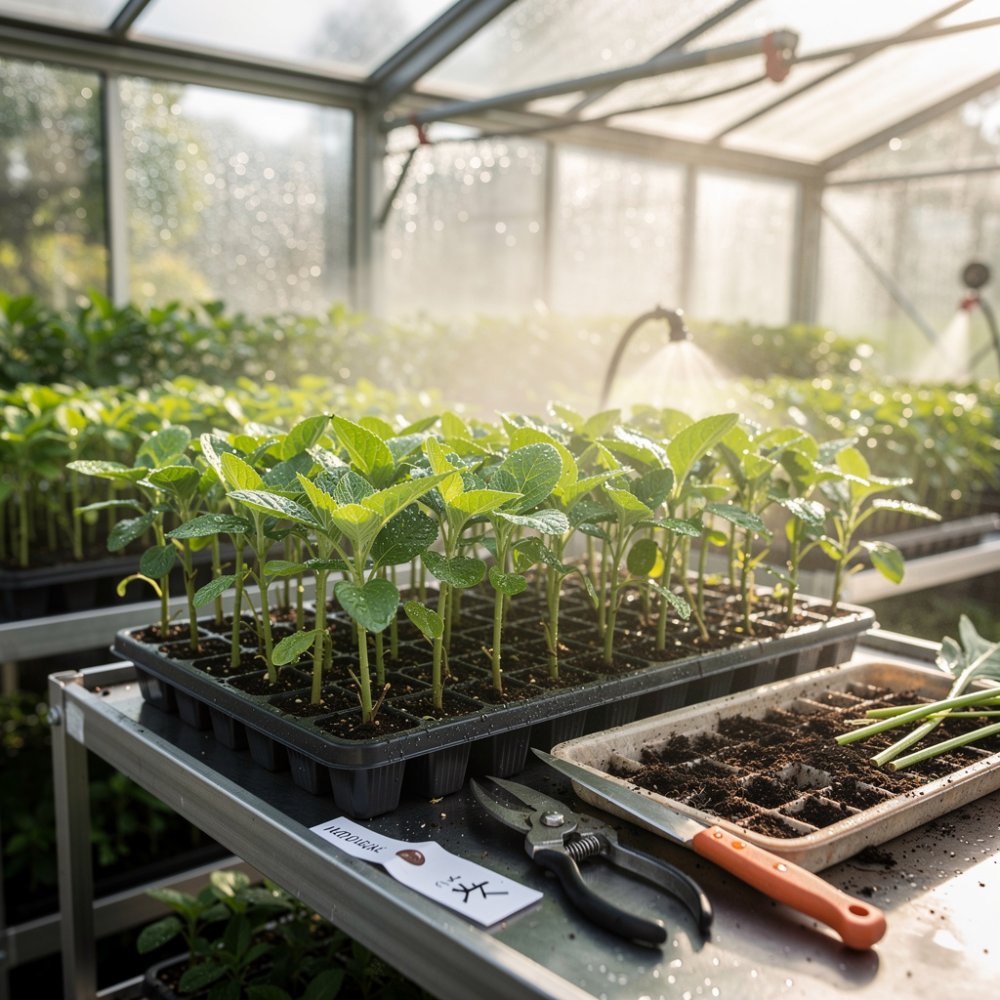
Cloning plants is one of the most valuable skills every experienced grower possesses. While seeds bring genetic variability – and with it unpredictable results – cloning guarantees an exact copy of the mother plant with identical growth patterns, disease resistance, fruit flavor, and flowering time. Professional growers therefore clone routinely as the foundation of consistent, season-after-season repeatable production.
In this guide, you'll learn how cloning works biologically, what equipment you actually need, and what procedures achieve success rates close to 100%.
1. Why Clone?
Advantages of Cloning
- Genetic certainty – each clone is an exact copy of the mother. You know in advance its yield, behavior, and response to growing conditions.
- Time savings – a cutting roots in 7–14 days; seeds require germination and an entire additional early vegetative phase.
- Preservation of elite genotypes – an exceptional plant with ideal traits can be propagated repeatedly by cloning without risk of genetic loss.
- Crop uniformity – all clones grow identically, greatly facilitating nutrient management, lighting, and space allocation.
- Economic efficiency – one packet of seeds yields a single generation. From one mother plant, you can obtain hundreds of clones per year.
When Cloning Is Not Appropriate
- If you aim for genetic diversity – when breeding or selecting new phenotypes.
- With annual species that germinate easily and quickly directly from seeds.
- If you don't have a quality mother – cloning an average plant yields only average copies.
2. Biology of Cloning – What Happens in a Cutting
After a stem is cut and placed in a moist environment, cells at the cut surface initiate a process called dedifferentiation – specialized stem cells reprogram themselves back into pluripotent cells capable of forming a new organ. These cells gradually form callus, healing tissue, from which adventitious roots develop under favorable conditions.
Auxins – natural plant hormones that naturally concentrate in the cut surface area – play a key role throughout the process, stimulating root initiation. Commercial rooting stimulators contain synthetic auxins – most commonly IBA (indole-3-butyric acid) or NAA (1-naphthaleneacetic acid) – which amplify this signal and accelerate root system formation.
3. Rooting Hormones – Types and Use
Gel
The most widespread form due to easy and precise application. Gel adheres to the cut surface and ensures even contact between the hormone and tissue. Most quality gels additionally contain fungicidal additives protecting against rot.
Disadvantage: In aeroponic systems, gel washes off quickly when sprayed by nozzles.
Powder
A classic and cost-effective variant with long shelf life. The cutting is briefly dipped in water and then coated with powder.
Disadvantage: Coverage tends to be less uniform and powder easily falls off during handling.
Solution (Liquid Concentrate)
A water-soluble preparation intended especially for aeroponic systems, where gel and powder wash away from the nozzles.
Advantage: Precise dosing, ideal hormone distribution during spraying.
Disadvantage: After dilution, shelf life is short – always prepare a fresh solution.
Tip: For aeroponic X-Stream propagators, liquid rooting hormones are the most suitable choice because, unlike gel or powder, they are not rinsed away by spray nozzles.
4. Cloning Methods
Cuttings in Substrate (Classic Method)
The most accessible approach suitable for beginners. The cutting is inserted into moist substrate – peat blocks, perlite, or vermiculite – and covered with a transparent propagation dome maintaining high air humidity.
Optimal conditions: Humidity 80–95%, temperature 22–25°C, diffuse light, substrate consistently moist but never waterlogged.
Cuttings in Water
Stems are simply submerged in a container of water. The method requires no equipment but achieves lower success rates and carries higher risk of stem rot.
Suitable for: Soft herbaceous plants (mint, lemon balm, basil) and houseplants with good adventitious rooting ability (pothos, philodendron).
Aeroponic Cloning – X-Stream Nutriculture
The most modern and results-wise most reliable method. Cuttings are held in neoprene collars above a sealed chamber where nozzles continuously spray fine mist directly onto the cut surfaces.
Why aeroponic cloning achieves the best results:
- The root zone is constantly supplied with oxygen – cuttings are not submerged in substrate or water.
- Constant moisture supply eliminates risk of both overwatering and drying out.
- Minimal risk of bacterial and fungal infections.
- Significantly faster rooting: 7–14 days versus 14–21 days in substrate.
The X-Stream propagator from Nutriculture is an acknowledged standard in aeroponic cloning in European hobby and professional cultivation. It is available in several sizes – from compact models for 12 cuttings to high-capacity systems for 120+ cuttings.
Key X-Stream design elements:
- Powerful pump with fine nozzles for even and continuous spraying.
- Neoprene collars for safe and gentle cutting placement.
- Transparent lid allowing visual inspection of rooting without unnecessary opening.
- Compatibility with aquarium heater for precise root zone temperature control.
5. Step-by-Step – How to Clone Successfully
Preparation
- Select a healthy mother plant – free from stress symptoms, diseases, or pests. The mother should be in the vegetative phase; during this period, the plant's hormonal profile is set for vegetative growth, not reproduction.
- Prepare equipment: Sharp sterile knife or scalpel, rooting hormone, propagator or X-Stream propagator, spray bottle filled with clean water.
- Sterilize tools – wipe the scalpel and scissors with isopropyl alcohol before each cut. Contamination from non-sterile tools is the most common cause of batch failure.
Cutting Selection
- Select an appropriate branch – a healthy, firm shoot 10–15 cm long with at least 2–3 nodes (internodes). Avoid apical shoots, which the plant favors for dominant growth.
- Cut at a 45° angle – a slanted cut enlarges the absorption surface and eases initial water uptake. Make the cut just below a node, where auxins naturally concentrate.
- Remove lower leaves – keep only 2–3 upper leaves. Trim large leaves to approximately half their size, thereby greatly reducing transpiration and cutting stress.
- Immediately submerge the cut in water – you prevent air embolism in vascular bundles, which blocks later water and hormone uptake.
Hormone Application and Planting
- Apply rooting hormone – dip the lower 2 cm of the cutting into gel, powder, or freshly prepared solution. Gently tap off excess powder.
- Place in medium:
- Substrate: Insert into pre-moistened peat block or perlite; never force it in to avoid shearing off hormone from the cut.
- X-Stream: Insert into the neoprene collar so the cut surface faces downward into the misting chamber.
- Cover with a dome – humidity under the dome must reach 80–95%.
Aftercare
- Temperature: 22–25°C. The root zone should be 2–3°C warmer than surrounding air – this supports enzymatic activity and accelerates callus formation. Use a heating mat or aquarium heater.
- Lighting: Weak, evenly diffused light with an 18-hour photoperiod. T5 fluorescent or LED panel at low power are ideal choices. Direct intense light (HPS, high-power LED) burns cuttings before they root.
- Leaf Misting: In substrate or water method, mist 2–3 times daily. In the X-Stream system, the nozzles handle this automatically.
- Dome Ventilation: Open the dome once daily for 5 minutes – air exchange reduces mold development risk at high humidity.
- Solution pH (X-Stream): Maintain stable values at 5.5–6.0. Do not use strong fertilizers at this stage – osmotic stress damages unrooted cuttings. Plain water or very weak solution with EC 0.3–0.5 suffices.
Checking Rooting and Transplanting
- After 5–7 days, check if roots are forming. In the X-Stream system, first white rootlets are visible through the transparent lid without needing to manipulate cuttings.
- Once roots reach 3–5 cm length, transplant the clones into final medium – substrate, coco coir, or hydroponic system.
- Gradual hardening: Immediately after transplanting, reduce air humidity from 90% to standard 50–60% over 3–5 days. Too rapid humidity decrease causes wilting.
6. Common Mistakes and Solutions
Mistake 1: Non-Sterile Tools
Symptom: Bacterial infection of cut surface, base rot of stem.
Solution: Sterilize scalpel with isopropyl alcohol or flame before every single cut, especially when taking multiple cuttings from different plants.
Mistake 2: Leaves Too Large
Symptom: The cutting transpires more water than it can take up without roots – noticeably wilts even at high humidity.
Solution: Trim all large leaves to approximately half size. Keep only 2–3 smallest, fully developed leaves.
Mistake 3: Lighting Too Intense
Symptom: The cutting attempts to photosynthesize at full power, but without roots lacks sufficient water uptake – dries quickly.
Solution: During the rooting period, use exclusively weak, diffuse light. Direct HPS discharge lamps or high-power LED panels are not suitable at this stage.
Mistake 4: Cold Root Zone
Symptom: Very slow rooting, increased rot risk due to low enzymatic activity.
Solution: Heating mat under propagator or aquarium heater in X-Stream reservoir maintains optimal 23–25°C in the root zone.
Mistake 5: EC Too High in Solution
Symptom: Osmotic stress – without roots the cutting cannot regulate mineral salt uptake, leaves curl and yellow.
Solution: In aeroponic systems, use plain water or very weak solution with EC no more than 0.5 mS/cm.
Mistake 6: Insufficient Air Humidity
Symptom: Cuttings wilt and dry quickly even at proper temperature.
Solution: Keep humidity under dome between 80–95%. Mist 2–3 times daily. In propagators, regulate humidity using adjustable ventilation holes in the lid.
7. Comparison of Cloning Methods
| Parameter | Substrate + Dome | Water | X-Stream (Aeroponic) |
|---|---|---|---|
| Success Rate | 70–85% | 50–70% | 90–98% |
| Rooting Time | 14–21 days | 10–20 days | 7–14 days |
| Initial Cost | Low | Minimal | Medium–High |
| Technical Difficulty | Low | Low | Medium |
| Rot Risk | Medium | High | Low |
| Scalability | Limited | Minimal | High |
| Ideal For | Beginners | Houseplants | Serious Growers |
Frequently Asked Questions (FAQ)
What Plants Can Be Cloned?
Practically all species forming stems – tomatoes, peppers, herbs (basil, rosemary, mint, thyme), houseplants, ornamental shrubs, and strawberries via runners. Difficulty varies: soft herbs root quickly and reliably, while woody shrubs require longer rooting time and higher hormone concentration.
How Large Should a Cutting Be?
Optimal length is 10–15 cm with 2–3 nodes. Cuttings too short lack sufficient reserves for root formation; those too long transpire excessive water and unnecessarily stress the plant.
Can I Clone from a Flowering Plant?
Technically possible, but results are significantly worse. The hormonal profile of a flowering plant is set for generative reproduction, not vegetative growth – root formation is therefore slow and unreliable. Whenever possible, take cuttings from plants in the vegetative phase.
How Long Does a Cutting Last Without Roots?
Under optimal conditions – high air humidity, weak light, temperature 22–25°C – a cutting remains active for 2–3 weeks. After reserves in tissues are exhausted, it dies. This is precisely why fast and reliable rooting is crucial to success.
Is Investment in an X-Stream Propagator Worthwhile?
If you clone regularly – approximately more than 10 cuttings per month – the investment definitely pays off. X-Stream from Nutriculture achieves the highest success rate (90–98%), shortest rooting time, and lowest labor requirements of all available methods. For occasional small-scale cloning, a simple propagator with peat blocks fully suffices.