
 Our products
 Aromatherapy - essential oils
 Essential oils
 Aroma lamps
 Aroma Diffusers
 Seeds
 Vegetables
 Herbs and spices
 Ornamental Plant Seeds
 Grass mixtures
 Sprouts and microgreens
 Growing supplies
 Cultivation and Gardening Supplies
 Hydroponics and indoor growing
 Protective equipment and gardening tools
 Exotic plants
 Exotic Fruit and Vegetables
 Exotic herbs
 Exotic trees and shrubs
 Ornamental exotic plants
 Roasted coffee
 Espresso coffee
 Ecological coffee preparation
 Thermal mugs and coffee cups
 Aeropress
 Thermos flasks and thermal mugs for coffee and tea
 Moka pot
 Filter coffee
 Coffee blends
 Accessories for coffee makers
 Water filtration
 Coffee grinders
 Cleaning the Coffee Maker
 Ecological Cleaning of Coffee Machines
 Coffee makers
 Coffee Preparation
 Coffee Accessories
 Food products
 For wildlife and pets
 Chocolate and others
 Hemp food products
 Natural cosmetics
 Hemp cosmetics
 Smoking supplies
 Bongs - water pipes
 Blunts and tubes
 E-liquids with Terpenes and CBD
 Grinders and Mills
 Papers and filters
 Smoking accessories
 Vaporizers
 Air fresheners
 CBD and CBG products
 CBD sprays
 CBD and CBN crystals
 CBD body and facial care
 Weeds
 CBD suppositories and capsules
 CBD oils and drops
 CBG oils and drops
 House and garden
 Fashion and Decoration
 Kitchen essentials and cooking
 Christmas Decorations and Accessories
 Gift Sets
 Bird feeders
 Seasonal and Special Tools
LED Lighting for Growing – How to Choose the Right Panel in 2026
Pokud pěstujete rostliny v interiéru – ať už bylinky na parapetu, saláty v hydroponickém systému nebo plodiny v growboxu – světlo je nejdůležitější faktor, který rozhoduje o úspěchu. A v roce 2026 je odpověď na otázku "jaké osvětlení zvolit" jednoznačná: LED panely.
Výběr správného modelu ale není trivální záležitostí. Na trhu existují stovky panelů, specifikace se liší výrobce od výrobce a marketingové údaje bývají záměrně matoucí. Tento průvodce vám pomůže pochopit klíčové parametry, spočítat potřebný výkon pro váš prostor a vybrat panel podle skutečných hodnot – ne podle nejlepšího obalu.
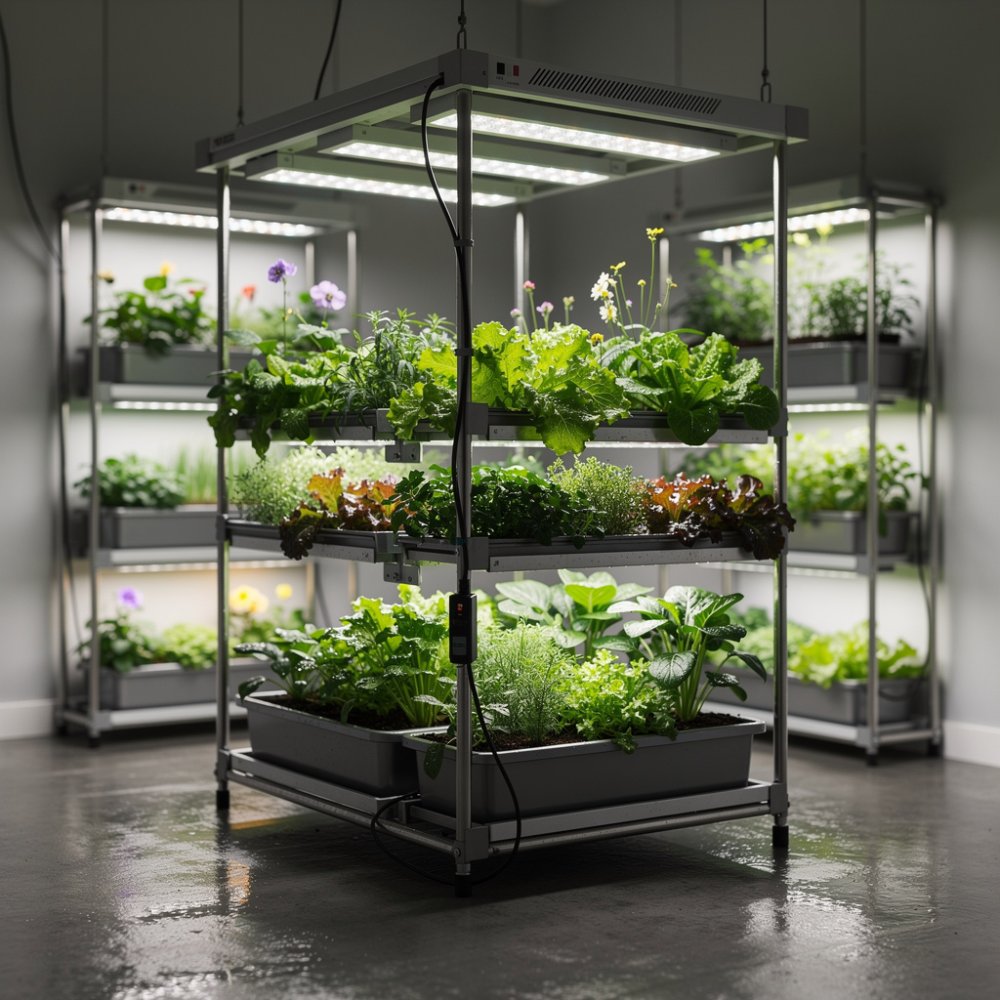
Why LED and Why It's an Investment That Pays Off
Even ten years ago, LED panels were an expensive novelty with problematic spectrum – anyone who remembers the purple "blurple" panels knows what we're talking about. Today, the situation is fundamentally different. Modern LED technology offers:
- Energy savings of 50–80% compared to sodium discharge lamps (HPS). LED converts 50–60% of electrical energy into light, while HPS only converts 30–35% – the rest is lost as heat.
- Lifespan of 50,000+ hours – almost 6 years of continuous operation, or over 10 years with standard use of 12–18 hours daily. An HPS bulb lasts 10,000–20,000 hours and gradually loses its output.
- Lower operating temperature, which means you don't need such powerful ventilation or air conditioning. An LED panel produces approximately 40% less heat than a comparable HPS bulb.
- Precise spectrum optimized for photosynthesis, including the ability to switch between vegetative and flowering phases.
- Higher yields per watt – modern LED panels achieve yields of 1.0–1.5 g/W, almost double compared to HPS.
The initial investment is higher, but the return comes quickly. With a medium-sized grow box (120 × 120 cm), you'll save 2,000–4,000 CZK annually on electricity compared to HPS – and that doesn't include savings on cooling and regular bulb replacements.
Basic Concepts – What You Need to Know Before Buying
Before looking at specific models, you need to understand four key metrics. Without them, you cannot meaningfully compare two panels and it's easy to fall for misleading marketing numbers.
| Term | Full Name | Unit | What It Measures | What to Look For |
|---|---|---|---|---|
| PAR | Photosynthetically Active Radiation | nm (400–700) | Range of light wavelengths used for photosynthesis | Not a measurable value, but a definition of the spectral range that plants use |
| PPF | Photosynthetic Photon Flux | µmol/s | Total number of PAR photons emitted per second | Indicates the total light output of the panel. A 300W panel should reach at least 700–800 µmol/s |
| PPFD | Photosynthetic Photon Flux Density | µmol/m²/s | Number of PAR photons hitting a specific area per second | Key operational value. For vegetation 400–600, for flowering 600–900+ µmol/m²/s |
| PPE | Photosynthetic Photon Efficacy | µmol/J | Efficiency – number of photons produced from one joule of energy | Minimum 2.5 µmol/J. Quality panel: 2.7+. Premium: 2.9–3.1 µmol/J |
| DLI | Daily Light Integral | mol/m²/day | Total daily dose of light received by the plant | Combines PPFD and photoperiod length – see table below |
How These Values Relate to Each Other
- PPF is like water flow from a hose – how many photons the light emits overall.
- PPFD is like measuring how much water lands on a specific spot in the garden – it depends on distance, angle, and beam spread.
- PPE expresses how efficiently the hose works – how much light you get per unit of energy consumed.
- DLI is like a rain gauge – total amount of light collected over an entire day.
Practical tip: Don't just believe the numbers on the box. Manufacturers commonly report PPFD measured in the center of the panel at minimum distance from the light. The actual average PPFD across the entire growing area will always be lower. Quality manufacturers therefore include a PPFD map (called a footprint) for the specific growing space. If you want to measure yourself, get a PAR meter.
DLI Table by Crop – How Much Light Your Plants Need
DLI (Daily Light Integral) is the most accurate way to find out if plants are getting enough light. The calculation is straightforward:
DLI = PPFD × hours of lighting × 0.0036
For example: PPFD 500 µmol/m²/s × 18 hours × 0.0036 = 32.4 mol/m²/day
| Crop | Minimum DLI | Optimal DLI | Recommended PPFD | Photoperiod | Note |
|---|---|---|---|---|---|
| Lettuce, spinach | 12 | 16–17 | 250–350 | 14–16 h | Excess light causes leaf bitterness |
| Herbs (basil, mint, parsley) | 14 | 16–20 | 300–400 | 14–16 h | Basil tolerates even higher DLI without issues |
| Microgreens | 10 | 12–14 | 200–300 | 12–16 h | Short growing cycle, lower overall requirements |
| Strawberries | 16 | 20–25 | 400–500 | 14–16 h | Higher DLI directly supports fruit formation |
| Tomatoes | 20 | 25–30 | 500–700 | 14–18 h | Fruiting plants with the highest light requirements |
| Chili, peppers | 20 | 25–30 | 500–700 | 14–18 h | Comparable requirements to tomatoes |
| Ornamental plants | 6 | 10–14 | 150–300 | 12–14 h | Depends on species – shade-loving species require less |
| Cannabis – vegetative | 18 | 25–35 | 400–600 | 18 h | Intensive vegetative phase requires corresponding input |
| Cannabis – flowering | 30 | 35–45 | 600–900+ | 12 h | With CO2 enrichment, it's possible to exceed 1,000 PPFD |
Warning: More light doesn't automatically mean better results. Each plant has its saturation point – above it photosynthesis stops responding to added light and light burn can occur, along with heat stress. Stick to the recommended ranges.
How Many Watts per m² – Practical Calculation
Wattage alone is not a precise quality metric, but it's still useful for a quick estimate of required power. For indoor growing with modern LED panels (PPE 2.5+ µmol/J), these approximate values apply:
- Vegetative: 150–250 W/m²
- Flowering (full capacity): 300–500 W/m²
Power Output Table by Growing Space Size
| Tent/Box Dimensions | Area (m²) | Minimum W | Optimal W | Recommended Panel Type |
|---|---|---|---|---|
| 60 × 60 cm | 0.36 | 100 W | 150 W | Compact quantum board, single-panel unit |
| 80 × 80 cm | 0.64 | 150 W | 200 W | Quantum board or smaller bar-style |
| 100 × 100 cm | 1.00 | 200 W | 300 W | Medium quantum board, 2–4 bar LED |
| 120 × 120 cm | 1.44 | 300 W | 400–480 W | Bar-style LED for even coverage |
| 150 × 150 cm | 2.25 | 400 W | 600 W | Powerful bar-style or 2 smaller panels |
| 120 × 240 cm | 2.88 | 500 W | 720 W | 2 bar-style panels side by side |
How to Calculate Wattage Accurately
- Measure your growing space area in m² (width × length).
- Multiply by the target PPFD for your phase (e.g., 600 µmol/m²/s for flowering).
- Divide by your panel's PPE value (e.g., 2.7 µmol/J).
- The result is the required power in watts.
Example: Grow box 120 × 120 cm (1.44 m²), target PPFD 700, panel with PPE 2.7:
(700 × 1.44) / 2.7 = 373 W – a panel with around 400 W output will be ideal.
Important: This calculation assumes reflective walls (mylar or white surface). In an open space without reflective surfaces, expect to need 20–30% higher power.
Full Spectrum vs. Targeted Spectrum – What Does It Mean in Practice
When browsing LED lighting on Pestik, you'll come across two basic approaches to spectrum:
Full Spectrum
Modern indoor growing standard. The panel emits white light covering the entire 400–700 nm range, supplemented with deep red (660 nm) and far red (730 nm). Advantages:
- Universal use – from seedling to harvest without need for switching.
- Natural colors – you can monitor plant health by eye, as you see leaves in natural colors.
- Simple operation – no spectrum mode switching.
Targeted Spectrum
The panel focuses on specific wavelengths – typically blue (450 nm) for vegetative growth and red (660 nm) for flowering. Advantages:
- Higher energy efficiency – no wasted energy on wavelengths with lower photosynthetic benefit.
- Lower heat output – due to narrower spectrum.
Which Approach to Choose?
In 2026, the trend is clear: full spectrum with targeted enhancement. That is, broad white spectrum as a base, supplemented with specific LED chips for deep red (660 nm), far red (730 nm), and in premium models also UV (380–400 nm). This hybrid approach combines the universality of full spectrum with the energy advantages of targeted solutions.
The vast majority of quality panels today use this exact combination. Old "blurple" panels with purely red-blue spectrum are technologically outdated and we don't recommend buying them.
Samsung LM301B/H – Why These Diodes Are the Industry Standard
If you've read any serious LED panel tests in the last three years, you've likely come across the designation Samsung LM301B or LM301H. These are LED chips used by most premium manufacturers, for well-founded reasons.
Samsung LM301B
- Efficiency up to 2.7 µmol/J (top bin).
- Flip-chip technology that pushed mid-power LED efficiency to a new performance class.
- Stable output, low degradation, and proven lifespan.
Samsung LM301H
- Technically identical chip to LM301B, designated for horti-specific applications.
- Best variants (SL bin) achieve 2.7–3.03 µmol/J.
- The difference in H/B designation is largely marketing – what matters is the specific bin (chip quality class).
Samsung LM301H EVO
- Latest generation with PPE up to 3.14 µmol/J.
- Used by premium brands like Mars Hydro (FC series) or Lumatek (latest models).
What Does This Mean for Your Choice?
The designation "Samsung LM301B/H diodes" in the panel description is a reliable quality signal. The diode brand alone isn't enough though – equally important are:
- Bin (quality class) – higher bin = higher efficiency.
- Driver (power supply) – quality MeanWell driver ensures stable power and maximum lifespan.
- PCB construction – affects heat dissipation and lighting uniformity.
- Overall design – diode layout, reflectors, beam angle (120° is standard).
Brands on Pestik – Comparison
On Pestik, you'll find several proven LED lighting brands. Here's their practical comparison:
Lumatek
Dutch premium brand at the absolute top of the market. Zeus and ATS series use Samsung and Osram diodes with efficiency up to 3.1 µmol/J.
| Model | Power | PPF (µmol/s) | PPE (µmol/J) | Suitable For |
|---|---|---|---|---|
| ATS 200W PRO | 200 W | ~540 | 2.7 | 80 × 80 to 100 × 100 cm |
| ATS 300W PRO | 300 W | 816 | 2.7 | 100 × 100 to 120 × 120 cm |
| Zeus 465W Pro 2.9 | 465 W | ~1,350 | 2.9 | 120 × 120 cm |
| Zeus 600W Pro 3.1 | 600 W | ~1,990 | 3.1 | 150 × 150 cm and larger |
Strengths: Top efficiency, bar-style design for even coverage, dimmable, precise construction.
For: Experienced growers who demand maximum power per watt and are willing to pay for it.
SunPro
European brand with excellent price-to-performance ratio. Uses Samsung chips and covers the full range from small TLED tubes to professional bar-style panels.
| Model | Power | PPF (µmol/s) | PPE (µmol/J) | Suitable For |
|---|---|---|---|---|
| TLED 26W Grow | 26 W | ~50 | ~1.9 | Supplemental lighting, seedlings |
| TLED 42W Grow | 42 W | ~85 | ~2.0 | Propagation, small spaces up to 0.5 m² |
| SunPro Panel 150W | 150 W | ~390 | 2.6 | 60 × 60 to 80 × 80 cm |
| SunPro Hitter 720W Eco | 720 W | 1,920 | 2.67 | 150 × 150 cm and larger, professional use |
Strengths: Affordable price, proven Samsung diodes, wide range for different space sizes.
For: Beginners and experienced growers looking for solid performance at reasonable cost.
Sylvania Gro-Lux
Historic brand with long tradition in horti-lighting. The LED Linear series excels in robust construction, passive cooling, and IP66 water resistance.
| Model | Power | PPF (µmol/s) | PPE (µmol/J) | Suitable For |
|---|---|---|---|---|
| Gro-Lux LED Linear 264W | 264 W | ~600 | ~2.3 | 100 × 100 to 120 × 120 cm |
| Gro-Lux LED Linear 396W | 396 W | 1,080 | ~2.7 | 120 × 120 to 150 × 150 cm |
Strengths: Extreme durability (IP66), passive cooling without fans – no noise, universal full spectrum.
For: Growers who need light resistant to humid environments or require absolute silence in operation.
LEDMAX (GardenHighPro)
Affordable panels for beginners and hobby growers. ECO and PRO series cover basic growing needs.
| Model | Power | PPE (µmol/J) | Suitable For |
|---|---|---|---|
| LEDMAX ECO 60W | 60 W | 1.95 | Small spaces, herbs, supplemental lighting |
| LEDMAX ECO 150W | 150 W | 1.95 | 60 × 60 to 80 × 80 cm |
| LEDMAX PRO 150W | 150 W | 2.06 | 60 × 60 to 80 × 80 cm, with UV booster |
Strengths: Low purchase price, simplicity (plug-and-play), 60,000+ hour lifespan.
For: Beginners with limited budget, hobby growers of herbs and ornamental plants.
Which Brand to Choose?
- Budget up to 3,000 CZK: LEDMAX ECO/PRO – solid starting point.
- Budget 3,000–8,000 CZK: SunPro – best price-to-performance in this segment.
- Budget 8,000–15,000 CZK: Lumatek ATS – professional power for reasonable price.
- Budget 15,000+ CZK: Lumatek Zeus – absolute peak available on the market.
- Humid environment / silence: Sylvania Gro-Lux – durable construction without compromises.
LED vs. HPS vs. CFL – Final Comparison
For a complete overview, we compare three main types of lighting for indoor growing. CFL (compact fluorescents) is slowly disappearing from sales, but you can still find it in grow shops.
| Parameter | LED | HPS (Sodium discharge) | CFL (Compact fluorescent) |
|---|---|---|---|
| PPE (efficiency) | 2.5–3.1 µmol/J | 1.5–1.7 µmol/J | 0.8–1.0 µmol/J |
| Electricity consumption | Low | High (2× more than LED) | Medium |
| Heat production | Low | Very high | Medium |
| Lifespan | 50,000+ h | 10,000–20,000 h | 8,000–10,000 h |
| Need for replacement | None during lifecycle | Every 1–2 years | Approximately every year |
| Spectrum | Full, adjustable | Mostly red/orange | Limited, fixed |
| Yield per watt | 1.0–1.5 g/W | 0.5–1.0 g/W | 0.3–0.5 g/W |
| Purchase price | Higher | Medium | Low |
| Annual operating costs (120 × 120 cm) | ~3,500 CZK | ~7,000 CZK | ~5,500 CZK |
| Cooling requirements | Minimal | High, air conditioning needed | Medium |
| Noise | None (passive) to minimal | Fans and ballast | Minimal |
| UV/IR supplementation | Integrated in modern panels | Requires separate lamp | Practically unavailable |
Verdict
HPS still has proponents – mainly in situations where the heat from the bulb also serves as supplemental heating in winter months. In any other case, LED is objectively the better choice.
CFL is justified only for seedling propagation or cloning, where you don't need high intensity. For a full growing cycle, it's inadequate.
LED is the clear choice in 2026 for the vast majority of indoor growers.
How to Hang the Panel and Set the Correct Height
Panel height above plants is a critical parameter. Too close causes light burn (bleaching tips). Too far leads to insufficient intensity and stretching. Modern LED panels offer dimming function, which adds necessary flexibility.
Recommended Distances from Plant Tops
| Growth Phase | Distance | Target PPFD | Dimming | Notes |
|---|---|---|---|---|
| Germination / Seedlings | 60–90 cm | 100–200 µmol/m²/s | 25–40% | Gentle light prevents stretching and burn of sensitive seedlings |
| Young plants / Clones | 45–60 cm | 200–400 µmol/m²/s | 40–60% | Gradually move closer and monitor leaf response |
| Vegetative | 30–50 cm | 400–600 µmol/m²/s | 60–80% | Intensive growth requires higher light input |
| Flowering – Early | 30–45 cm | 500–700 µmol/m²/s | 75–90% | Smooth transition to higher intensity |
| Flowering – Full | 25–40 cm | 600–900+ µmol/m²/s | 90–100% | Full power, regularly check for stress signs |
Practical Tips for Height Adjustment
-
Always start higher with lower power. Gradually lower distance and increase intensity. Adapting plants to more light is easier than treating burn.
-
Monitor leaves. Upward curling ("taco" effect), yellowing tips, or white spots signal excess intensity. Stretching stems and pale green leaves indicate insufficient light.
-
Use adjustable hangers. Ratchet hangers allow quick height adjustments. Most panels from Pestik's range include them.
-
Measure PPFD at plant level, not at the panel level. A PAR meter is the most accurate tool for setting optimal distance. Find it in the measurement devices section.
-
Adjust height continuously. Plants grow – check distance every 2–3 days during the vegetative phase.
Quantum Board vs. Bar-Style – Which Design to Choose
You'll encounter two main LED panel construction formats on the market, each with distinct strengths.
Quantum Board (QB)
Compact panel with diodes arranged on one large board. Typical shape: square or rectangle.
- Advantages: Lower price, simple construction, high intensity in center area.
- Disadvantages: Worse coverage uniformity in corners, central "hotspot" with significantly higher PPFD.
- Ideal for: Smaller spaces (60 × 60 to 100 × 100 cm), budget-conscious setups for beginners.
Bar-Style (multi-bar)
Multiple LED bars distributed across the frame. Typical shape: rectangular frame with 4–8 parallel bars.
- Advantages: Excellent uniformity across the entire area, hotspot elimination, better light penetration into the canopy due to distributed light source.
- Disadvantages: Higher price, larger dimensions, higher weight.
- Ideal for: Larger spaces (120 × 120 cm and above), professional and semi-professional growing.
Recommendation
For a grow box 120 × 120 cm and larger, we clearly recommend bar-style design. The difference in coverage uniformity is fundamental – the corners of the grow box receive sufficient light and the entire canopy grows uniformly. For smaller spaces, a quantum board is fully adequate and more cost-effective.
5 Most Common Mistakes When Choosing an LED Panel
1. Buying Based on Wattage
The mistake: "I need a 300W panel because the seller told me so." Wattage is meaningless without knowing the panel's efficiency (PPE). A 300W panel with PPE 2.2 performs much worse than a 250W panel with PPE 2.8.
The solution: Always ask for PPF (total light output in µmol/s) and PPE (efficiency in µmol/J). Calculate required power based on your space and target PPFD, as shown in the calculation section above.
2. Ignoring the "Footprint" – Where Light Actually Lands
The mistake: "The label says 1,000 µmol/s, so it must cover my entire 120 × 120 grow box perfectly." Not true. That's the peak measurement at minimum distance. In reality, corners receive only 50–70% of that.
The solution: Ask the manufacturer for a PPFD map for your specific space height. If not available, assume corners will have 30–40% lower values than center. Plan accordingly.
3. Choosing "Blurple" Panels with Fixed Spectrum
The mistake: Buying old-style red-blue panels because they're cheap, not realizing that spectrum matters throughout the plant lifecycle and that modern full spectrum panels outperform them significantly.
The solution: Insist on modern full spectrum with deep red and far red enhancement. Avoid any panel that looks purple at night.
4. Skipping the Dimming Function
The mistake: "I'll just buy a fixed panel and put it at the right distance." This limits flexibility as plants grow and as you experiment with different varieties with different light requirements.
The solution: Prioritize panels with 0–100% dimming capability. It's essential for seedling propagation and allows fine-tuning of intensity throughout the cycle.
5. Not Accounting for Space Loss
The mistake: Buying a panel that "should" cover a 120 × 120 cm space and then being disappointed by uneven edges. Modern panels rarely provide quality light to the outermost 10–15 cm of the space.
The solution: For a 120 × 120 cm grow box, account for approximately 100 × 100 cm of usable space. Size the panel accordingly or accept that outer zones will have lower intensity.
Final Checklist Before Buying
Before completing your purchase of LED lighting from Pestik, verify these key points:
- [ ] Know your space dimensions and have calculated the required wattage using the PPE-based method, not just wattage recommendations.
- [ ] Verify PPF and PPE values – don't rely on manufacturer claims alone, check for independent test data if available.
- [ ] Request PPFD map (footprint) for your specific growing height.
- [ ] Confirm dimming capability – minimum 0–100%, preferably with remote control.
- [ ] Check warranty – minimum 2 years; 5 years is standard for premium brands.
- [ ] Verify power supply quality – preferably MeanWell or equivalent.
- [ ] Look for driver certification – UL, CE, or FCC certification indicates proper quality control.
- [ ] Confirm diode type – Samsung LM301B/H or Osram SSL are industry standards.
- [ ] Plan for cooling requirements – even LED generates heat that must be managed.
- [ ] Calculate running costs – multiply wattage by 365 days × typical hours per day × your local electricity rate.
Conclusion
In 2026, the choice of LED panel is more important than ever. The technology has matured to the point where modern panels from reputable manufacturers (Lumatek, SunPro, Sylvania, LEDMAX) can reliably deliver outstanding results. The key is understanding the parameters, calculating your actual needs, and avoiding the marketing pitfalls that plague the grow lighting industry.
Start with the right foundation – quality light tailored to your space – and 80% of your growing success is already assured. The remaining 20% depends on genetics, nutrition, environmental control, and experience.
Happy growing!