
 Our products
 Aromatherapy - essential oils
 Essential oils
 Aroma lamps
 Aroma Diffusers
 Seeds
 Vegetables
 Herbs and spices
 Ornamental Plant Seeds
 Grass mixtures
 Sprouts and microgreens
 Growing supplies
 Cultivation and Gardening Supplies
 Hydroponics and indoor growing
 Protective equipment and gardening tools
 Exotic plants
 Exotic Fruit and Vegetables
 Exotic herbs
 Exotic trees and shrubs
 Ornamental exotic plants
 Roasted coffee
 Espresso coffee
 Ecological coffee preparation
 Thermal mugs and coffee cups
 Aeropress
 Thermos flasks and thermal mugs for coffee and tea
 Moka pot
 Filter coffee
 Coffee blends
 Accessories for coffee makers
 Water filtration
 Coffee grinders
 Cleaning the Coffee Maker
 Ecological Cleaning of Coffee Machines
 Coffee makers
 Coffee Preparation
 Coffee Accessories
 Food products
 For wildlife and pets
 Chocolate and others
 Hemp food products
 Natural cosmetics
 Hemp cosmetics
 Smoking supplies
 Bongs - water pipes
 Blunts and tubes
 E-liquids with Terpenes and CBD
 Grinders and Mills
 Papers and filters
 Smoking accessories
 Vaporizers
 Air fresheners
 CBD and CBG products
 CBD sprays
 CBD and CBN crystals
 CBD body and facial care
 Weeds
 CBD suppositories and capsules
 CBD oils and drops
 CBG oils and drops
 House and garden
 Fashion and Decoration
 Kitchen essentials and cooking
 Christmas Decorations and Accessories
 Gift Sets
 Bird feeders
 Seasonal and Special Tools
In the flood of natural products, it's becoming increasingly difficult to choose truly quality essential oils. Certifications and quality standards can make your selection significantly easier. Do you know what designations like ECOCERT, ISO or other international standards mean? In this article, we'll look at how different certification agencies assess the origin, purity and composition of essential oils – and how this information will help you select truly quality products you can trust.
This article is updated for 2025 to bring you the latest information on how to recognize truly quality essential oils. You may have noticed designations such as ECOCERT, ISO or USDA Organic – these aren't just decorative labels, but confirmation that the product has undergone thorough inspection.
✨In this article, we'll look at how essential oil quality is verified, why standards and testing are important, and how to recognize an oil that meets high standards of purity and origin. You'll learn what to look for when choosing, and what to watch out for if you want to be sure you're using a truly quality and safe product.
Article Contents
- Certification Agencies: Who Monitors Essential Oil Quality?
- What Standards Verify Essential Oil Quality?
- Control Processes: What Gets Tested?
- How to Recognize a Certified Essential Oil?
- Benefits of Certified Essential Oils
- Conclusion: Choose an Oil You Can Trust
Certification Agencies: Who Monitors Essential Oil Quality?
The designation certified essential oil isn't just a marketing trick. Behind these labels stand independent organizations that set strict rules for origin, processing, and overall product quality.
Among the most well-known certification authorities are:
- ECOCERT – monitors the ecological origin of plants, cultivation methods, and processing.
- ISO – establishes international standards for quality, purity, and production processes.
- USDA Organic – American standard for ecological and organic products.
- AFNOR – French institution defining quality standards in aromatherapy and oil production.
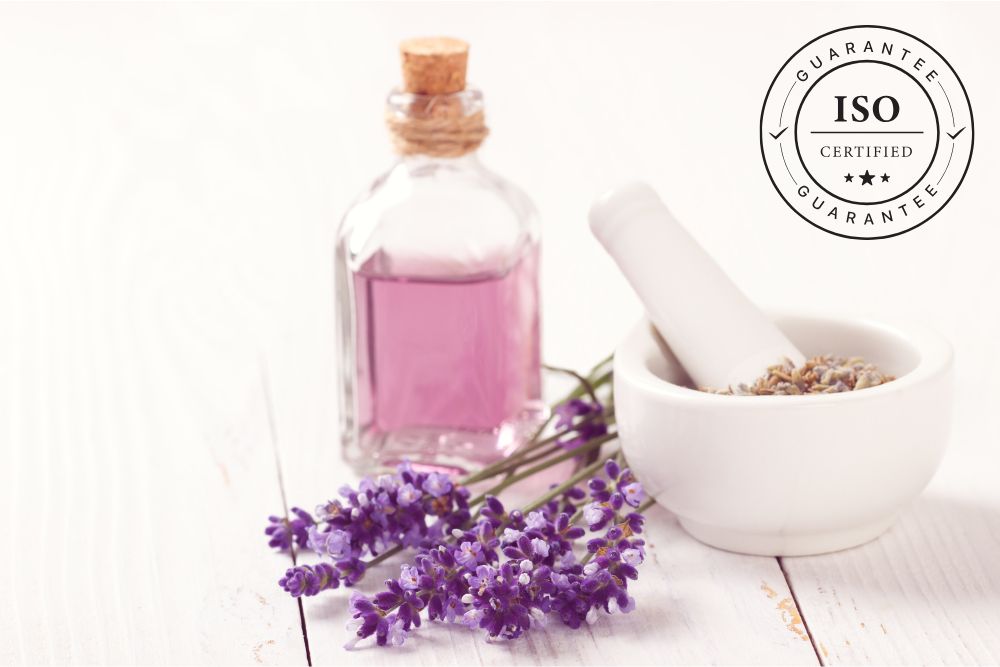
💜A bottle of essential oil with lavender and an ISO certification symbol.
What standards verify the quality of essential oils?
Quality standards set clear rules for the production, origin, and processing of essential oils. Thanks to them, you can better understand how the oil was produced and what standards it meets.
- GMP (Good Manufacturing Practice) – focuses on proper, hygienic, and controlled production.
- ISO 9001 – international standard for quality management in companies.
- ECOCERT – recognized certificate for organic products with emphasis on ecological origin and gentle processing.
- Organicert – confirms the ecological origin of raw materials without the use of synthetic fertilizers or pesticides.
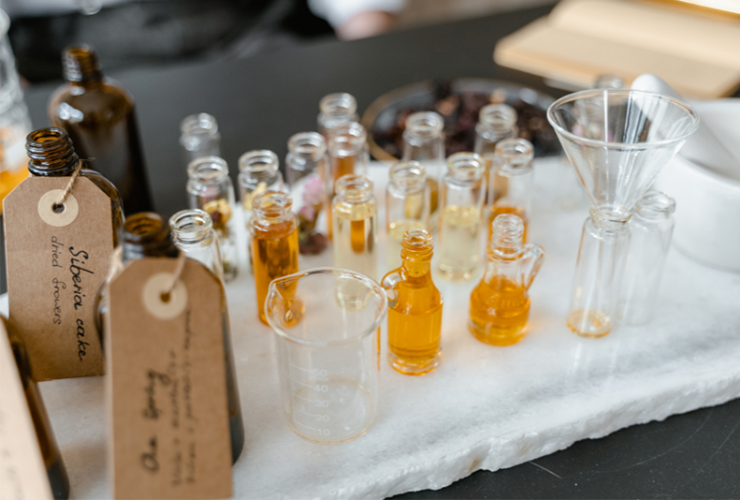
💜Glass bottles with plant extracts and oil samples prepared for laboratory quality testing.
Control processes: What exactly gets tested?
Before an essential oil reaches the customer, it goes through a series of controls that verify its origin and quality. Testing focuses on various parameters, from raw material purity to the stability of the final product.
What is most commonly tested?
- Plant material identification – confirms the botanical origin and correct species of plants used.
- Chemical analysis (e.g. GC/MS) – determines the oil composition and compares it with the natural profile of the given plant.
- Microbiological tests – verify that the oil does not contain unwanted microorganisms such as moulds or bacteria.
- Stability tests – monitor the oil's behaviour over time and evaluate its resistance to light, heat and storage conditions.
Quality essential oils should be stored in dark glass bottles, away from direct light and at a stable, preferably lower temperature. Proper storage helps oils maintain their properties for as long as possible.
📌 Want to know how essential oils are actually made? Check out the article: The Secret of Distillation – How Essential Oils Are Made.
How to Recognise a Certified Essential Oil?
Recognising a quality and certified essential oil can be challenging at first glance, but there are several reliable indicators that will make it easier for you:
- Certification authority logo (e.g. ECOCERT, USDA Organic, Organicert).
- Labels such as "certified organic" or "100% pure essential oil", which describe the production method or purity of composition.
- Information about plant origin, harvest location and processing method.
- Manufacturer details and possible references to laboratory tests or quality standards.
📌 We also recommend: Read about how to use essential oils safely and effectively so they bring you maximum benefit in aromatherapy.
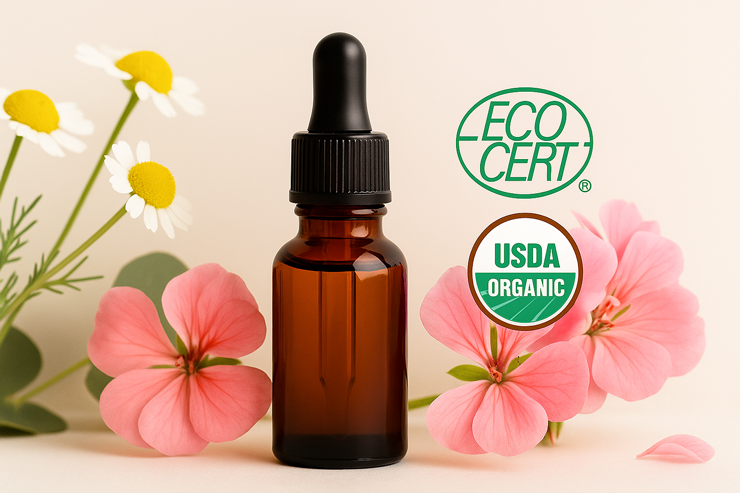
💜 A brown glass essential oil bottle surrounded by flowers, complemented by ECOCERT and USDA Organic certification logos.
Benefits of Certified Essential Oils
🌿 Transparent Origin and Verified Quality
Certified essential oils undergo inspections that confirm compliance with specific standards. Certification typically verifies the origin of plants, cultivation methods, and processing procedures. For customers, this means greater assurance that the product meets the declared criteria.
🌿 Support for Gentle and Sustainable Cultivation
Organic certifications (such as ECOCERT, USDA Organic) emphasize ecological agriculture, meaning cultivation without synthetic fertilizers and pesticides. This supports healthier soil, biodiversity protection, and an overall gentler approach to nature.
🌿 Greater Trust in the Manufacturer
Brands that invest in certification demonstrate their commitment to transparency and quality. Certification is voluntary and obtaining it requires meeting strict conditions, which can increase trust in the manufacturer and their products.
Conclusion: Choose an Oil You Can Trust
When selecting a quality essential oil, it's important to pay attention to its origin, production method, and any certifications. International quality designations help verify that a product meets established standards and can make it easier to navigate between different brands.
Certified oils are typically associated with organic cultivation and transparent production, which is appreciated by anyone who prefers a gentle approach to nature and honest processing.
🌿Want to learn more about choosing oils? Read more about selecting the right essential oil or discover our range of essential oils.