
 Our products
 Aromatherapy - essential oils
 Essential oils
 Aroma lamps
 Aroma Diffusers
 Seeds
 Vegetables
 Herbs and spices
 Ornamental Plant Seeds
 Grass mixtures
 Sprouts and microgreens
 Growing supplies
 Cultivation and Gardening Supplies
 Hydroponics and indoor growing
 Protective equipment and gardening tools
 Exotic plants
 Exotic Fruit and Vegetables
 Exotic herbs
 Exotic trees and shrubs
 Ornamental exotic plants
 Roasted coffee
 Espresso coffee
 Ecological coffee preparation
 Thermal mugs and coffee cups
 Aeropress
 Thermos flasks and thermal mugs for coffee and tea
 Moka pot
 Filter coffee
 Coffee blends
 Accessories for coffee makers
 Water filtration
 Coffee grinders
 Cleaning the Coffee Maker
 Ecological Cleaning of Coffee Machines
 Coffee makers
 Coffee Preparation
 Coffee Accessories
 Food products
 For wildlife and pets
 Chocolate and others
 Hemp food products
 Natural cosmetics
 Hemp cosmetics
 Smoking supplies
 Bongs - water pipes
 Blunts and tubes
 E-liquids with Terpenes and CBD
 Grinders and Mills
 Papers and filters
 Smoking accessories
 Vaporizers
 Air fresheners
 CBD and CBG products
 CBD sprays
 CBD and CBN crystals
 CBD body and facial care
 Weeds
 CBD suppositories and capsules
 CBD oils and drops
 CBG oils and drops
 House and garden
 Fashion and Decoration
 Kitchen essentials and cooking
 Christmas Decorations and Accessories
 Gift Sets
 Bird feeders
 Seasonal and Special Tools
Do you dream of growing bonsai but don't know where to start? We'll guide you on how to choose the right species, how to care for your bonsai, and how to shape it. Growing these miniature trees isn't complicated when you know how.
Do you dream of growing bonsai but don't know where to start? We'll show you how to choose the right species, how to care for bonsai and how to shape them. Growing these miniature trees is not difficult if you know how.
History and Origin
This art of growing miniature trees in a pot originates from ancient China, with a history dating back 2,000 years. Later, bonsai spread to Japan and subsequently to the entire world.
Species Selection
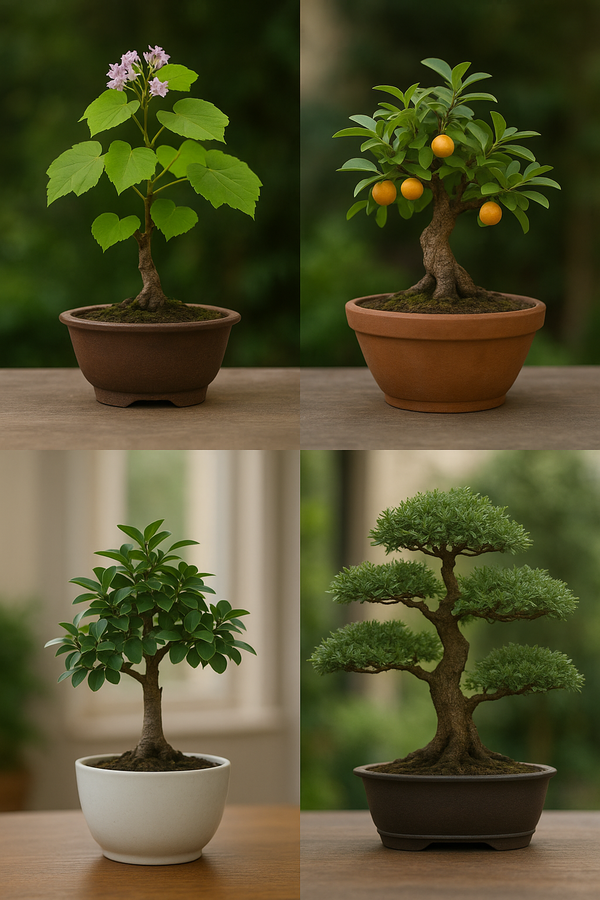
🌳 For outdoor growing, which is easier by the way, it's best to choose a deciduous species at first, such as linden, hornbeam or fruit trees, which will additionally offer you a wonderful sight in summer in the form of small fruits. Lilacs, fuchsias or azaleas will also be a guaranteed decoration for your garden.
🌳 With indoor bonsai, you can go for any woody species of potted plants. The most common indoor bonsai are citrus trees, small-leaved ficus or Chinese elms, which will be year-round decorations thanks to their evergreen nature.
If you thought that bonsai only grow to a few centimeters, you're mistaken – bonsai can reach up to two meters. If you're planning to have a larger bonsai, you can buy an already mature tree or a pre-shaped plant.
You can also grow bonsai from seed, but it requires patience and plenty of time. The advantage, however, is that you have the plants in your own hands from the beginning, and the result is definitely worth it.
Bonsai Sizes
- Large: 60 to 120 cm
- Medium: 30 to 60 cm
- Small: 15 to 30 cm
- Miniature: 5 to 15 cm
- Baby bonsai: 7.5 to 15 cm
Bonsai Care
Location
If you want to grow an indoor bonsai, choose an east or west-facing window. If you've chosen an outdoor bonsai, it's best to select a bright location, but avoid direct midday sun. In winter, outdoor bonsai should be protected from wind, rain and snow.
Substrate
When you buy a bonsai from a shop that isn't specialized in bonsai, it's best to repot it immediately. If you bring the plant in from outdoors, it's better to let it gradually adjust to the pot. Thick roots need to be shortened, and you should choose an ordinary pot that's appropriate for the plant's size.
For growing bonsai, choose a substrate designed specifically for them. It's sufficiently permeable, doesn't retain moisture and is therefore suitable for developing new roots. These substrates also contain fertilizer that nourishes the plant for up to six months.
Watering and Fertilizing
Since these plants are grown particularly in shallow dishes, regular watering is necessary and should be done at least once a day. It's best to use rainwater or settled water for watering.
Fertilizing must begin no later than six months after planting, as the fertilizer in the substrate is already depleted by this time. Fertilize once every 1 to 2 weeks from spring to mid-autumn, using either bonsai fertilizer or ordinary fertilizer.
Deciduous overwintered species should be watered very little during winter, while evergreen indoor species should be watered to prevent the substrate from drying out and fertilized once every 2 to 4 weeks.
Bonsai Forms
Japanese design forms of bonsai include:
- Chokkan - this bonsai has a conical shape and a straight vertical trunk that is evenly covered with branches
- Moyogi - is asymmetrical and its trunk has a maximum of three curves, it is also evenly covered with branches
- Shakan - its root system is reversed compared to the base of the trunk, it has a slanted trunk and a strong root system
- Fukinagasi - the trunk of this form is bent, with branches growing towards the side of the slope
- Hokidachi - has a straight trunk with fan-shaped growing branches
- Kengai - its trunk and branches are hanging over the edge of the pot
- Han-kengai - horizontal trunk with a semi-cascade or cascade-like appearance
- Ishitsuki - its roots grow around trunks in the ground, it is a rock bonsai
- Sokan - two trunks grow from one root system
- Sankan - three trunks grow from one root system
- Kabudachi - this bonsai has several trunks of different thickness, which always grow in odd numbers, its shape resembles a shrub
- Yose-ue - called a forest composition, several trees of different ages and sizes grow in the container
- Ikadabuky - this bonsai resembles a forest composition of several trees whose trunks are on or in the soil, branches grow upwards
Shaping Bonsai
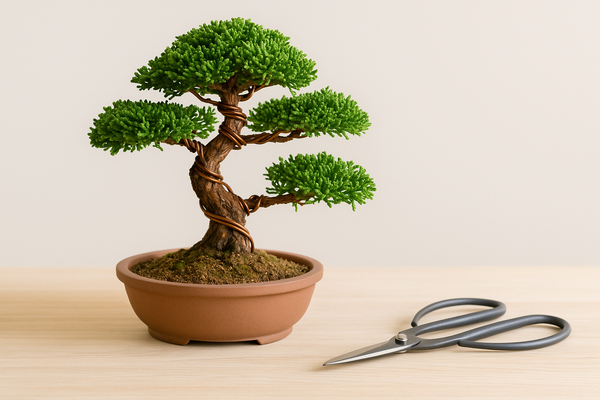
The trees are shaped mainly using wires and scissors, if you already have a clear idea of how the bonsai should look, you can get started. Remove shoots that are too long or excessive and treat the wound with grafting wax.
For shaping, we recommend purchasing wires specifically designed for bonsai, as they are gentle on the bark of the plants and help you achieve the desired shape. You will need wires of various thicknesses for shaping, depending on individual branches, always start from the bottom and from the strongest branches to the weakest. The wire, which must always be anchored on strong branches, is wound onto the branches at an angle of approximately 45°.
Once you have wired the entire tree, start again from the bottom, this time shaping it into the desired appearance. Buds should point outward from the center and branches should not overlap. If you want to bend a branch more, first gently move it in all directions.
🛒 Recommended Products to Buy (suitable for growing as bonsai):
- Lemon Bottlebrush - Callistemon citrinus
- Bael Fruit Tree - Aegle marmelos
- Common Myrtle - Myrtus communis